
How to Be Profitable During One of the Worst Market Crashes in History

Here’s a quick story.
When I was around 15 or 16 years old, I was studying for some Japanese university entrance exams while I was training or competing. The subjects ranged far and wide, with everything from the Japanese language to European history.
And among these subjects was my arch-nemesis: finance.
I couldn’t grasp some of these concepts even if my life depended on it — and not for lack of effort. I truly couldn’t understand the interconnectedness of money.
Naturally, I called up my dad, who literally built his business off of these concepts (which I also never understood).
I explained one particularly tricky portion about stocks and yields and what your money did in the middle.
He paused for a second and told me:
It’s simple. You buy something good. If what you buy stays good, your money turns into more money.
I was dumbfounded. Everything clicked at that moment, and all of the information I had been fed turned into actual useable knowledge because everything suddenly made sense.
MONEY CAN GROW.
This was the moment that I decided investing was pretty cool and worth pursuing.
I told you this story because while that lesson never made me any money directly, it was the realization and studying that impacted how I make money today. This was the ‘aha’ moment that put me on the path to finance… and that’s what you need to find as well.
So, let’s get back to addressing the question of the day.
How can you be profitable through a market crash?
The biggest and most important thing you need to do is to take a step back from the news cycle. Every single day, the headlines are spouting doom and gloom left, right, and center. “Dow Jones down 1000 pts, coronavirus cases top ___ number, White House blah blah.”
Yes, the world kind of sucks at the moment — we get that. However, the key to getting through a downturn like this is not necessarily to focus on the hard numbers.
There is a time and place for that, but what you should instead focus on are the fundamentals and the things that will make you money in the long run.
A quote by one of my mentors embodies this very well.
The stock markets, in particular, are always a forward-looking instrument, so you should be too.
What you should do in a time like this is to focus on the future.
Take the time to do some analysis.
When all is said and done, these markets are going to turn out to be a generational buying opportunity — and what you decide to invest in now can very well make a difference in how much money you have 30–40 years from now.
- Think about what companies you will have wished you bought five years from now.
- Think about what companies have a robust business model and will probably be around a long time from now.
- Most importantly, make sure these companies had strong financials before the crisis.
Now, the one caveat I would add to this is that as I’m writing this, market turmoil is likely far from over. In fact, many of the money managers that I know still have hedges in place to prepare for further volatility. However, we are probably closer to a market bottom than a top, and it could be wise to start nibbling into quality stocks that are “on-sale.”
Learn something new (that’s actually difficult)
No — I’m not talking about cliche stuff like learning Spanish on Duolingo or learning how to knit.
Instead of those skills, take the time to hone your analysis, trading, or investing knowledge in general. Maybe you could learn how options work and how you can use them to scale into stocks efficiently.
Or, perhaps you could read some big books you wouldn’t otherwise think of tackling.
You could even practice day trading using a simulator if you’re interested in that sort of thing. After all, day trading is a practiced skill, and any great day trader will tell you that the time you put in has a very direct connection with the output.
My point is, make sure you learn something that has a clear path to profits in the future.
Finally, become an optimist
It’s pretty common to feel optimistic after being profitable. After all, we all like making money, right?
However, one lesser-known fact is that your optimism can also affect how profitable you are. Studies have proven that positive people outperform their pessimistic counterparts in almost every metric — and that’s something I happen to like.
An easy way to see this concept in the markets is that bears (pessimists) rarely make money while the bulls (optimists) have always had the edge in the long term.
Just take a look at this chart:
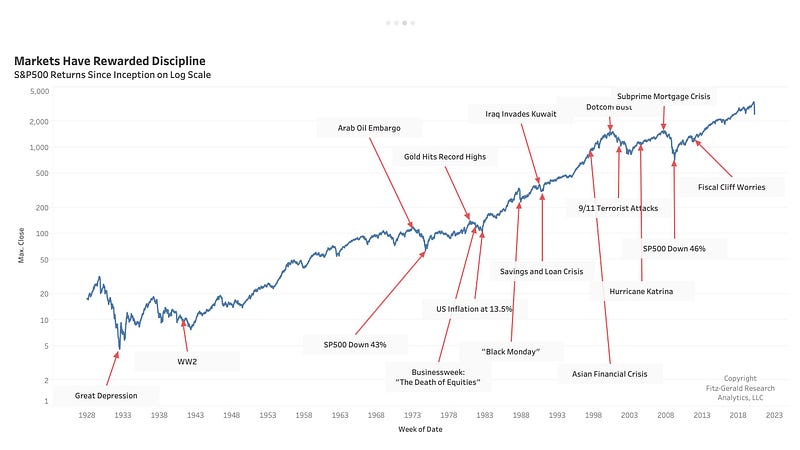
The markets have always favored growth and has been profitable in the long term.
Remember — the markets are a forward-looking instrument, and you should be one too.
This article is for informational purposes only not all information will be accurate. This should not be considered Financial or Legal Advice. Consult a financial professional before making any major financial decisions.