
How to Be in Harmony and Sustain our Interdependency: Lessons from Aikido
“Remember that harmony is inextricably bound up with the conflict from which it sprang.”
Terry Dobson
Morihei Ueshiba’s portrait hangs above the kamiza, a place of honor in the front of our Dojo’s practice area, as it does in all Aikido Dojos internationally. He was born in 1883 and died in 1969. Aikido a martial art based on peace and harmony, with its flowing circular movements, was founded by him after many years of practicing adversarial martial arts. His goal was to create a “path” and way of life to reconcile all conflict. Aikido is now practiced throughout the world and its lessons are applicable to all who seek better relationships. In the opinion of many, he was the greatest martial artist who ever lived. His life was a dedicated journey in matters of spirit. Like so many other mind/body methods, Aikido uses one’s Ki — or universal energy — to blend with others and to mitigate the never-ending injurious interactions in our life.
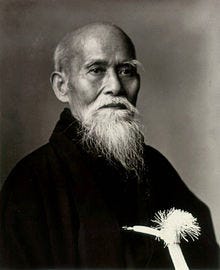
O Sensei or “Great Teacher,” as he was fondly called by his students, was a devotee of Kotodama, which respected the sounds of the universe, Shinto Buddhism with its focus on nature and poetry, and Omoto-Kyo which focused on the spirit of resolving conflict through harmonious blending of the energy of an attack. The belief of Kotodama is that the universe has an enormous dense energetic vibration, called Su. Like the Zero-Point Energy expressed in Quantum Physics, the theory of Su is that untapped energy exists in the vacuum of space and is available to us in the form of Ki or Chi. The vibrations of Kotodama are represented by various sounds that are believed to be the foundations of the universe.
In Aikido there are infinite ways to receive an attack, which necessitates being open to many options when practicing. This leads to what are called “lifetime techniques,” illustrating the many and never-ending learning possibilities that we are offered in life. When confronted by another, be it a physical or verbal attack, one who is trained in Aikido gathers the universal Ki that is accessible to us all and waits in a meditative action state right up to the last instant. It is then that they gracefully step off the line of attack (sensing the perspective of the attacker’s viewpoint to attain a position to protect,) and reconcile or even enlighten the attacker. As Lao-tzu the Chinese poet said, “The way lies in not doing, yet nothing is left undone” (from Tao Te Ching, translated by Ralph Alan Dale, New York: Barnes and Noble, 2002).
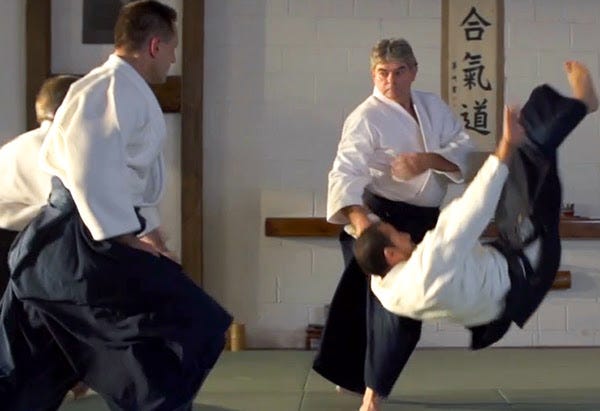
Pushing back when one is pushed is a western cultural habit; however, this stops us from recognizing different means to resolve situations. Harmony can be attained from weathering opposing views. It is an expression of our faith in humanity, to embrace even the most powerful of attacks and find a space to connect with it and produce a unifying result.
Aikido provides many segues to finding one’s “self” and transforming one’s life. Practicing Aikido prepares one to deal with aspects of conflict and communication skills, not only on the mat but in everyday life, as demonstrated by the writings of Terry Dobson, George Leonard, Wendy Palmer, John Stevens, Foster Gamble and my sensei, Greg O’Connor, to mention a few. Being prepared to blend, as George Leonard remarks in his The Way of Aikido (New York: Penguin, 2000), that mutual learning does not mean one has to censor or weaken their true self. He continues by stating “To begin experiencing the self and the universe as one, we must learn to sit, stand, move, speak, feel, think, create, and love as if the impetus for each of these activities arises in our center, a point in the middle of the abdomen an inch or so beneath the navel.” (p.33)
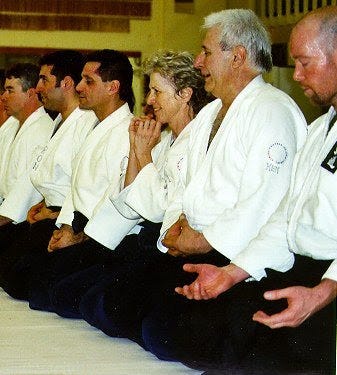
Here is an exercise that I use to demonstrate the power of centering which enables you to withstand moving when being pushed. Try sitting in a chair, hands on your lap with a friend behind you. Now begin practicing standing up from this sitting position without using your hands. Have your friend then put her hand on your shoulders pressing down gently and firmly. Notice how much effort you are expending. Try again, but this time relax your breathing, place your energy an inch below your navel, and with your friend pushing on your shoulders again raise yourself from your center. What difference did you experience? Try moving through your day with an awareness of your breath and having your energy emanate from your center. At the end of the day make a note of any differences you encountered. Being centered is the affirmation of life.
We cannot deny the yin/yang of life with its many ways of saying “no” and “yes,” but we can continue to interact in a calm relaxed way, choosing when to blend by actualizing our Ki, whether it be from Aikido, Yoga, Tai Chi, Qigong, Centering etc. Who can doubt the need today to take care of each other?
In an article “Aikido and Psychotherapy” by Patrick Faggianelli and David Lukoff (The Journal of Transpersonal Psychology, 2007, vol. 38, no. 2), the authors presented their finding that the practice of Aikido can provide a mind/body unification that is healing. They also stated that Aikido’s centering skills produce the same effect as being “present” in therapy. Also, “getting off the line “(blending, and extending one’s energy via Aikido) is applicable to use in Psychotherapy. They believe that Aikido “can be described as moving meditation” because it requires stilling of the mind even as the body is in action. As with meditation, “the practice of Aikido induces a harmony of spirit that can be described as flow, higher state of consciousness, and peak experience.”
Implications of Being in Harmony:
George Leonard, who was a former president of the Association of Humanistic Psychology and an Aikido teacher, recommended a simple process when you are taking a hit in life.
Firstly, he suggested that we experience and acknowledge what it is that we are feeling. Secondly, to ground yourself and breathe deeply as you bring your attention to that place right below your navel. Thirdly, become aware of the additional energy/ Ki that you now have available due to the circumstances of taking a hit. Lastly, think of all your newly assembled energy as part of the universal Ki and how to use it wisely.
There are many options in life to deal with the ongoing opposing forces and energy that come our way. The Buddhist doctrine of “suffering” exemplifies a perspective that the world does not always work the way we would want it to. The ever present need to cope with injurious patterns is a given. If two people are walking toward each other on a narrow sidewalk, one must give way to make room to pass the other. It usually is the least hassle way that prevails. Blending our energies in harmony is, according to Morihei Ueshiba, “a way to reconcile the world.”
In his book Aikido in Everyday Life (Berkeley California: North Atlantic Books, 1993) Terry Dobson, who was one of the first Americans to study in Japan with Morihei Ueshiba, describes different responses to conflict. We can fight back, withdraw, parley, do nothing or use deception. The problem, according to him, is that we must manage our feelings to make a good choice. Here is where widening one’s lens helps us to perceive all elements of the situation. Success “will lie in your ability to find your center and retain it or regain it if it gets lost.” (p.76)
Terry wrote a wonderful essay that was republished in the original Chicken Soup for the Soul (Edited by Jack Canfield and Mark Victor, 1993) where he describes being on a tram in Japan and seeing a man bullying others and throwing kisses at him. His first reaction was to get ready to use his martial art skills to subdue this fellow. However, as he started to approach the agitator, an elderly man sitting in the tram yelled for the bully to come over to him. When the elderly man asks what is bothering him the bully begins to cry, explaining that his wife had just died and he lost his job. Terry leaves the bus seeing the old man hugging and comforting this fellow and begins to contemplate the many options to merge and blend with others.
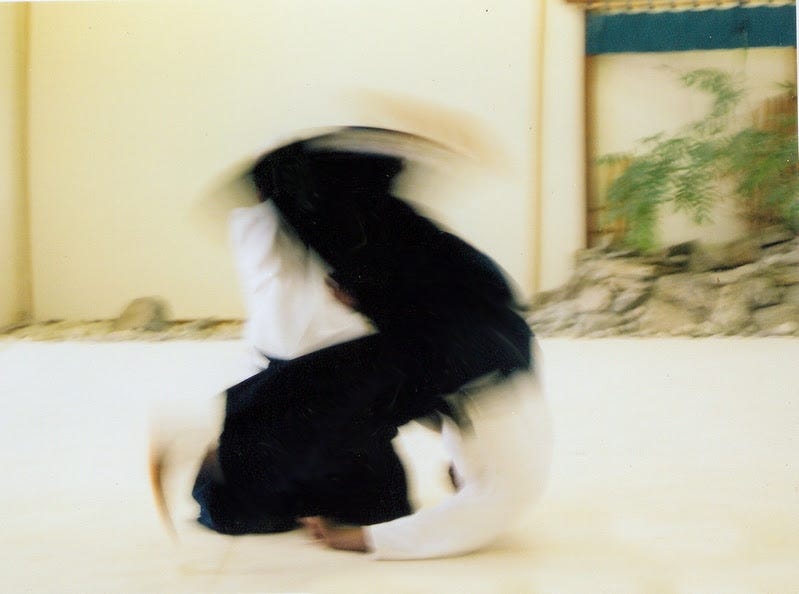
When techniques are taught in Aikido, it takes two or more to resolve a conflict, underscoring what Gregory Bateson pointed out that “it takes two to know one.” Aikido is more than a metaphor for blending and mutually learning. It is not only a way to harmony; it is a means to celebrate our interdependency. The result is the wisdom of understanding that conflict is neither good nor bad, rather it is knowing how we are interconnected through the grist of creativity. I believe this is our aesthetic potential that gets us as close as we can to experiencing nature. In everyday life there is an edge which we seldom utilize, that liminal moment when we can take advantage of the opportunity to improvise and explore infinite possibilities. We can better evolve in our many contexts if we simultaneously feel and see the wider manifestations that await us. There will be inevitable paradoxes and seemingly unresolvable contradictions, however with the peripheral lens of mutuality and harmony, we can avoid stifling double binds and have the chance to enjoy the messy yet amazing patterns of nature where there are no opposites, only a unity.
Here are a few inductions to ponder the above:
Have you ever been in a conflict situation where the outcome could have been less injurious had you considered other options?
What sensations do you exhibit when you are in a conflict situation?
How would creating win-win alternatives influence your day-to-day interactions?
In what ways would viewing conflict as a means to harmony influence your daily life?
How can you transform being victorious from a personal accomplishment to being beneficial for everyone in your life?
What modalities make you feel better or worse in a situation where you are uncomfortable?
*This article was adapted from my book, A Wider Lens: How to See Your Life Differently


