
How to Double Your Productivity
A step-by-step guide I used to improve my productivity by over 250%

There is a big difference between being busy and being productive. It’s pretty easy to spot, but not so easy to implement. Looking in from outside of the day-to-day bustle, we could say:
“Being busy is working on things while being productive is working on the right things.”
But that distinction isn’t so clear in the fog of work.
Even ‘working on the right things’ is unfairly obscure. It so conveniently assumes that we know what the right things are. Because, in fact, the true definition of productivity has nothing to do with what’s being worked on, but what is being produced. So if we were to be ultra-specific then it should be:
“Being busy is working on things and being productive is producing the right things.”
It’s the word ‘right’ that keeps me up at night, though. Surely it is the crux of this puzzle? If we get ‘right’ right, then the only thing standing between us and success is doing it — another challenge altogether. But the issue here is not with defining productivity, or work, or even what’s ‘right’, rather, it’s with defining a goal.
You see, the reason the word ‘right’ is so convoluted is that it doesn’t have a static meaning. Nor does it have a right or a wrong definition. It depends, it’s subjective, it’s relative. But relative to what?
Well, that’s the point really. It’s relative to whatever you want to achieve. And that, my friends, is the variable that gives ‘right’ its meaning.
What you have to do depends on what you want to achieve.
Great. But that’s only the theory bit of this conundrum. In practice, we need to figure out what to do and actually do it. If what’s ‘right’ defines what we should be working on, then ‘focused’ should define how we work.
You could work on the right thing for hours at a time, but if you’re not focused — and I mean truly focused — it’s not going to matter much.
In fact, it’s likely counterproductive.
In a study done at the University of Illinois, researchers showed that taking brief breaks during a task significantly improves focus. And the reason is more obvious than you think.
The brain just starts to ignore constant stimuli. Think about it, when there is a consistent noise in the background, the brain shuts it out. When there is a stationary object in the periphery — like the book sitting on my desk right now — the brain shuts it out. And if you’re sitting for too long on a single task, well, the brain simply shuts it out.
In the same study, researchers showed that the group with brief breaks from a given task, had no significant decline in performance, while the control group — that had no breaks — declined steadily over time.
But these brief breaks need to be exactly that. Brief, and breaks. Working on another task leads to a different enemy of productivity: context switching.
When you decide to work on a task, the brain sets up rules — an environment — with which to deal with it. But, when you switch tasks, that environment needs to change to accommodate the new task. This switching can cost you up to 40% of your productive time.
So I identified four elements of productivity:
- Objectives — what we want to achieve;
- The right work — what we need to work on in order to achieve it;
- Focus — how we work on the right work; and
- Schedule — how long we work on the right work.
Over the last while, I’ve collected hacks to deal with each of these elements. Even though I’ve known them for a while, over the last week, I decided to implement them all and see how it impacted my productivity.
Short answer: they work.
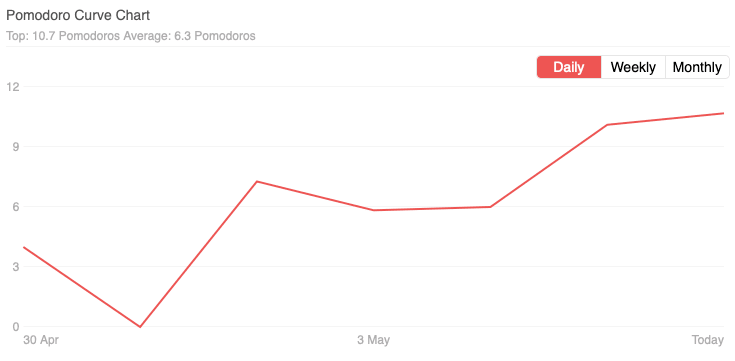
This graph shows the number of 25-minute focus periods (or Pomodoros, I’ll explain later) per day over the last week. Over a 250% improvement. While the starting base is low, it’s not an uncommonly low. Remember, this is 25-minutes of uninterrupted focused time. That means actual productive work, not busy work. It turns out I did a lot of the former and not enough of the latter.
Also, the true impact — due to gains in less measurable attributes, like the quality of work — is likely orders of magnitude more, but harder to quantify.
This is what you can do to get similar results.
Objectives
Define what it is you’re trying to achieve. But actually define it. Write it down so that it’s clear to you, and then rewrite it so that it is clear for anyone that doesn’t have context. Doing this eliminates the little shortcuts our brains use when we think we have a complete picture but don’t.
Ever found a typo in an email even though you proof-read it three times? Yeah, me too. That’s because your brain knows what you want to say and checks that, rather than what you actually say. Writing it down forces you to close those gaps and be specific.
It also helps to understand why you want to achieve something. Not just because it makes your drivers visceral, but because there is sometimes an overarching goal hidden within. Sometimes, discovering that gem can shed light on a better — or quicker — route to your destination.
I’ll give you an example.
A while back I set the goal of writing every day. But after asking why, I found that I wanted to improve my writing — go figure. What’s important, though, is that I thought about it a little more and realised that, even though writing every day is a great path to becoming a better writer, spending some time learning how to be a better writer was also critical. So I adjusted my schedule to write or read (or both) every day.
The right work
Once you have your objectives, breaking them down into tasks is a whole lot easier. Rather than taking a bottom-up approach — building tasks up to your goal based on what you can do now — take a top-down approach — breaking the objective down into sub-objectives until you get to a list of tasks you can do now.
The difference is in the concentration of a task. If you take the bottom-up approach, you run the risk of listing something that seems like it will get you to your goal, but may not. Going back to my example, if I had stuck to just writing every day, I might have gotten marginally better, but there would have been no outside stimuli to improve it. I would be stuck in a silo of my own bad habits and style. Instead, I realised that my goal was being a better writer, and that involved learning as well as practice.
If your goal is anything remarkable, it’s likely not something you’re going to achieve in days or weeks. This means you have another enemy: entropy.
Over time, things change, environments change, and you will change. It’s easy to get lost in those smaller tasks even if you used the top-down approach. Maybe you struggle to complete a task in a specific way and adjust it slightly? These small adjustments, which are completely necessary by the way, compound which can result in you moving away from your objective. I call this ‘tangential entropy’.
And if you have other obligations, you are likely to get incoming requests on a daily basis which eat up your time and focus. I call this ‘parallel entropy’.
There are two tools to handle this. First, for tangential entropy, a simple hack.
List ten things you spend the most time doing, circle the two that move you closer to your objective and do more of them. Delegate, outsource or eliminate everything else.
For parallel entropy, there is Stephen Convey’s Time Management Matrix.
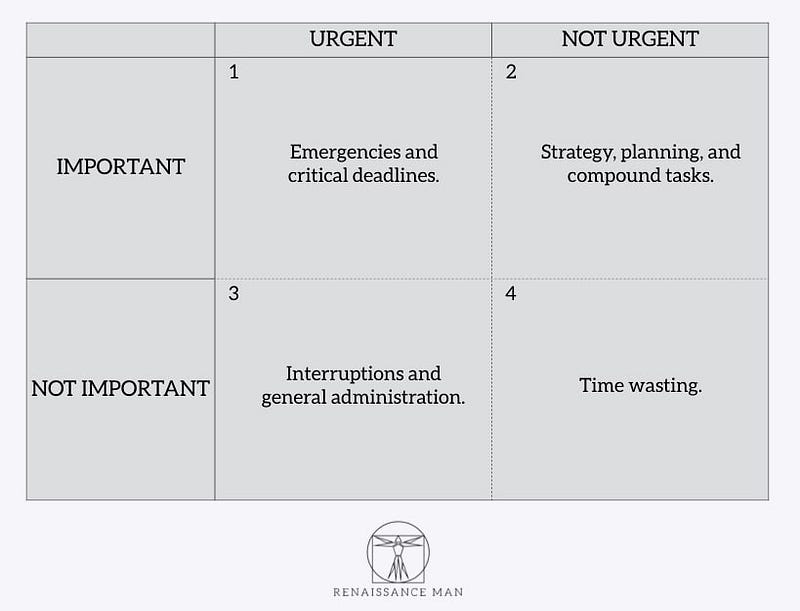
I use it as follows:
Quadrant one is for everything I can’t put off that is critical to what I’m trying to achieve. Projects with critical deadlines, crises, urgent problems.
The action: do these things now. The test: if I don’t do this now, how bad is the likely outcome from 1 to 10? Anything above 8 goes here.
Quadrant two is for important activities that aren’t time-critical. Strategy, planning, learning, and things that will get me to where I want to go.
The action: do these things as soon as possible. The test: if I do this constantly, how good is the likely outcome from 1 to 10? Anything above 8 goes here.
Quadrant three if for unimportant things that are time-sensitive. Meetings (the kind that most people have), phone calls, email, interruptions, etc.
The action: avoid or delegate. The test: if I don’t do this now, how bad is the outcome from 1 to 10? Anything below 5 goes here.
Quadrant four is for unimportant things that are not time-sensitive. Pretty much anything else.
The action: eliminate mercilessly. The test: if I do this now, how good is the outcome from 1 to 10? Anything below 5 goes here.
Focus
I use the Pomodoro technique. It’s based on the research on the focus that I mentioned earlier. Basically, I work in 25-minute blocks, with 5 minutes break in between. Every fourth block, every 2 hours or so, I take a longer, 15-minute break. There are many great applications for this, but the one I like the best is aptly called Focus To-Do. It combines a task list, projects, and the Pomodoro technique in one.
The results are remarkable. The first remarkable point was seeing how little of my day I was actually focused. The second remarkable point was how it literally improved by over 250% in a week. That’s another reason I like Focus To-Do: it gives me reports to show me where my time is going, and how it improves over time.
I am hard on myself and log everything, even social media time. This way I’ll get a little ping after 25 minutes of Twitter and potentially avoid the infamous rabbit hole. It also gives me a clear indication of what I’m spending my time on so I improve.
One tip: make sure the 5-minute breaks are actually breaks. Sit and try not to think about anything. And don’t start doing something unrelated if it’s work or it will take longer than 5 minutes to get back into what you’re meant to be doing.
Schedule
Plan your time.
Obviously there will be things that sit outside of your control but, generally, the majority of interruptions are self-inflicted or, at the very least, could be avoided. Block out time to complete a task and try to keep it to that task alone. Turn your phone to ‘do not disturb’, close those thirteen stubborn tabs, and get after it. You would be surprised how much more you get done. Honestly.
A trick that I found helped minimise the impact of unavoidable context switching was creating themes for my days. I try to group similar tasks by the type of work it is and schedule them on the same day.
While we’re on planning. One of the best tips I can give is to plan at the end of the day or week. I found, for whatever reason, the end of the day my mind hums with ideas of things that I could do, while in the morning, it’s a constant struggle to figure out the best use of my time.
Part of me thinks this has to do with what I feel like doing. Because I don’t have any more time in the day, I can focus — guilt-free — on what I should do not what I feel like doing. So I’ve confiscated my morning me’s ability to make that choice.
At the end of the day, I make a list of tasks to do in the morning and then do those first thing. I don’t even allow myself the space to interrogate them in the morning — I always lose if I do — so I just do them and think about it later.
These are tools and frameworks that I have used to improve my productivity by orders of magnitude. I know, first hand, that they work. The last thing left is using them. That requires discipline.
And if you want something badly enough, it won’t be that hard to find.
A quick favour before you leave.
I’ve set a goal of growing my newsletter subscriber base to 1,000 subscribers by the end of August. If you like this article, please consider assisting. You can subscribe here or share this article. Or both. You’re the best.