
How to Be as Happy as the Happiest People in the World
The 2022 World Happiness Report is out, and one country tops the list for the fifth time in a row. Which is it, and what are its secrets?

Henri and Tarja Jansson woke up in the inky darkness to a pair of screeching alarm clocks. It was 6:30 am, but they didn’t expect the sunrise for four more hours. Winters are harsh and dark at the edge of the Arctic Circle.
Henri is a university professor, and his wife Tarja is an architect. They live a comfortable life in a modest home in Oulu, a popular resort city in Northern Finland.
They and their two children are among the 5.5 million other citizens of Finland who work hard all year long and enjoy five weeks of paid vacation whenever they please. They don’t worry about money because jobs are stable, and a strong safety network is available if needed.
Their cities are clean, modern, safe, and technologically advanced. Restaurants, bars, and cultural events are plentiful and popular even in the deepest darkest months of the winter. Unlike their neighbors in Russia, Finns are welcome to travel whenever and wherever they like and pursue education, careers, and interests that strike their fancy.
Henri and Tarja are happy, among the happiest in the world.
World Happiness Report
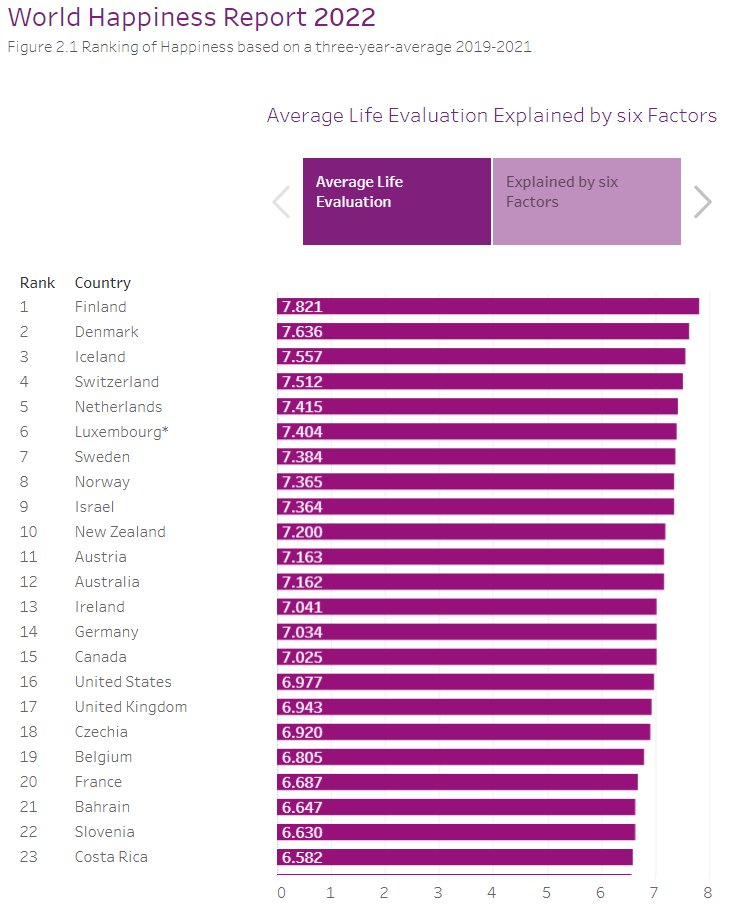
Finland has stood atop the World Happiness Report for five years in a row, with this year’s score of 7.821 (out of a possible 10). Their Nordic neighbors Denmark, Iceland, Sweden, and Norway also appear in the top-10 consistently.
Canada and the United States rank 15th and 16th respectively.
All of the top-20 countries are free, stable, democratic, and comparatively rich, freeing citizens to pursue more rewarding endeavors that lead to personal happiness and satisfaction.
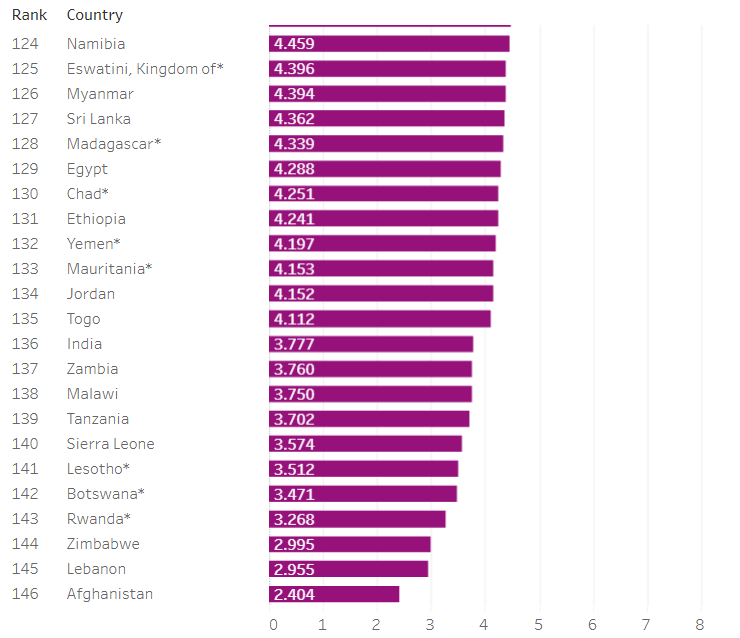
In contrast, at the bottom of the list, we find countries that are grappling with wars, corruption, and chronic poverty, illustrating the dire effects of conflict and struggle on people’s wellbeing.
How do we measure our happiness?
Happiness is an abstract concept, highly personal to each individual. We can, however, statistically show that certain factors explain differences in happiness between individuals.
Researchers have identified six key variables that predict happiness, and these are used by the Sustainable Development Solutions Network, the organization that prepares this annual report. They work with the Gallup organization to poll residents of countries on these life assessment variables.
- Social support: “If you were in trouble, do you have relatives or friends you can count on to help you whenever you need them, or not?”
- Freedom: “Are you satisfied or dissatisfied with your freedom to choose what you do with your life?”
- Generosity: “Have you donated money to a charity in the past month?”
- Corruption: “Is corruption widespread throughout the government or business?”
They also use Economic and demographic variables such as:
- GDP per capita: Gross Domestic Product is a measure of a country’s purchasing power and wealth, and this economic data correlates to personal financial security.
- Healthy life expectancy: The expected lifespan for healthy babies is a strong indicator of healthy behaviors and the availability of quality medical care.
These six factors explain 60–70% of the happiness equation, while the balance is explained by genetics.
Lessons from Finland and the World Happiness Report
One way to improve your happiness might be to head over to Finland and move in next door to Henri and Tarja.
But if living in a Nordic country isn’t your cup of iced tea, you can still incorporate the factors of happiness into your own life, wherever you are.
- Build a strong social network. When you have friends, family, and government resources to fall back on in times of trouble, you worry less about basic needs like housing and income.
- Help others. One of the strongest happiness factors identified is generosity — donating, volunteering, or just helping someone in need to stand up on their own. Compassion is a powerful tool for helping others and that directly contributes to one’s own happiness.
- Save your money. Modest lifestyles are the norm in most of the happiest countries. They’ve found that happiness doesn’t come from owning extravagant ‘things,’ it comes from friendship and community.
- Lobby for universal healthcare. The USA is the ONLY country in the top-20 that doesn’t offer its citizens some type of affordable universal healthcare. If you’re a resident of the United State, you should stand up and lobby your government leaders to provide it. Affordable healthcare is considered a fundamental human right in most developed countries, and the lack of it creates anxiety and financial hardships that can lead to depression and financial ruin.
- Vote. If you live in a democratic country you’re fortunate to have a voice in how your government is run. And because of that, you’re likely to be far happier than those living under the rule of autocrats and dictators. Vote whenever you can, it’s your duty as a citizen.
- Exercise your personal freedoms. Enjoy your life, your community, and your friends. Make time for yourself. Educate, travel, and explore new ideas and places. The more open you are to experience and diversity, the richer your life will be.
- Be a responsible citizen. Without vigilance, corruption seeps into every nook and cranny it can. Trust in one’s government and local businesses is a contributing factor to your happiness, so speak up and speak out when something isn’t right.
Making happiness a fundamental human right
A former prime minister of Bhutan, Jigmi Thinley, is a visionary genius. Under his leadership, his nation adopted “Gross National Happiness” as its primary development indicator. They emphasize physical and psychological well-being, diversity, ecology, education, and living standards above economic measures like GDP.
In 2011, the UN General Assembly passed a resolution urging members to follow Bhutan’s lead and give equal importance to non-economic aspects of well-being — and make it a “fundamental human goal.”
In support of the idea — hundreds of cities, governments, and communities around the world have adopted some version of a happiness index — inspired by the Kingdom of Bhutan.
Finland and many other leading countries are on the path of ensuring that happiness is a fundamental right, more important than economic growth.
When all countries embrace happiness as policy, the world will be a better place.
And a lot happier too!
Care to join me?
If you’re considering joining Medium you can sign up here (https://brianfeutz.medium.com/membership) and I’ll get a slice of your pie. No additional cost to you and it’s a great way to support independent writers. Thank you!
Oh, and thanks for reading!
Connect with me here on Medium and in my blog: the Life After Work Zone. You’ll find articles, stories, and poems about finance, life, travel, and retirement. Don’t miss a word. Stay in touch by subscribing to his newsletter or emailing directly to [email protected].
If you liked this article, here’s another that you’ll love:


