
How To Be An Arab
An insight into the Western gaze of the Arab world
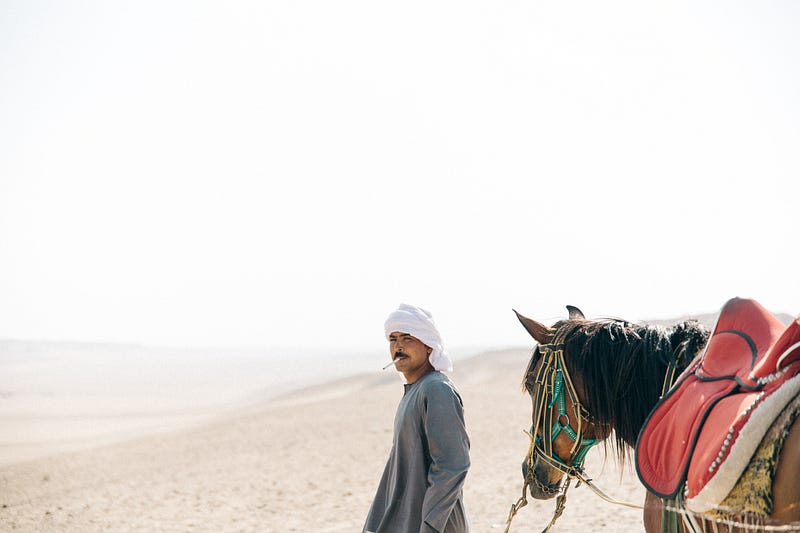
“The Arabs were barbaric hordes who ate little but camel dung.” — Winston Churchill, 1930s
I’m an Arab. I bet you figured that much, right?
My profile picture with my desert-brown skin and hijab-clad mug may have confirmed your suspicions when you clicked on this essay.
I mean, it would be weird if you tried to understand what it means to be an Arab from a non-Arab, right?
Funny.
My dear reader, you possess a particular image of what an Arab looks, behaves and thinks like. You have an image of what an Arab is.
Don’t believe me? Let’s do a brief experiment and see how we paint the Arab.
I want you to pause and close your eyes and say out loud what you imagine when you think of an Arab. Now.
What did you see?

- A white-clad Middle Eastern man with infinite money and mansions? Lions and tigers as pets? Dubai, penthouses, Rolexes and endless beaches?
- Extravagant music videos? Botox-filled singers like Nancy Ajram and close-ups of Amr Diab’s chiselled jaws?
- Exotic and vibrant colours straight out of Disney? Majestic mountains of gold? Belly-dancers, cabarets and hookah lounges? 1001 Arabian Nights?
- An abyss of black-veiled women? A woman not allowed to drive?
- Honour killings and a deep hatred for women? ISIS, underage-brides and sex-slaves? Terrorism?
- A corrupt government? Poor civilians and hungry people? Nations teeming with injustices?
- A bedouin with camels and goats? The pyramids? A vast and desolate desert?
- A world where Pan-Arabism is desired by any means possible? Rebels and the Arab Spring? An abysmal lack of hope?
My dear reader, don’t feel guilty for your perceptions.
Even I can’t get my head around the different ways we see an Arab. And I’m an Arab.
What does it mean to be an Arab?
Note: Not all Arabs are Muslim. There are Christian Arabs, Jewish Arabs, Polytheistic Arabs and Agnostic and Atheist groups.
The origins of the noun Arab are perhaps interesting in mapping perceptions.
Scripture:
Scripture offers us a testament (pun intended) of what an Arab meant.
The Old Testament defines Arabs with the nomadic lifestyle in the deserts and harsh climates. In the Book of Isaiah 21:13, it states: “The burden upon Arabia. In the forest in Arabia shall ye lodge, O ye travelling companies of Dedanim.”
This is the prophecy against Arabia. The Arabs are historically nomadic, so living in tents and keeping cattle makes them easy prey for a target. They will face great destruction.
In the Book of Jeremiah 25:24, appears the line: “all the kings of Arabia, and all the kings of the mixed tribes who dwell in the desert”.
Here, Arabia means desert. The ‘mixed tribes’ refer to nomads (read: Arabs).
If we look towards the Quran, we see a similar definition. Arabia refers to the vast and desolate desert whilst the noun ‘Arabs’ refers to the nomadic tribes.
Pre-Islamic Arabs:
The first mention of an ‘Arab’ derives from records of the Neo-Assyrian Empire (911–612 BC).
As the Assyrians moved southward in the desert, they encountered ‘nomadic camel-herding peoples’. They called them ‘Aribi’.
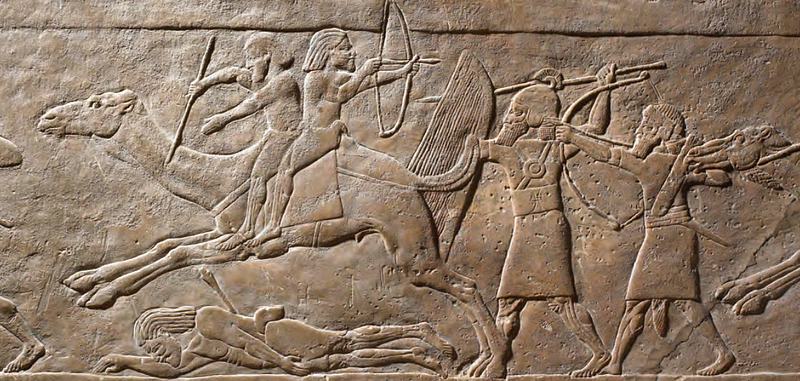
Today, Arabs translate ‘bedouin’ or ‘nomad’ to ‘Aribi’ (اعرابي). This sounds like ‘Arab’ so we can deduce that these were the earliest generation of ‘Arabs’.
However, the connotations are far from a self-label by Arabs. It connoted ‘desert steppe’, ‘outsider’, ‘westerners’ and ‘locusts’.
Thus, the term ‘Aribi’ highlights what the Assyrians thought of the nomadic and distant groups along their borders. It does not show how these groups organised themselves.
After the fall of the Assyrians, the Babylonian and then the Achaemenid Persian empires inherited the name and label imposed on the nomad Arabs.
Greek civilisation:
Much like the Assyrians, the Greeks had little interaction with Arabia beyond their borders.
A homogenous group of ‘Arabs’ generalised anyone living in the harsh deserts. It was a means to label the ‘barbarians’ of the south.
However, we know what the Greeks thought of the Himyarites.
The Himyarite Kingdom was an Arab polity in the south of Yemen, existing from 110 BC — 520s AD.
The Greeks and Romans in later years referred to them as Homerites.
In one text, the Periplus of the Erythraean Sea noted the trading empire of Himyar and its ruler — Charibael.
“23. And after nine days more there is Saphar, the metropolis, in which lives Charibael, lawful king of two tribes, the Homerites and those living next to them, called the Sabaites; through continual embassies and gifts, he is a friend of the Emperors.”— Periplus of the Erythraean Sea, Paragraph 23.
Perhaps it is interesting that the term Arabs remained within its definition as nomads and desert peoples.
Yet, the Greeks recorded specific kingdoms and peoples and they formed bonds.
Again, the Arabs themselves did not self-label themselves as ‘Arabs’. In fact, there is no ancient ‘Arab’ self-labelled community.
Archaeologists have unearthed thousands of pre-Islamic inscriptions from Yemen to Jordan, and reference to ‘Arab’ as a label for oneself or one’s own community is absent within this corpus. — Peter Webb
So when did Arabs label themselves as Arabs?
The first people who called themselves Arabs were the elite of the early Caliphate.
This came with the birth and rise of Islam.
These Arabs inhabited new towns created by Muslims across the Middle East (the modern Basra, Baghdad and Cairo). They adamantly distinguished themselves from the nomad bedouins.
Thus, being Arab was the novel label to place oneself akin to the early Muslims and elite leaders.
It was a label to establish themselves with the new urban empire.
It’s also interesting that the noun Arab comes from I’rab (اعراب) meaning parsing.
Some believe that the first Arabs got their name because they were eloquent in their tongue.
Often when one goes to study a language, they go to modern universities. But with Arabic, the best speakers are the still existing nomads.
They preserved their tongue, and their Arabic is the most authentic.
The birth of the Western gaze
Western academia aligns Western civilisation with Greek civilisation.
Yet, it is perhaps more appropriate to view Ancient Greek culture as a hybrid with Eastern cultures.
Tim Whitmarsh, professor of ancient literature at the University of Oxford, raises interesting questions.
He asks: “What if what we think of as the classical world has been falsely invented as European, for reasons serving the cause of 19th-century imperialism? Should the Greek and Roman worlds, albeit in different ways, be seen rather as part of the Iraqi-Syrian-Palestinian-Egyptian complex? If so, what would that mean for ideas about European identity today?”.
Such questions map a different course of history.
Because it is by aligning the classical world with Europe, the Western gaze is born.
Imperialism and Colonialism
French powers colonised Algeria in 1830. The Gulf states were in British ‘protection’ in the 1830s.
European colonisation of the Arab world lasted until 1967 with the British leaving Aden and became independent as South Yemen.
With over 100 years in a vast region, no doubt the Europeans formed opinions and stereotypes of their subjects.
We record some in artwork and history books, others pass down as bigotry and racism.
If we look only towards Jean-Léon Gérôme’s artwork, we would not need to look further.
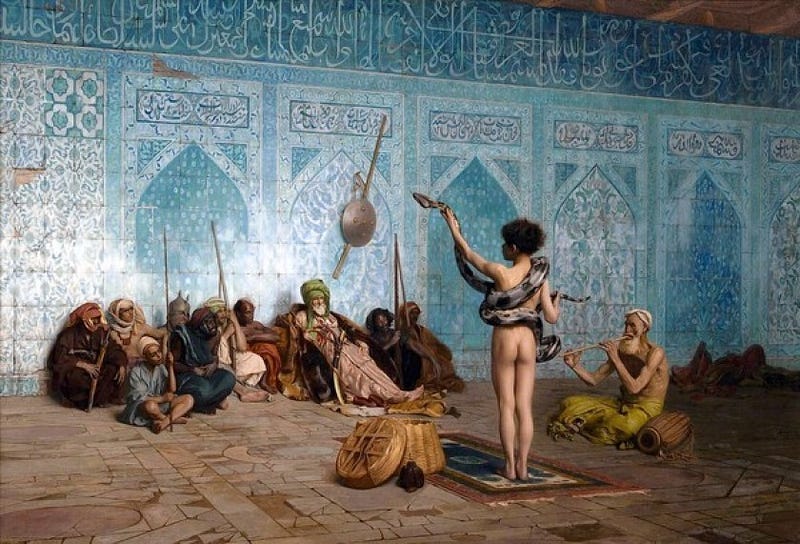
As you can see above, the West desired the orientalist fantasy of an exotic land. It’s desired because it is a tempting fantasy.
But it is not the ideal.
Orientalism feeds on a phallic and sexually savage east. The nude boy in front of a group of older men is predatory at best, and barbaric at worst.
The boy is standing on a prayer mat. There is disrespect for religion.
The Islamic tiles paint this image in an Arab city, most likely in a mosque.
This, for many modern viewers, seems like a crude image straight out of 1001 Arabian Nights. In a world akin to Sinbad and Aladdin.
These characters were fictional. These images did not even appear in the tales of Sheherazade.
Contrary to the movement, Gérôme’s orientalist fantasies are far from Impressionist. They expose a Western fragility of Eastern and Arab cultures.
Later in 1978, Edward Said reflects on such East vs West dichotomies in his seminal text: Orientalism.
I will not delve deep into his inspired writings, but I urge you to read it.
Here are 3 quotes from the introduction that may lure and tempt you to read Said’s text.
- “The Orient was almost a European invention, and had been since antiquity a place of romance, exotic beings, haunting memories and landscapes, remarkable experiences.” (1)
- “the Orient has helped to define Europe (or the West) as its contrasting image, idea, personality, experience.” (1–2)
- “Orientalism as a Western-style for dominating, restructuring, and having authority over the Orient.” (3)
The end of the Ottoman Empire
1919 saw a new world. It was the end of the Ottoman empire.
Whilst it was founded in 1299, it was only active for about 90 years in the 1500s. Between the 1600s and 1922, the decline of the empire was painful and tormenting.
One quote that comes to mind about the end of the Ottoman empire is Winston Churchill’s words in the 1930s.
“The Arabs were barbaric hordes who ate little but camel dung.” — Winston Churchill, 1930s
In one slip of the tongue, he said more about his opinion of Arabs than all his work.
The Western gaze of the British and French consuls in Arabia by the end of WW1 is telling.
It is perhaps noteworthy that with the end of the Ottoman Empire, Arabia was to have new borders, new leaders and new politics.
The British were to rule the Arabs, and Kurds, Assyrians, Chaldeans, Amazighs, and others.
The making of new borders and the modern Arab world
Perhaps this section warrants a bitesize history lesson.
Once upon a time, in the not so long ago year of 1919, stood a group of foreign consuls.
Their pale and sweaty faces clashed with the bleak Arabian desert. They looked around and huffed.
They had just finished dismantling the once-powerful Ottoman empire. Now they had finished off “the sick man of Europe”.
One Sir Percy Cox furrowed his brows as he thought of what to do with the deserts of Mesopotamia.
He looked to his right at Gertrude Bell. Yes, she would be an excellent Oriental Secretary.
Perhaps we owe credit to Bell for having the fantastic idea that Mesopotamia should rule itself without British interference.
But then again, she also thought, “Mesopotamia is not a civilised state”.
Anyway, legend has it that sitting in her tent, Bell held a ruler and pen over transparent paper placed on a map of Mesopotamia.
She was creating Iraq out of pen and paper.
As she drew the straight borders around the vast region, she turned to talk to someone. In doing so, the paper moved and so did her ruler. Her pen moved along.
And that, ladies and gentlefolks, was the story of how Jordan got more land.
European imperial powers created the modern borders of parts of Arabia. The Gulf states formed agreements among themselves on their borders.
By the 1930s, the Arab world with its brand-new borders was ready to take on the world.
On the 22nd of March 1945, six nations signed the Pact of the League of Arab States in Cairo, Egypt. Today, there are 22 members.
- Algeria, Bahrain, Comoros, Djibouti, Egypt, Iraq, Jordan, Kuwait, Lebanon, Libya, Mauritania, Morocco, Oman, Palestine, Qatar, Saudi Arabia, Somalia, Sudan, Syria (suspended), Tunisia, United Arab Emirates, and Yemen.
It was European consuls that determined Arabian borders. But it was Arab nations and peoples that took matters in their own hands to create a league.
A league ‘to draw closer the relations between member States and co-ordinate their political activities with the aim of realizing a close collaboration between them, to safeguard their independence and sovereignty, and to consider in a general way the affairs and interests of the Arab countries’. — Pact of the League of Arab States.
Arab-Israeli conflict
In 1948, the Arab-Israeli conflict sparked a fire. With both sides not willing to back down, the conflict still lives today.
The British let down the Palestinian people with the Balfour Declaration of 1917.
This was a statement of British support for “the establishment in Palestine of a national home for the Jewish people.”
To this day, many Arabs believe that the British had no right to hand over an Arab state.
The Arab-Israeli conflict is bitter.
Whilst the Western world sees anti-Semitism, the Arab world sees an injustice.
It is perhaps noteworthy to remind readers that the Arab-Israeli conflict is not an anti-Semitic one.
Arabs believe that Jews are our Abrahamic cousins. We love and respect Jews. But we do not stand for Zionist-Israeli occupation.
We once lived in harmony with Jews, and we still do in certain parts of the world. But the occupation is not the answer to coexistence.
The rise of Arab nationalism
The 50s to the 70s saw a rise in Arab nationalism aided by the Muslim Brotherhood. Religion became politicised in the Arab world.
PSA: The Muslim Brotherhood are a legalistic terrorist organisation that spread hate against the West in the name of Islam. They politicise Islam.
It is also important to note that they are systematically non-violent in the West. But their ideologies provide a fertile environment for other terror groups to radicalise.
The organisation is highly complex and nuanced because they operate largely within the law.
The West looked on as the Arab world began to self-destruct.
They saw the Arab world synonymous with the growing terror groups politicising Islam.
Muslims as a whole and Arabs became one.
This meant that the West had little sympathy for the Arab world. And the Muslim Brotherhood took advantage of this.
Interestingly, though, the West saw the Muslim Brotherhood as ‘a reactionary group which was destined to disappear’.
But they were wrong, Even after the decline of Arab Nationalism, the Muslim Brotherhood continued to thrive in a desperate Arab world.
The West today views the Brotherhood still as a threat to society because they stand in the way of integration.
The 9/11 terror attack
With a thriving terrorist environment, the Arab world gave birth to more terrorists. This time, they attacked the West.
No one can justify the 9/11 terror attack. As a Muslim and an Arab, I feel compelled to say this.
I guess this is proof of how the West sees the Arab world.
Suddenly, every Arab was a terrorist. Every Muslim was a terrorist.
The word ‘terrorist’ became synonymous with my people.
The West began calling a War on Terror. They sent military forces to Iraq, in the name of protecting their state.
The West also mass-produced films and TV series that centred around the 9/11 terror attack.
To this day, this one attack remains fresh in the cultural memory of the West.
The West blacklisted the Arab world.
Arab Spring
The Arab world self-destructed.
8 member states out of the 22 of the Arab League saw protests, civilian deaths, and some saw an end to the tyranny of their dictators.
The Arab Spring became a monumental change in world politics.
It validated the British and French consuls’ opinion that the Arab world could not self-rule.
It showed how little the Arab world knew of politics and how blinkered they were in their own histories.
Some people see the Arab Spring as an outcry from the Middle East that could never decolonise.
A politicised land because of the oil reserves and one that still has Western Imperial interference.
Globalisation
With more globalisation, the world shrank. This meant that at any one time, the Arab world could ‘strike back’.
But unlike the West, the Arab world rarely holds vendettas.
Globalisation meant Arab peoples fled their war-torn countries and sought refuge in the West.
The Arab diaspora increased exponentially.
Growing up during this period meant I also saw people looking like me on TV. And for the first time, not on the News channel.
The Arab diaspora entered the Western media. Films and TV shows had Arab actors.
Sometimes, they didn’t play the terrorist.
The birth of knowledge economies
Of all the Arab nations, one state stands out. The United Arab Emirates.
In recent years, it has shown itself as a nation intent on building a knowledge-based economy.
In 2015, the UAE government injected AED300 billion to foster a knowledge economy, driven by innovation to prepare the UAE for a world after oil.
They realise that for the nation to continue to be relevant and resourceful globally, they must produce knowledge.
The Arab world is consumer-based. It is very rare for the Arab world to be producers.
The Arab world is agricultural and pastoral. The literacy rate is abysmal.
To invest in “innovation, scientific research and a knowledge economy,” is inspiring.
In 2020, the UAE joined the USA, USSR/Russia, ESA, and India in their launch of a Mars mission.
The first Arab interplanetary mission. Something to be proud of. Something to celebrate.
And the Mars mission is not a copy-cat mission.
The Emirates Mars Mission “Hope Probe” will be the first probe to provide a complete picture of the Martian atmosphere and its layers when it reaches the red planet’s orbit in 2021. It will help answer key questions about the global Martian atmosphere and the loss of hydrogen and oxygen gases into space over the span of one Martian year. — UAE Space Agency.
Besides this, the UAE was granted nuclear power to meet the demand for energy. They projected escalating electricity demand from 15.5 GWe in 2008 to over 40 GWe in 2020.
The UAE is proposing a ‘new dawn’ for the Arab world. A world where the Arab world is not disposable.
One that is part of a larger global force for science and innovation.
How to be an Arab
At the start of this essay, I asked of you to project your image of what an Arab looks like.
There are many stereotypes and caricatures of Arabs. But throughout history, Arabs proved they are resilient in changing their image.
I hope this essay has explored the different ways we see Arabs through the Western gaze.
The Western gaze will not disappear overnight. But the Arab world is adamant in changing its image. It aims for a new image. One that is resourceful and relevant.
That’s the Arab I aspire to be. That’s the Arab I am.
Fatima Sultan is a writer, tutor and self-proclaimed nerd. She writes about life and its many excitements and disappointments. She also apparently likes referring to herself in the third person. You can read more of her writing by subscribing to her free newsletter.