
How to Be a Happier Runner
Eight happiness driving behaviors applied to running
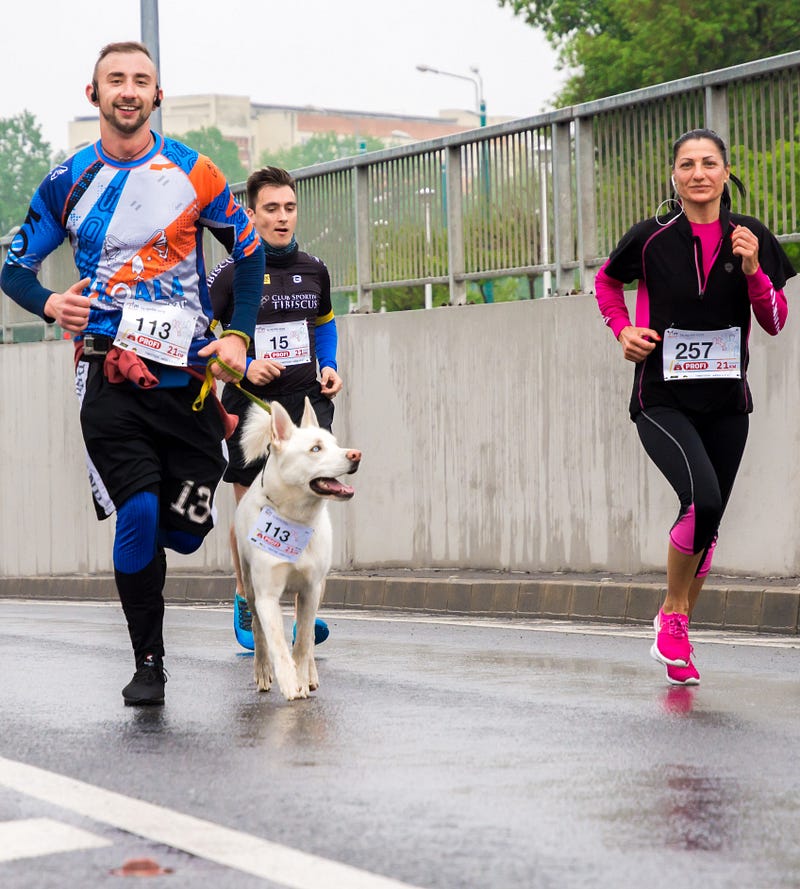
One of my happiest runs was with my best friend Julian; we’ve known each other since college when running was our go-to for stress relief before finals.
It was a slow (and long) run, more about catching up than performance. With time on our hands, we started playing a silly game with simple rules:
- To score one point, runners had to respond to you “hey” or “hello.”
- To score two points, walkers had to answer.
While runners are relatively easy to engage with, walkers are harder targets. First, there’s little time given the speed difference. Second, they aren’t part of the running community. They can even be slightly afraid of other people arriving so fast, a sort of atavistic reflex, maybe.
The trick is to make eye contact and smile before saying hello. Most people won’t dare leave your salutation unanswered, and most of them will smile in return. Most of them will even look genuinely happy about it.
Why was this a happy run? It’s not only because I was smiling all the time, but it’s also because it ticked several of the ‘happiness’ boxes. At least the ones according to this article from the Harvard Business Review.
Disclaimer: all these pieces of advice apply to real life as well. As if real life was anything but running!
Here are the eight boxes to tick for a happy running life.
Start with frequency and then bring in intensity (and duration).
Concerning happiness, the argument goes that it’s better to have a good day, every day than to have an amazing one every month.
When it comes to running, whether you’re training for a specific event or not, “regularity maketh the runner.” At least, at the beginning. Once the frequency is in place, short bursts of intensity can be very beneficial.
Run with your network and other social connections.
We can easily practice running on our own, and my guess is that’s why some of us like it so much. I enjoy solo runs, but sharing the running experience with other people from time to time does bring another dimension to it.
According to the HBR article, our happiness levels are correlated with the strength of our social networks. And to mix running and networking, I recommend running with work colleagues.
It’s a great and healthier way to compete with the informal network of smokers! By that, I mean people sharing rumors and information while on a cigarette break.
So, start a running group in the office and network across silos in your organization!
Take running challenges, distance, speed, streaks; anything is up for grab!
Following the HBR article, taking part in achievable challenges makes us happier.
Most of the running apps include this feature in one way or another, but they’re usually about competing with others more than challenging ourselves.
As motivating as it sounds, setting a new personal best can be a hazardous challenge. There’s no guarantee you’ll succeed. Instead, I use challenges linked to methodology or training plans. These challenges need the same kind of focus and are comparably motivating, but their success is more probable.
And, there’s even a good chance they’ll result in a new record.
Meditate during your runs.
You could argue that running is already pretty close to a meditative exercise. The difference I would make, however, relates to how conscious the exercise is.
More often than not, I find myself mindlessly running; this is very good to get relaxed. But I’m not fully aware of what’s happening; I’m not mindful.
To introduce meditations in my runs, I use two classical meditation practices.
The first one is to focus on my breath. Be careful! The following doesn’t work during interval training! During slow runs, however, it’s possible to use the method. For example, I breathe in for five steps and breathe out for the next five.
The second is a body scan during which I pay special attention to how my feet are touching the ground. I try to break down the movement as much as possible; for example, heel, sole, toes. An extended version would be to also pay attention to how your legs are moving, what your arms are doing, how straight your back is, etc.
The first exercise gives me a rhythm that is a bit hypnotic and helps me go for longer runs, typically during half-marathon training.
The second one helps to focus on my posture and improve my running. For example, I’m less likely to be stomping my feet.
Get physical exercise!
Well, that’s exactly what we’re doing while running! So this box is quite easy to tick. For extra points, have a small break in the middle of your run and do some push-ups or a similar exercise.
As a runner, I easily forget about my upper body conditioning. To remedy that, I take breaks during my run to use the exercise bars or other equipment available in the park.
Sleep well before, or after, a run.
That’s classic advice, although a difficult one to follow before a big run. Too much excitement!
My personal favorite is the nap you take after an intense run.
There’s nothing better than having a short sleep because of physical exhaustion in my experience. However, don’t forget to stretch your legs before!
Practice running altruism.
If you’re into running competitions, there are many possibilities. You can volunteer to help the organization, for example. Depending on your running level, you could also be an official pacesetter.
But, and it’s my recommendation, you can always be an unofficial one. Pacesetting for a friend trying to achieve a new PB is a fun thing to do. The only requirement is for you to feel super at-ease at their target pace during the whole run. Then you can pep-talk, carry drinks, and energy boosts.
If pacesetting is too much for your level, joining for half the distance, or even a few kilometers, is already a great way to offer support.
Practice gratefulness.
A recommended practice is to, twice a week, write down three things for which we are grateful.
As for running, it’s easy to find reasons to be grateful and even easier to forget about them. In my case, injuries were, unfortunately, the best reminder of how much I appreciate running. When your leg is in a cast and you are struggling with crutches, you can only look at runners passing you with envy.
Now, I’ve got the best of both worlds. It’s mostly behind me, which means I can run. And it’s hurting often enough to remind me how pleasant it is to run without pain!
Final words
Practicing the eight behaviors above regularly will help you live a happier life, at least that’s what scientists say (and many religious figures).
What I try to do is to apply these rules in different areas of life. I look for ways of breaking them down into smaller parts that are easier to implement and specific to that area.
Running is one of the examples and the most important one!
Happy running to you!


