
How to Avert Death and Disease in a Positive Style
Pastor and new belief will help — far from religion

From the prenatal stage on, stressors accumulate over time in our bodies.
The more stressors pile up, the sooner we fall ill or die.
Allostatic load
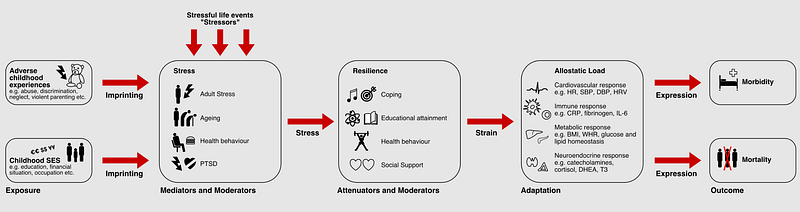
Childhood adversity as well as wear and tear of the adult body (called allostatic load) influence the brain and body system health.
Specifically, high levels of repeated or chronic stress cause overload and breakdowns.
If you already know this, jump right to belief system.
“Living in stress is living in survival.” — Dr. Joe Dispenza
The main causes of stress are poor time management, traumatic life events, the effects of aging, and an unfavorable lifestyle.
Too little exercise, insufficient sleep, too little time to unwind, an unvaried diet, alcohol, and smoking are the principal adverse lifestyle choices.
As shown in the diagram below, all the aggregated stressors over our lifetime affect our cardiovascular, immune, metabolic, and nerve and gland cell responses.
Belief system
Yet, another important factor influences our allostatic load — our belief system.
“You can change anything about yourself quite quickly. All you have to do is give up the belief system that says that it takes a long time to change.” — Robert Anthony
“The brain is involved in everything your body does and feels, so to suggest that some illnesses are purely in the mind and some are purely in the body is not really accurate,” argue Sara and Jack M. Gorman in Psychology Today.
Our health benefits if our belief system is aligned with our inherent needs and interests. But it suffers if the doctrines we practice contradict our values and motives.
A belief system that draws on our deficiencies leads to vexation and guilt feelings. These feelings evoke self-hatred, self-critique, and self-accusation.
Such a behavioral pattern is highly damaging and evokes illnesses.
Again, if you’re lucky to be an old hand on this subject, scroll right down to PASTOR. Otherwise, read on.
“There is a mental aspect to every physical disease,” confirms Dr Caroline Wiggins, General Practitioner and medical author for Patient.
“As many studies can attest, your family of origin helps to shape your worldview, determines how you relate to and interact with others, and can impact your mental and physical health,” reports the BetterHelp editorial team.
“We learn our belief systems as very little children, and then we move through life creating experiences to match our beliefs. Look back in your own life and notice how often you have gone through the same experience.” — Louise L. Hay
In The Key to Self-Liberation, author Christiane Beerlandt lists some 1,000 diseases and explains in great detail to what extent they are tied to our worldview. She points out attitudes, opinions, beliefs, or other routines and practices that harm our physical health, and describes how to overcome them. Shockingly, the elaborations are revealingly correct.
“The world we see that seems so insane is the result of a belief system that is not working. To perceive the world differently, we must be willing to change our belief system, let the past slip away, expand our sense of now, and dissolve the fear in our minds.” — William James (‘Father of American psychology’)
Resilience
Both stress and belief system are intertwined.
Our worldview directly affects our behavior and lifestyle, including habits that impact our aging process, and, consequently, our mental and physical health.
Vice-versa, we stress ourselves to comply with our belief system.
However, by questioning our belief system and our attitude toward stress, we build resilience.
Resilience has an extenuating and moderating effect on stressors.
Resilience is a panacea and a lifesaver. It diminishes the allostatic load.
It is not an innate talent, but a learnable skill.
Here are two techniques to internalize resilience:
PASTOR
The positive appraisal style theory of resilience (PASTOR) contends that we retain our mental health so long as we keep a positive attitude toward stressors.
At it, positive is defined as non-negative: We should neither be too pessimistic nor catastrophize potentially stressful situations. Rather, the idea is to maintain an optimal stress level and avoid unnecessary strain and tension.
The optimal stress level is between underload and overload, specifically between fatigue and exhaustion.
We need to view stress as a useful physical reaction that allows us to sharpen our senses and gets us in shape for a specific occasion.
Challenging beliefs
“The most common ego identifications have to do with possessions, the work you do, social status and recognition, knowledge and education, physical appearance, special abilities, relationships, person and family history, belief systems, and often nationalistic, racial, religious, and other collective identifications. None of these is you.” — Eckhart Tolle
As with stress, we must develop a positive appraisal style of who we are.
What are the beliefs we better not believe because they warp our true selves?
To find out, we must first identify and challenge our limiting beliefs. They often go unnoticed but hinder love and personal success.
We must understand in the process that our beliefs filter our perceptions. To widen our range of vision, we must expand the lens through which we perceive reality.
Next, it is time to do some soul-searching and express these confining beliefs. Why do they hold us back from making choices that could propel us forward? Ideally, we should write down our thoughts clearly and discuss them with a friend to gain clarity. Note that the beliefs may not be fully developed, making it difficult to recognize and challenge them.
If rejecting or recognizing our limiting beliefs seems too difficult, we may consider envisioning how our lives would change if we held more positive beliefs about ourselves.
In doing so, we must refrain from negative self-talk that we would not impose on others.
Lastly, we need to acknowledge that emotions change more slowly than beliefs. We should expect lingering influence even after rational acceptance of falsehoods.
“We ourselves cause every so-called ‘disease’ in our body.” — Louise L. Hay
Therefore, we must kill our parent’s child.