
How to Ask Anybody Anything: Life Lessons from Sharing Buddhism with Others
Has proselytizing been given a bad rep?

Q: Why did the Buddhist excel in beauty sales?
A: Zen-territic Cosmetics make you feel like you’re in nirvana and look like a goddess too — with just a daily application! — author
All joking aside — as if a Buddhist can do that. The practice of Buddhism may produce enlightenment, but a sense of humor seems to be a preliminary indicator that you are on your way. Have you ever known an unhappy practicing Buddhist? (Hey, we all have our moments — but I mean a consistent inclination toward joyfulness is regularly demonstrated.)
The practice of SGI Buddhism is relatively easy. Thank God (oops, the wrong figure of speech) I’ve found something that doesn’t require threading a camel through the eye of a needle or practicing asceticism in caves for years. Or wearing robes and shaving my head. Besides, I look terrible in orange. The dropout rate of this type of asceticism is pretty high as you can imagine and unnecessary.
SGI Nichiren Buddhist practice consists of just three aspects — called the “basics” — faith, practice for self and others, and study. Three is not so many, that it’s difficult to remember — just between you and me and the fence post.
This was explained to me when I was introduced to SGI Buddhism over 40 years ago. Since then, I have striven to do the practice correctly. I didn’t realize how challenging it would be or how much of a work-in-progress I was. And what I was soon to discover, is that I would have to change myself if I wanted to be unshakably happy. Hey, I’m only human. I just wanted somebody to fix it. I wanted it to be simple and painless.
In the beginning, I looked at it as more of an experiment, scientifically observing to see if I could make a connection between my practice and my life unfolding according to my desires. I developed a “faith” based on perceiving this relationship. If I chanted for money to go on a trip and I got it miraculously, I started to have “faith” in the process. I also enjoyed the act of chanting as I could feel joy welling up in my heart whenever I chanted.
The study aspect was also in my wheelhouse and painless, since I had been reading widely in search of the correct way to live for years. Also, the writings of Nichiren Daishonin, the original Buddha, are beautifully written — rich with metaphor and allegory. It is intellectually stimulating and requires minimal energy — just a quiet place to read and reflect.
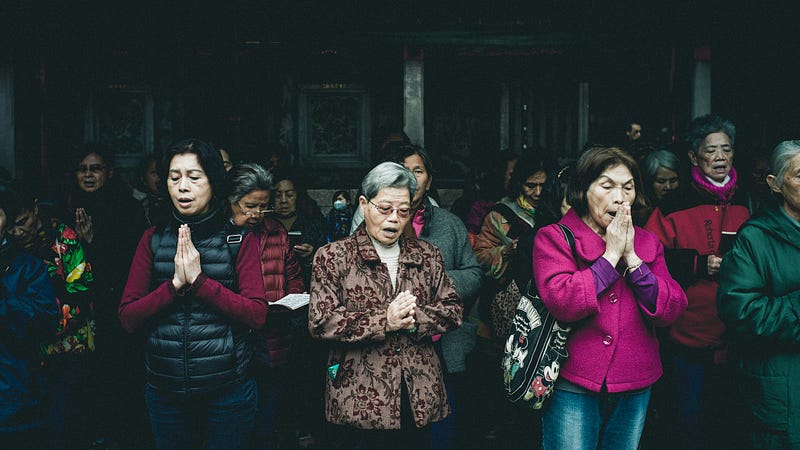
Practicing for myself involves chanting the liturgy — 2 chapters from the Lotus Sutra — and chanting the daimoku — Nam Myoho Renge Kyo — daily. Not too difficult — though a certain amount of resistance can develop whenever something requires a daily commitment. But, chanting as much or as little as you wish makes it very doable. Once I established this as a positive habit in my life, the strength of the habitual helps overcome some of the resistance. The joyful feeling in response to chanting provides an intrinsic motivation. In some ways, the fact that my wishes would eventually manifest was a bonus.
The greatest difficulty for me was the aspect involving practice for others. I remember when I first learned that telling others about Nichiren Buddhism was a necessary part of the practice. I had been hoping I could just chant and study to my heart’s content — and gain enlightenment. Saweet!
It turns out that being truly happy is not a singular event — it involves others. How can a person truly be happy when there is so much suffering everywhere? Yet, I remained very silent and had a great reticence to overcome when it came to what I considered “proselytizing”.

And while I intellectually understood that sharing my experiences with the practice of Buddhism with others could be a very natural conversation — like telling someone about a fabulous movie you just saw for example — it filled me with trepidation. How could I go up to someone and say, Hey, you wouldn’t believe the experience I had recently — I chanted for the money to go on vacation to California — and the money, in the exact amount, appeared in my mailbox!

I recalled the feelings I experienced when I was approached by someone promoting their brand of religion and I would immediately feel turned off. It smacked of salesmanship. And I never wanted anything to do with the business of sales either. I shunned salesmen as hucksters and mouthy people pushing their own agenda and wanted nothing to do with them. And I certainly wouldn’t want to inflict my agenda upon others.
I chanted that I could practice Buddhism and gloss over this particular part of the practice. Don’t make me do it! It never occurred to me this was where my growth as a human being lay, and there was no avoiding it. The practice is carefully designed to aid in our self-development.
In the process of my spiritual growth, I’ve learned much about myself. I suspect I had lost the ability to speak up for myself, probably at an early age. I didn’t even know what I wanted. If someone asked me a simple question, “What do you want for dinner?”, I couldn’t answer. That’s how thoroughly squelched I was. I learned from an early age, that there’s no sense in asking for what I want because I’m probably not going to get it. I had to get in touch with my desires again and believe in the possibility. I had to reclaim my voice.

Once I began finding my authentic voice, I needed to learn to speak with an open heart. After feeling jaded after so many years of living as above, I needed to connect with others from my heart center.

We all do sales every day. Whenever we open our mouths, we are saying to someone else that we deserve this person’s time and attention because we have something valuable to impart.
Intellectually I needed to thoroughly vet this practice for myself. I knew that I could not promote something that I could not get behind 100 percent. Thus, I hardly ever promoted anything including my thoughts and ideas. How could I even be sure this brand of cereal is better than that or that a particular idea I have is what you need to hear? What proof do I have?

As a young person, I said very little. I didn’t believe with conviction that anything I had to say was of such import that someone should stop and listen. I was quiet, but always listening and learning. At the beginning of my practice, I was slowly developing faith in myself as well as belief in the validity of the practice. Eventually, I realized I need not wait until I’m thoroughly convinced — perhaps years later — to finally jump into the challenging aspect of propagation. I could promote Buddhism and be open to practicing something else if I found something that works better.
In the company of a group of practitioners, I also became convinced that I did have something valuable to offer. It may be the greatest treasure that anyone could ever wish for — the ability to become truly happy, no matter what’s happening — through your own efforts. Freely given and available to everyone — with no personal cost except your time — being able to take faith in SGI Buddhism is truly a gift. And through the multiplication effect, we are also creating the foundation for world peace based on each of us becoming truly happy.
During the first years, as I chanted and gained experience, my life improved and my studying gave me material to draw upon when having conversations. I was laying the groundwork for some fundamental change in myself, without realizing it. Like watching a tree grow, it’s difficult to perceive the changes while you watch, subtle as they are — but I was surely growing.
Early examples of sharing Buddhism with others were offered at meetings with my fellow practitioners. I heard stories about some of my fellow practitioners’ more intense experiences when sharing about Buddhism with others. They were sometimes not just shunned, but had water thrown on them, and had doors slammed in their face. At the time it was offered as an example of a “badge of courage” and as a way of demonstrating how one can expiate karma through such actions, and why we should not be discouraged by such negative responses. However, these stories had the effect of further scaring me — making me even more reluctant to put myself in such a position. Such examples are no longer mentioned at meetings. Instead, examples of organic and natural ways of sharing Buddhism with others are offered.

One of the biggest lessons to learn in terms of propagation is that you can ask anyone for anything when you make it okay for them to say “no”. This means that I cannot have my own need for approval or affirmation of myself as a human being attached to this conversation. We tend to avoid risking disapproval — even with complete strangers. But how would it be if my sense of well-being was strong enough to withstand people’s reactions no matter how negative they were? Meaning, I am not worried about what people think of me to feel safe, happy, and well. These things are best internally sought after and satisfied. Being a lesbian perhaps affected my public persona in terms of feeling extra cautious. I already had enough problems with people making negative judgments about me once they learned who I am.
As I became stronger in my self-worth, I learned that one of the simplest ways of overcoming the fear of asking for what I want of someone else is to notice whether my attention is on me or them. If my attention is on me, I may be setting myself up for fear or discomfort if the person says “no”. If my attention is on them, and how what I’m asking will benefit them — the discomfort disappears and it becomes much easier to ask for what I want.
In Buddhism, we understand that everyone has the Buddha nature, which makes us all equal. This has a profound effect on how I view others. When I see people around me as being both unique and “just like me” — no better and no worse — it opens a gateway to deeper connections and longer-lasting relationships.

I recently had the experience of singing while looking down at the audience and our chorus conductor, because we were spread out on three levels in the building’s atrium. It had the odd effect of upending the usual point of view. Instead of looking up at the conductor, I was looking down on him and he up at me. This is a subtle difference but can bring about an awareness of how we view ourselves in relation to others.
When giving a speech, an exercise that has been commonly taught to overcome the fear of public speaking is to imagine the audience in their underwear. While this may help with the fear, it is just trading superior feelings by denying our shared humanity. It’s easy to come off as egotistical. A better idea is to cultivate a sense of “unique equality” — one that recognizes our uniqueness and our commonality with every person on the planet. I might not feel as confident as I would if I tried to hold myself to be superior, but something even better becomes possible — a sense of ease and well-being, regardless of whom we happen to be with.
An introvert by nature, and reticent by early training, the process of sharing my beliefs, ideas, and interests with others has taught me to have the courage to find my voice, develop self-confidence, respect my own and other’s ideas, and treat people as equals. And more especially, I learned that it’s okay for people to respond negatively to my offerings. Their response is not attached to my own need for approval — or fear of disapproval. Any negative response from others is more about them than me.
The danger to our survival as a species increases as we continue our abuse of the environment — driven by our pursuit of wealth and the pressures of overpopulation. Empathic communication amongst all the peoples of the world — giving voice to the earth and all inhabitants — is the surest way to develop a global network for peace.
In learning to speak out, I am choosing to be part of the Great Conversation at a turning point in history. Apathy is the worst possible choice at this crucial juncture. Will you contribute your voice to the dialogue? Will you speak up?
Q: What does a Buddhist comedian say when the audience stops laughing? A: I know you’re out there. I can hear you breathing.
A Zen master told me, “Do the opposite of what I tell you.” So I didn’t.
Q: What did the Buddhist say to the pizza chef? A: Make me one with everything. The pizza chef prepares it and gives it to the monk. The monk pays him and asks for the change. The pizza vendor says: “Change comes from within.”
Q: What happens when a Buddhist becomes totally absorbed with his computer? A: She enters Nerdvana.
A zen student asked his master: “Is it okay to use email?” “Yes,” replied the master, “but with no attachments.”
(Jokes from Elephantjournal.com)