
How to Archetypally Understand Toxic Masculinity and Toxic Femininity
The yin and yang of balancing ourselves and our world
Toxicity
The terms “toxic masculinity” and “toxic femininity” can be difficult terms to understand. They’re often thrown around (particularly the former), with an intention to hurt individual people. There’s a good argument for not using them at all — as they create more defensiveness than they do communication and healing.
But if we can understand these terms through this yin/yang archetypal lens, we might realize that they’re not about blame or finger-pointing. They’re not intended to start gender wars. It’s simpler than all that. It’s nothing more than a question of balance.
Defining yin and yang
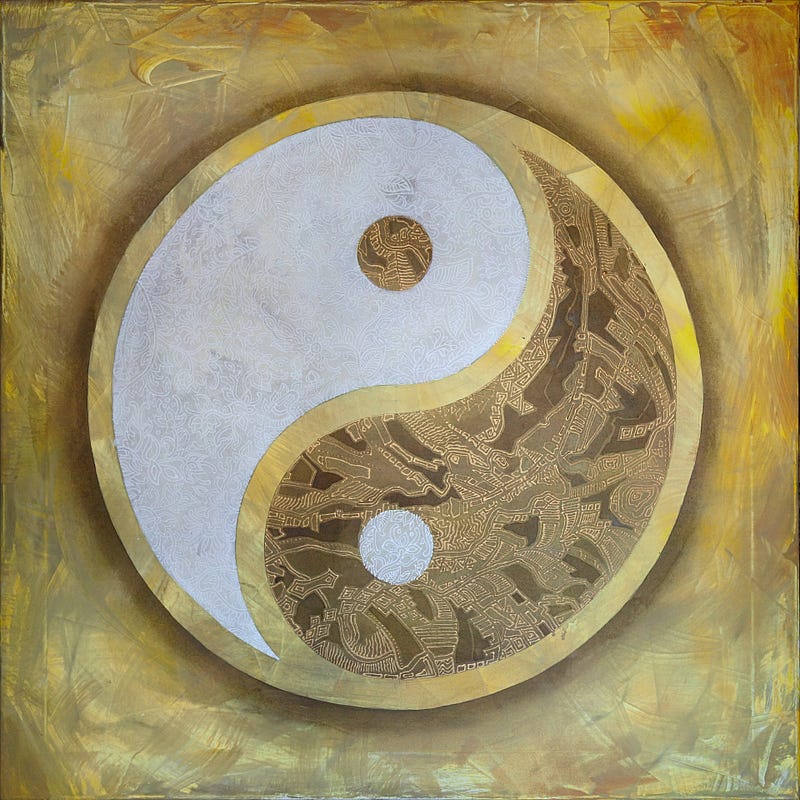
As depicted in the famous yin/yang symbol of Chinese philosophy (called the Taijitu), yin and yang are equal but opposite counterparts. Yang is associated with the archetypal masculine energy, while yin is associated with the archetypal feminine energy.
Yang energy is hot, quick, light, and bright. It is ambitious and driven. It is associated with daytime, the sun, and the element of fire. Yang energy burns. It is a lighting bolt of force to be reckoned with. Whether it offers life-giving heat or destroys with an unappeasable appetite depends on how we tend to it.
Yin energy is soft, slow, reflective, receptive, and compassionate. Its nature is gentleness and simplicity. Yin nurtures, allows, holds, and receives. Yin energy is associated with the elements of earth and water. Yin rules over nighttime and the moon. Yin cools. It too is a force to be reckoned with, but for entirely different, mysterious reasons.
Yin and yang are not labels and should not be assigned to people. They are an archetypal way of defining energy. Archetypally speaking, these terms actually have nothing to do with our genitalia, sexual orientation, or gender identity, but have everything to do with our innate and unique energy.
Both males and females embody masculine and feminine energy in varying degrees. No one is entirely masculine or feminine, and these energies do not remain static throughout our lifetime. They are always on the move, shifting, and, in their healthiest form, they seek wholeness through the balance the other offers.
But, because of their different core qualities, it follows that when the masculine and feminine go out of balance (when they become toxic), they do so in different ways:
Toxic masculinity
Too much yang without yin to support it looks scattered, rageful, jealous, angry, and impulsive.
At its worst, without the wisdom of yin supporting it, yang is ruthlessly ambitious and destructive like a bull that has seen red. It can act as greedy as a wildfire — without reason, pacification, or a care for others’ needs.
Because of its natural outward trajectory, imbalanced masculine energy moves in an outward fashion. Violence, rage, hatred, name-calling, sarcasm, bullying, and all kinds of abuse — these are symptoms of the toxic masculine.
We see a lot of imbalanced yang energy in the world today — in our governments, our corporations, our police forces, and our streets. It is an energy that casts aside and marginalizes the feminine, neglects the soul, and scoffs at authentic and vulnerable expression. It looks like the January 6th insurrection in the United States of America.
If yang energy remains imbalanced, it affects the world and other people. But at some point, like a boomerang, it moves back to hurt the person expressing it, too.
Toxic femininity
Yin energy without yang is also imbalanced. Without the light of yang, we can’t find our way in life. Depression is a perfect example of yin without yang, as it is missing the fire necessary to clarify and cleanse our thoughts and bodies. At its worst, yin without yang is withdrawn, bitter, spiteful, and passive-aggressive. Here too, the soul cannot come forth. Creativity is stifled when there is no light to usher it in or bathe it beneath.
Because of its inward focus, imbalanced feminine energy moves inwardly. Guilt, depression, anxiety, lack of self-worth, bitterness, spite, or clingy behavior — these are the symptoms of the toxic feminine. This imbalance might also manifest as petty criticism or (unwarranted) suspicion and is a projection of a lack of self-worth.
Toxic femininity is a cry for help from someone who struggles with core survival issues such as self-worth, self-acceptance, and self-love.
Yes, a man can be withdrawn and spiteful. And yes, a woman can be violent and wrathful. But in these examples, the man is presenting toxic femininity, and the woman is expressing toxic masculinity — archetypally speaking. What matters is not what we call it. What matters is that we realize both people are imbalanced, and both need healing.
Wholeness
In order to be healthy and whole, we need all the qualities of the yin and the yang in our lives. This means in our food, our activities, and our relationships. It’s good, for instance, to have friends who fire us up, and challenge our assumptions through their dominant yang energy. It’s also good to have friends who cool us down, and support us from their yin.
The forces of yin and yang are interdependent and complementary halves of a whole person or functional society. If the masculine is out of balance, so goes the feminine, and vice versa. When one changes, the other reacts. When one is warped, so too is the other. To revere one as more important or worthy is to disturb the equanimity and balance of our bodies, home, country, or universe. As our human bodies are each a microcosm of the universe, imbalance occurs if we focus only on developing one half of our nature at the expense of the other.
Wholeness can never be attained without appreciation for both sides of the Taijitu. If we reject the masculine in us, the feminine will collapse in darkness. And if we reject the feminine in us, the masculine will burn itself to the ground. We need both yin and yang to create wholeness, and we need both to be in their healthiest expression for healing.