
How to apply SOLID Software Design Principles to Spring Boot Application (Part 4)
ISP: Interface Segregation Principle

(skip the first paragraph if you have already read other parts of this blog series)
This article is the fourth part of the blog series, dedicated to well-known software design principles, that evolved over time and were finally summarised by Robert C. Martin with initials of the corresponding principles. These principles guide us how to build well-designed software systems, giving best practices for arranging classes, functions, building blocks. We will look at each principle in depth and apply it to the Spring Boot Application. The idea is refactoring existing software based on these principles from architectural point of view.
The word S.O.L.I.D. stands for:
- SRP: Single Responsibility Principle
- OCP: Open-Closed Principle
- LSP: Liskov Substitution Principle
- ISP: Interface Segregation Principle
- DIP: Dependency Inversion Principle
This fourth part is about ISP. Before jumping to concrete example, let’s have some theory.
Interface-Segregation Principle states that no client should be forced to depend on methods it does not use.
Before even starting to explain what are insights of this principle, we should make it clear that, this principle is applicable mostly to statically-typed programming languages like Java, C etc. In dynamically typed languages like Python or Ruby this principle does not make a big sense.
Statically-typed language can be referred to the languages where the type of variables is known at the compile time. Dynamically-typed language whereas executes many common programming behaviours at runtime.
Based on this principle, software components (plugins, packages, classes …) should not have dependencies that they don’t use. Luckily, at almost all modern IDEs like eclipse or intellij, there is a “Organize Imports” function that will remove unused imports. But the problem is not so trivial.
So if we take a look at our “beloved” cash flow management application, we can imagine a situation that our Income and Expense Use Cases are dependent on a functionality that holds business logic for both cases. So Income Use Case has an abundant dependency on a functionality that is used for Expense Use Case and Expense Use Case has the same issue in respect to Income Use Case. Following is the Violation of ISP based on above discussion:
Since IncomeConverterServiceImpl and ExpenseConverterServiceImpl both must implement unused methods, we are throwing Exception to catch those cases, but it would make sense if we isolate them. So any change in convertExpense() method will lead to compile errors and need for change in IncomeConverterServiceImpl, which even does not need that method. Following is the refactored Class Diagram of Interfaces based on Interface-Segregation Principle in cashflow.core.* Package:
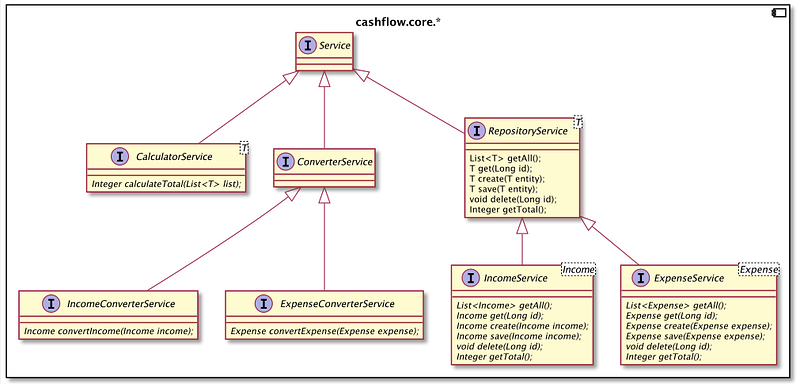
So basically, what we did here is to split ConverterServices into Use Cases and let them extend abstract Service Interface. For our example it might be not the best solution since we have only one method to implement for each Use Case. But imagine a situation where you have got lots of interface that are implemented multiple times for different contexts. It is gonna be a big mess, isn’t it? Actually it is all about ISP: split modules into smaller modules to avoid unused dependencies.
Please see the branch feature/isp-refactored-step-1 for commits and puml files to understand the principle deeply.
The last part is dedicated to DIP, Dependency Inversion Principle. You can find that blog here.


