How to Apply Gibbs Cycle of Reflection
And Why This is Useful for Your Learning and Personal Development

In this article, I will focus on the role of reflection in becoming a better professional and individual. I will provide tips and suggestions on how to choose a critical incident, how to engage in high-quality reflection, and how to apply each step of the Gibbs cycle of reflection.
What is reflection?
Reflection is a method of experiential learning where you step back from your direct experiences, try to make sense of them, and turn them into deeper learning in order to develop your own personal and professional practice. It helps you to focus on the ways in which you understand, develop, and apply your learning in new situations.
What are the benefits of reflection?
Reflection helps you to:
- enhance your ability to evaluate situations and formulate action plans for your future success,
- revisit your experiences to turn them into wisdom and deeper learning,
- enhance your self-awareness and emotional intelligence,
- improve your problem-solving skills,
- develop creative answers to the challenges you face, and
- evaluate the need for change and initiate the process of positive change.
Why is reflection critical for professionals?
Reflective thinking is critical because employers want professionals:
- who are self-aware and eager to develop themselves,
- who can capitalize on and amplify their strengths,
- who will have an impact and make a contribution wherever they work,
- who are committed to their own personal development and life-long learning,
- who can manage their own learning, self-monitoring, and self-evolution, and
- who can confidently provide ample evidence for these claims.
What is Gibbs Cycle of Reflection? How does it work?
Gibbs Cycle of Reflection was developed by Graham Gibbs in 1988 to provide a structure for learning from experiences. It offers a cyclical framework for examining experiences, allowing you to learn and plan from things that did or did not go well.
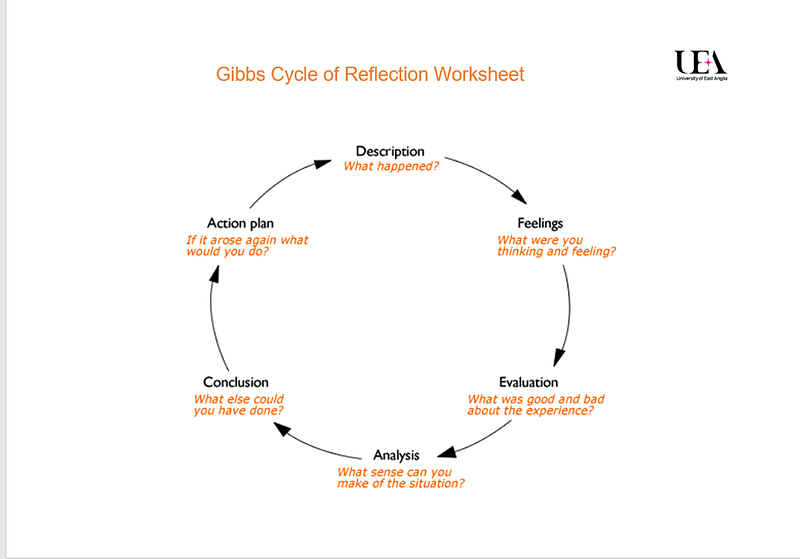
Gibbs Cycle is formed up of six parts or stages:
- Description of the experience,
- Feelings about the experience,
- Evaluation of the experience,
- Analysis to make sense of the situation,
- Conclusion about what you learned, and
- Action plan for how you would deal with similar situations in the future.
Why should you apply Gibbs cycle of reflection?
Gibbs Cycle of Reflection helps you to:
- record and capture what happened,
- structure, think about and reflect upon what happened,
- step back from an experience and take time to review it, and construct meaning from it,
- make sense of what happened and turn it into deeper learning,
- plan, develop and evidence your own reflection and deeper learning,
- write down what you have learned, tried and critically reflected upon,
- record your experiences, thoughts, feelings and conclusions,
- create relevant insights for your personal and professional development,
- create an action plan on further relevant learning. and
- plan on how you will use new knowledge, insights, skills in the future.
How to choose your critical incident
A critical incident is an incident which has had a significant impact on your personal and professional learning. Maybe it has made you stop and think, maybe it has kept you awake at night, or maybe it has raised some confusion or questions for you. Perhaps you have questioned your beliefs, values, assumptions, or behaviours as a result.
Try to choose a hook or a story that is interesting and significant. Why should we care? Why do you care? Try to choose an experience or an incident that you want to revisit, go back, anayze, and reflect upon.
You can refer to this reflective blog to see sample critical incidents:
Below are some critical incident examples that you might want to consider — perhaps you have had a similar experience and you want to reflect on it:
- an aspect of your work that went particularly well,
- an aspect of your work that did not go well,
- a conflict that you have had with one of your colleagues,
- a communication accident, gap, or misunderstanding,
- an aspect of your work that you found particularly challenging,
- a time that you have felt confronted,
- an incident which made you question yourself and your assumptions,
- a difficult episode in your life that you want to revisit.
After you make your choice, please give a brief history of the incident. Please take notes to remember what happened:
- What happened?
- Where were you?
- When was this?
- Why was this incident critical?
- What have you learned?
- How have you changed?
How to Apply Each Stage of the Gibbs Cycle of Reflection
In this section, you will go over and apply each stage of the Gibbs cycle to your critical incident. Please take quick bullet point notes to capture your stream of thoughts in each section. You can then turn these notes into full reflective writing.
Description
Describe the situation in some detail.
- What happened?
- When did it happen?
- Where did it happen?
- How did it happen?
- Who were there?
- Why were you there?
- What did you do? How did you act?
- What happened as a result of your actions?
- What did other stakeholders do?
- How did the events unfold?
- What was the outcome?
Feelings
Reflect on your feelings and thoughts that you have had during the experience.
- How were you feeling at the beginning? How did your emotions change during the course of the events? Afterwards?
- What were you thinking during the incident? What do you think about the situation now?
- What do you think other stakeholders were feeling? What do you think other stakeholders feel about it now?
- What did other people’s actions make you think/feel?
- How did you feel about the outcome? What do you think about it now?
Evaluation
Evaluate what went well and what did not go well.
- What was good about the experience?
- What was bad about the experience?
- What went well?
- What did not go so well?
- How did you and other stakeholders impact the situation?
Analysis
Try to make sense of what happened. You can do research to understand and make sense of what happened and why. Divide into parts and anayze the experience. Try to extract meaning.
- Why did things go well or not well?
- What did you do well/not so well? Did everything go as expected? Why/why not?
- How would you behave if you were the other person? How would you behave if you were an independent observer?
- How can you make sense of the situation?
- How can you break this into parts and analyze further?· How can you analyse this experience by breaking into parts or stages?
- How can you approach this situation from multiple angles or perspectives?
- What knowledge, theories, research, and resources can help you in understanding the situation?
Conclusions
Extract your learning, insights, and conclusions about the situation. So what? What did you learn? How can you summarize your learning?
- What did you learn from this situation?
- What are the key things you have learned from this incident — about you, your performance, and others?
- What are the new insights and perspectives that you can carry forward?
- How could this have been a constructive and positive situation for everyone involved?
- Could you have done anything differently? What will you do differently next time? How will you do it differently next time?
Action plan
Now, having taken an inventory of all your perspectives and insights, you look forward. You plan how you will do things differently next time if a similar situation arises in the future.
- If a similar situation arises again, what would you do differently?
- How can you make sure that you act differently and more effectively next time?
- Where are your gaps/areas for improvement? What aspects of your knowledge/skills could you develop? How will you do this?
- How will you develop the required knowledge and skills you need?
- How do you make progress and go forward?
- How do you keep learning and improving yourself regarding relevant issues?
- What goals can you set yourself for the future? What outcomes or competencies do you need to focus on?
Samples of Reflective Writing using Gibbs Cycle
You can refer to the following web pages to see some good samples of reflective writing. Many of these examples are in the healthcare context. I tried to choose examples where they apply the Gibbs cycle of reflection:
How to Increase the Quality and Depth of Your Reflection
As you apply Gibbs Cycle of Reflection, your goal is to engage in high-quality reflection. In order to increase the quality and depth of your reflection, pay attention to the following points:
- Have you chosen good hooks that are interesting and compelling? Do you have interesting ‘critical events’ that you draw on? Why are these events interesting for the reader? Where is the deeper learning here?
- Have you clearly described the events and the context (with rich ethnographic details)? Can you capture attention of the reader?
- Point out multiple layers and complexities in a situation instead of sticking to one-sided arguments.
- Think about multiple ways of approaching your topic — what other perspectives, theories, tools, concepts might be applied to enrich your understanding? Are there alternative explanations?
- Can you enrich your analysis through getting feedback and perspectives from your co-workers, your manager, your mentor/friend/family member, or other stakeholders?
- Feel free to ponder and generate more possibilities and questions rather than searching for one right answer.
- Please start keeping a diary/learning log where you reflect on the daily events/experiences that you have come across in your workplace.
- You can use personality tests to explore yourself and different personal styles you have encountered. The descriptions in the following site are more detailed and accurate compared to others: https://www.16personalities.com/
- Ask yourself: Am you being honest with myself? Is this process useful for you? Is it helping your process of learning and development? As a result of this reflective process, what did you discover that you did not know about yourself and your workplace? What would you do differently next time?
- Try to use/apply multiple reflective tools, frameworks, and models to engage in deeper reflection and sensemaking (MBTI, Belbin, Gibbs’ Cycle, Kolb Cycle, Schon etc.)
- As you write, make sure you report on your deeper learning and change; i.e. As a result of the reflective process, what did you discover that you did not know about yourself/your organization? What would you do differently next time?
- Have you really discovered something new/striking and critical as a result of your reflections? Why should we care? Where is the deeper learning?
- Have you documented the change in yourself, your emotions, your assumptions, your behaviours etc?
- Have you come up with implications and points for learning/ improvement?
- Have you pondered on ambiguities/ambivalence/difficult emotions and challenges? Have you incorporated your own reflective voice?
- Have you revisited your experience with a fresh/renewed perspective and with new knowledge and wisdom?
- Have you considered/discussed the role and impact of the context? Have you included a thick description of the context (i.e. your role, department, and organization)?
- Have you built rigorous linkages/bridges between the world of practice (your experiences, workplace, critical events) and the world of theories (theoretical perspectives, tools, frameworks, academic references)?