
How to address HIPPO requests using an opportunity canvas

Your boss bursts into the room:
“Quick! A customer wants this feature in the product. How long do you think it will take to build it?”
Who has experienced this situation before?
With every feature you add to your product you are making lots of assumptions. Of course there’s the one everyone wants to know: “How long will this take to build?”
But, more importantly you must make sure everyone in the team/company understands that:
- Building it really solves a problem for someone
- It will actually get used, really solve the problem, and those using it will really get value out of it
- And hopefully that the value people get is significant enough for them to be giving you some return on your investment
Your company should be really confident in all those things before it decides to invest lots of time and money into designing, building, and releasing this feature.
Right? Do you agree?
But let’s assume that the “boss” is right. Sometimes you don’t start with an idea. Maybe you think you know enough about the problem. Maybe you already have a solution in mind, and you just want to get it out in production ASAP. You want this to be THE priority — NOW!
The problem is, as product leaders, our job is really not to prioritize solutions. Prioritizing solutions is a left-over side effect of being output focused. When we are judged by what we deliver, the key decisions are focused on what to build and when to ship it. But when we are judged by what outcomes we want to drive, it becomes less about what solutions we deliver and more about what problems we solve for our customers.
There can be many ways to solve a problem — as long as you understand the problem well enough. There can be many solutions to the same problem. Our job is to choose the right solution given the constraints and opportunities we have identified and validated. Only then it becomes all about execution.
But let’s say for the sake of argument that you already have a solution in mind. Your job then is to ask if you really understand the problem you are solving and the target customer you are solving it for. It’s important to identify the outcome you expect to observe after you have delivered it, and how it ultimately impacts your business.
Because if you didn’t understand all those things, should you really be building it?
Opportunity canvas
One way to make sure we don’t spend time and money on the wrong things is to do a simple exercise. I like to start with the solution idea I’ve been asked to implement and working backwards to understand the problem it solves. Then working forwards to understand the value it brings: the outcomes we’ll expect to observe when it’s used and the ultimate impact on our business.
The order we discuss the sections in the canvas really doesn’t matter. But for the sake of clarity I’ll just explain them one by one so you can get an idea of what is imperative to understand in order to fully commit to a solution with confidence.
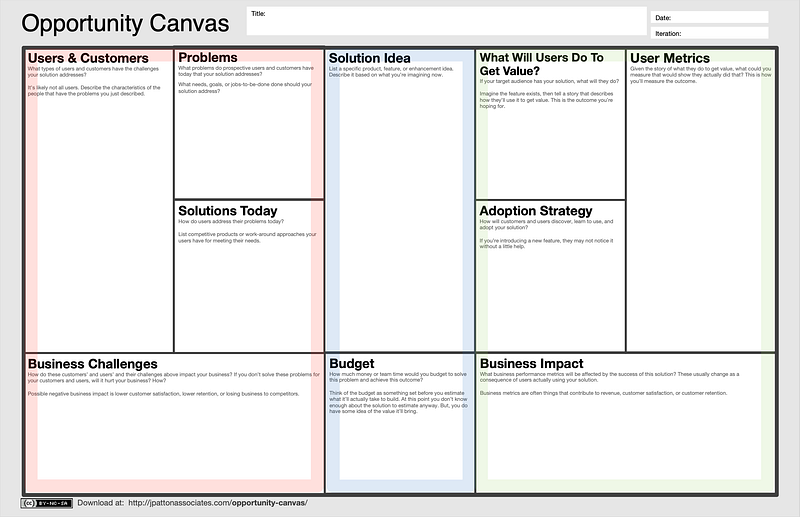
Solution Idea
List a specific product, feature, or enhancement idea. Describe it as best you can. If the idea came from someone else, ask the individual to articulate the vision based on their current imagination.
Problems
Centers on understanding the specific issues faced by the prospective users and customers.
What problems do prospective users and customers have today that your solution addresses?
What needs, goals, or jobs-to-be-done should your solution address?
Customers & Users
Focuses on identifying the target audience for the solution and explores the specific challenges faced by this group.
What types of users and customers have the challenges your solution addresses?
It’s likely not all users. Describe the characteristics of the people that have the problems you just described.
Solutions Today
Highlights how the users currently address their problems.
How do users address their problems today?
List competitive products or work-around approaches your users have for meeting their needs.
If your user’s problem is worth solving it’s likely they’ve figured out some ways to solve it. If they haven’t, maybe it’s not that big of a problem. If they have, you’ll learn a lot by understanding what they’ve done to solve the problem. Your solution is competing against these alternatives.
Business Challenges
Consider the broader business implications.
How do these customers’ and users’ and their challenges above impact your business? If you don’t solve these problems for your customers and users, will it hurt your business? How?
Possible negative business impact is lower customer satisfaction, lower retention, or losing business to competitors.
What Will Users Do To Get Value?
Envisions the users’ interaction with the proposed solution and projects the potential outcomes and benefits for the users.
If your target audience has your solution, what will they do?
Imagine the feature exists, then tell a story that describes how they’ll use it to get value. This is the outcome you’re hoping for.
Metrics
Determines how to measure the solution’s success based on user behavior.
Given the story of what users will do to get value out of the solution, what could you measure that would show they actually did get it? This is how you’ll measure the outcome.
Adoption Strategy
Details how the solution will be introduced to users and should cover strategies for discovery, learning, and adoption.
How will customers and users discover, learn to use, and adopt your solution?
If you’re introducing a new feature, they may not notice it without a little help.
Business Impact
Discusses how the solution should affect business metrics.
What business performance metrics will be affected by the success of this solution? These usually change as a consequence of users actually using your solution.
Business metrics are often things that contribute to revenue, customer satisfaction, or customer retention.
Budget
How much money or team time would you budget to solve this problem and achieve this outcome?
Think of the budget as something set before you estimate what it’ll actually take to build it. At this point you don’t know enough about the solution to estimate anyway. But, you do have some idea of the value it’ll bring.
Notice that everything on the left side of the canvas is something you can actually verify. You could talk to customers and learn about their problems and workarounds. You could do some analysis to make an educated guess at how this problem impacts your business.
Everything from the solution and to the right of it is an assumption. You won’t know what the solution is until you design it. You won’t actually know how long it will take to build until you build it. You won’t know exactly what customers will do until you observe them doing it.
But, you can test those assumptions and build confidence that what you believe will happen might actually happen. You could do a little design to create a prototype and put it in front of customers. That’ll give a little evidence that they actually want it and can use it to solve their problems. You could do a little technical exploration and write a little test code. That’ll give you more confidence that you can actually build the solution in a predictable amount of time. All of this is product discovery work.
Pros & Cons of the Opportunity Canvas
The Opportunity Canvas is a robust tool for understanding and evaluating business problems and solutions. By ensuring a user-centered approach, it highlights the importance of understanding and catering to user needs. However, like any tool, it has areas for improvement and should be used in conjunction with other methodologies and frameworks.
Pros:
- Holistic View: The canvas offers a comprehensive view of the problem and solution, from the user’s perspective to the business impact.
- Structured Approach: By breaking down the evaluation process into sections, it ensures that all aspects are considered.
- Versatility: Can be applied to various business problems and solutions.
- Encourages User-Centered Thinking: Puts emphasis on understanding user needs, behaviors, and challenges.
Cons:
- Potential Overemphasis on Users: While user-centricity is crucial, the canvas might downplay other stakeholders.
- Lack of Market Analysis: The canvas doesn’t explicitly go into market trends, competitors, or market size.
Recommendations & Missing Pieces:
- Market Analysis: Take time to focus on understanding the current market trends, competitive landscape, and potential market size.
- Technical Feasibility: There could be a section discussing the technical constraints or challenges related to the proposed solution.
Conclusion
“A product team’s job is to create value for the customer in a way that creates value for the business.”
As product leaders we do this by:
- Understanding the problem we’re solving before identifying solutions
- Considering many possible solutions and not just one
But we must also evaluate the risks:
- Desirable (Does anyone want it?)
- Viable (Should we build it? Does it drive business value?)
- Feasible (Can we build it?)
- Usable (Can anyone use it?)
- Ethical (Is there any potential for harm? Who is this solution serving? Who are we leaving out?)
And in those cases where “somebody” suggests a specific solution packed with assumptions and tells you to build it. Try the opportunity canvas. It’s one tool you can use to help expose those assumptions so you can make sure you are building the right thing with the time and resources you have.
This article is the third in a series of 3 articles:


