
Wait, what?
How to Actually Remember What You Learn
Learning isn’t helpful if you forget it all
What was the name of your 3rd-grade teacher? Or, how do you calculate the integral of f(x)dx as you learned in your high school math class?
You may not remember any of the above.
Me neither.
And that’s fine, none of this information serves you in your daily life anyway. There isn’t any value in memorizing these random facts.
But, let me ask you another question: what was the main takeaway from your favorite book of 2018?
Now, this question is different. The aim here is to see how well you can remember information you set out to discover.
There is a difference between information learned through forced action (e.g. studying for a midterm with the goal of getting an A instead of learning) and information you willfully set out to learn (e.g. taking an online class on graphic design). Most of the information you learned in school was done in order to comply with the rules and pass the tests. That’s the opposite of the information you voluntarily sought out.
While it may not matter much if you forget the random facts learned during your schooling, I think there is a real issue when your memory fails you when trying to remember the things you once wanted to learn.
Information you forget is as useless as information you’ve never learned.
To return to the question about your favorite 2018 book, first, you probably may not remember what was your favorite book from 2018. Second, if you do, you may not remember what you actually learned from it or why you found it helpful. That is because of a simple concept called “The Forgetting Curve”.
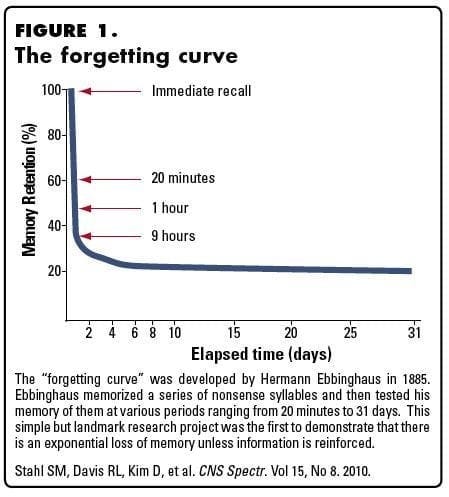
Discovered in 1885 by Hermann Ebbinghaus, the forgetting curve illustrates how easily we can forget new information learned. In a matter of days, you can forget 80% of everything you’ve learned about a specific topic.
That is a huge problem.
Most of us make a living by learning useful skills and selling them to the market. We spend most of our lives from kindergarten to graduate school accumulating a massive amount of knowledge just to forget most of it in a few months or years. It is akin to spending your life filling up a toolbox with many tools but not knowing how to use any of these tools.
Information you forget is as useless as information you’ve never learned.
What really matters is not how much new information you can learn, because there is no point in learning if you keep forgetting it all, but how much of that information you can retain.
The game you must focus on is retention.
That is what most successful people by conventional metrics focus on. Read any article about people who have worked with Bill Gates and you will often hear not only that he is a learning machine but that he retains close to 90% of everything he learns.
That is great for Bill Gates, but what about me?
I am glad you asked.
The number one trick to remember what you actually learned is through spaced repetition. Spaced repetition is defined as:
An extremely effective learning approach where lessons are retaken at increasing intervals until knowledge is fully embedded in long-term memory.
In layman’s terms, it is basically the ability to recall knowledge by using a simple cheat code: reviewing your notes at a specific interval. This interval can be every few days, every two weeks, every month, or every quarter. The interval will vary based on how useful that piece of information is to you.
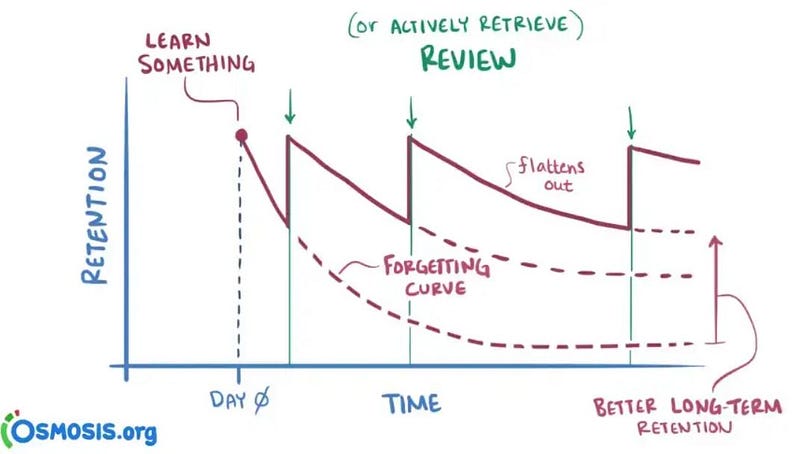
The issue with learning without spaced repetition is that you will most likely forget what you learned. All the time spent studying and working hard to learn something will go to waste and no one likes to see their time wasted.
Spaced repetition can take the form of reopening your notes, re-reading highlighted paragraphs from your books, or having a conversation with a friend about that topic. No matter how you choose to do it, spaced repetition will bring you value as it will help consolidate the memory of the knowledge you gained.
I hope you find this article helpful, and if you ever forget how to remember what you learned, make sure to come back and re-read this article.
If you enjoy reading articles like this one and wish to support me as a writer — please consider signing up to become a Medium member. It’s $5 a month, and will give you unlimited access to all stories across the platform. If you sign up using my link, I’ll earn a small commission.


