
How to Achieve Mindfulness as a Non-Meditator
Tips and tricks on how to achieve focus for those who don’t like to meditate

“If you can’t find 10 minutes to meditate, you need 20”.
Hearing that phrase, I blamed myself even more.
I know that meditation is good for me. I also know that I could increase the quality of my work and life if I were more present.
I used to practice daily meditation for 2 years straight. I’ve read all the books I could find on the topics. I’ve tried apps like Calm and Headspace. I’ve attended offline meditation and yoga classes. But then, for some reason, I stopped. I can’t tell you why I stopped meditating daily, but at some point, I just couldn’t push myself any longer. It felt like an obligation. It felt like a duty that I must fulfill.
The whole point of meditation is to relax and restore your emotional state. Yet all of it felt like work.
If you are like me, you’ve probably felt it too.
But deep inside, I had this longing to be more present and less impulsive. I liked the benefits of meditation — it’s just the need to constantly sit down and do it killed me. Some people say that that’s the whole point of meditation and the fact that it’s uncomfortable means it’s working.
But I am the type of guy who likes when things come organically, without the need to push myself too hard. I like it when it’s simple.
So I thought, “There must be a way to meditate without, you know, actually meditating”. And it turned out, there is.
Over the course of a few months, I realized that meditation is not something you do formally, by sitting down each morning and closing your eyes. Meditation can be incorporated into your life organically, without changing your daily routines or putting too much pressure on yourself.
Meditation can be simple, and most importantly, fun. And instead of calling it meditation (which usually refers to the formal part of this practice), let’s call it mindfulness.
Below are a few tricks on how to incorporate mindfulness into your life today.
#1. Do (Absolutely) Nothing
Great place to start.
This may be the hardest, yet the simplest ways to achieve mindfulness. In fact, I found that this practice may be even more productive than the formal meditation.
It’s simple:
- You find a comfortable place to sit — on a sofa, or a chair. You can probably lie down, but I prefer sitting.
- And you do nothing. Not thinking. Not reading. Not listening to music. Absolutely nothing. You just sit and stare at the wall (or outside the window, if you prefer it to white paint). You just breathe.
- Do this for 10–20 minutes daily.
The best part is that unlike the formal meditation, you are not scared of it and it doesn’t have many steps. In fact, it doesn’t have any practical steps at all. You just sit and stare right in front of you.
At first, it’ll be hard. Then you’ll get used to it. You’ll feel the blood pressure drop. You’ll feel the agitation go down. Your eyelids will lower and your face muscles will relax.
Then you’ll have thoughts coming in and out, let them come and think them through.
Sometimes our mind is like a cluttered inbox with thoughts like unread emails — and doing nothing is the best way to swipe them “Done”.
We tend to think that listening to more podcasts, reading more self-help and educating ourselves makes us better humans. In my experience, sitting down and doing nothing is a very profound (un)activity.
Everyone can read and listen to Tim Ferriss. But how many people do you know that can disconnect and do nothing for 10–20–30 minutes?
#2. Eating Mindfully
Once you commit to finding mindfulness moments in your life as an alternative to formal meditation, you’ll start seeing opportunities everywhere.
When you eat, pay attention to the food. Focus on the smell, the taste, the texture of the food in your mouth. I really feel eating it. There is research that such mindfulness is not only good for the mind, it also helps us digest the food better (and it tastes good too!).
The whole point of mindfulness (and meditation) is to be present. So to bring even more mindfulness into my food, I started cooking. It’s very easy to overeat or eat something unhealthy when somebody else prepares the food for you. You just grab and go. When you prepare the food yourself, it helps you focus on the ingredients you put it and you won’t want to put too much sugar or salt into what you eat. Nobody is their own enemy.
For example, Jennifer was tempted in the supermarket to buy one of the sweet cereals, and she ate a bowl of this cereal each morning. But she noticed that she was always hungry a few hours after breakfast, craving a muffin or sweet roll. On the suggestion of a friend, she started eating eggs for breakfast, and found she wasn’t so hungry and didn’t crave sugar. (This was probably because the protein and fat in the eggs made her feel full while her previous breakfast, which had more sugar, probably increased her insulin level. The insulin reduced the glucose level in her blood, making her feel hungry.)
Making your own food and being mindful when eating also helps us eat less of it and digest it better. It’s very easy to overeat when you stuff yourself as fast as you can. The whole point of being mindful is about taking it slowly, not rushing the process to let the food digest and our brain to acknowledge that it’s receiving food.
Susan Albers, author of Eating Mindfully, suggests that in our fast-paced world, attentiveness to the things you “have to do takes on a greater priority than what is going on internally.” “Slowing down” she says, “is a foreign concept to busy individuals. Doing several things simultaneously is considered a more efficient way of doing things.” We may not even care that multi-tasking registers as stress in the mind and therefore triggers a stress response in the body.
#3. Mindful Walking
Another place where I found the opportunity to be mindful is walking.
I knew the benefits of long walks before and with the help of Stepz App, I am trying to hit my daily 10K. So if it’s 8 PM and I see that I don’t have enough steps walked during the day, I just get out of the house and go for a walk.
Walking helps me think, reflect and be more present with myself. I found that it’s important though, to go on a walk without your phone. The feeling that you can connect in a second and receive more dopamine from checking your “likes” on social will prompt you to do so.
On the contrary, when you’re walking without a gadget, you are not even thinking about it. You just walk. Pay attention to nature. Breathe. Do nothing.
I found that whenever I feel overwhelmed or distracted, going for a long walk is the best way to bring focus back into my life. It may seem at first like wasting time and being unproductive, but the quality of the work skyrockets once you’re in the right state.
Give this to yourself.
#4. Being Present in Everyday Life
The way my father spend time with me and my sister was by watching movies. And although watching TV may seem like a collective experience, it’s actually an individual one. Everyone is in their own heads, receiving signals from TV and interpreting them on their own. It’s actually a very solo experience if you think about it.
My girlfriend made me reassess the meaning of the phrase “quality time” and I’ve found that it’s a great mindfulness practice too.
But in order to be present in everyday life, you’ve got to adjust your environment first.
This is what we do:
- At dinner, we put our phones away in a separate box and don’t touch them until the next morning. This has to be at least 2–3 hours before bed.
- We put our phones in the “No Disturb” mode (these days, I actually have it always on with the exception of a few important contacts).
- We get rid of all notifications (you can do those in Settings) on your iPhone or Android from apps, including SMS. Social media is there for me, not me for social media.
- We don’t pick up our phones until after breakfast. The worst enemy of mindfulness is to pick up your phone right after you wake up. Some people start texting while still in their bed — I can’t imagine what it does for their mindfulness.
In my experience, I found that whenever I break any one of these rules, my mindfulness levels go down and I become impulsive, irritable and reactive.
- When I pick up my phone in my bed, I can’t do proper “deep work” (a term coined by Cal Newport) later in the day and constantly get distracted. It’s as though my brain is programmed by the first hour of the day. What you put in it, will determine the rest of the day.
- When I don’t put my phone away at least 2–3 hours before sleep, I can’t fall asleep fast. (Lifehack if you really need to use technology before bed: install Flux — it makes the screen yellowish and does less impact on the brain and eyes).
- When I have notifications turned on, I jump every time I get a new one and start wondering whether it’s something important. Rule of thumb: in 99.9% cases, it’s not.
This is how my phone looks like today:

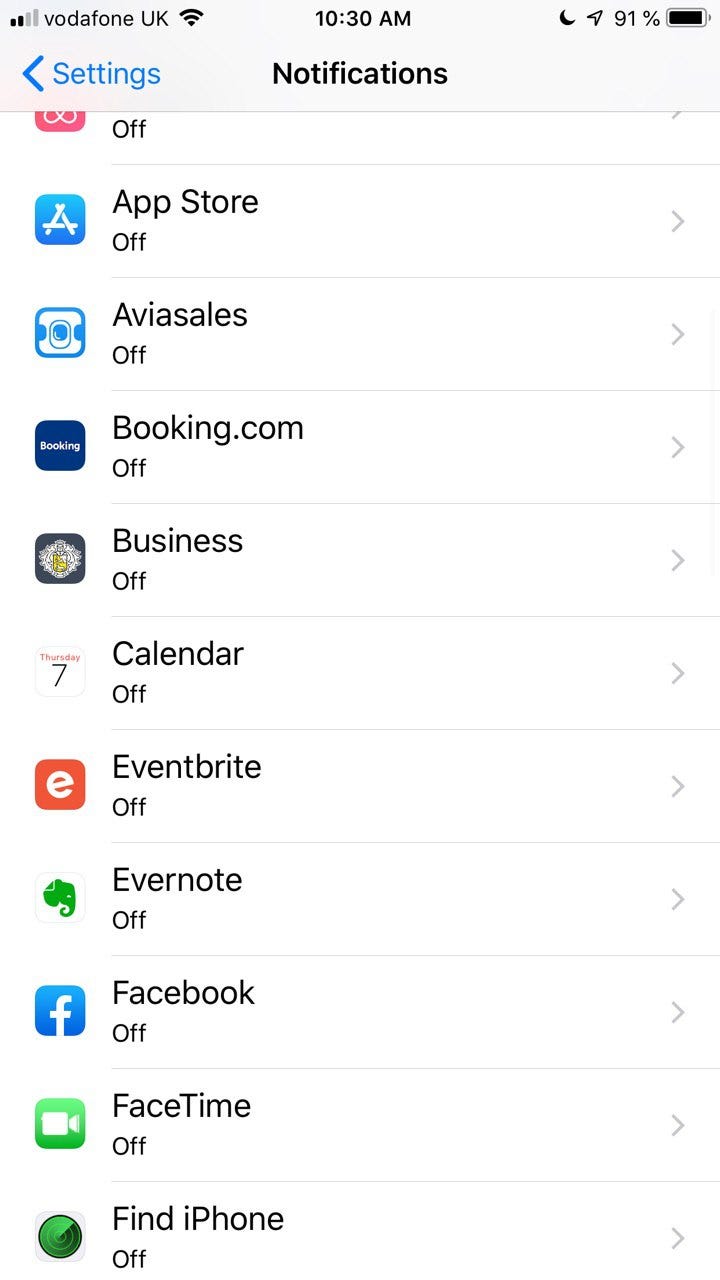
When you have your environment set, you are now ready for real “quality time” with your loved ones.
Research shows that eating together with your family or close ones increases oxytocin levels (the hormone that directs the feeling of belonging and bonding, which is usually seen when giving a person a hug), and can make you live longer (and happier).
#5. Mindfulness in Work
Another great place to practice mindfulness — work. And because we literally spend 70% of our lives working, this may be the most important place to do so. After all, we practice mindfulness because we want to be more focused and productive, to do our work better.
For me, mindfulness in work is all about not having the feeling of being overwhelmed. Whenever I feel that I am overwhelmed and there is too much to do, that’s the moment when I need to do something to return myself in a good state of mind. Nothing good ever happens at work when I am not present.
Here are a few things that I do to keep working at my best (yet being mindful):
- I keep my desk clear. Going back to the previous trick. Your environment defines your thoughts and your mind space. It’s also a reflection of what’s inside of you. Having more mind space (which is the whole purpose of this practice) means to have a clear desk, with nothing unnecessary on it. My desk usually consists of a laptop, a few blank sheets of paper to jot my ideas on and a pen. That’s it.
- I keep noise to a minimum. I know there are people who are more productive and focused when they have Spotify on. That’s not me. Sometimes I listen to classical music (especially Bach) to restore and unwind, but when I am working I like to keep it very quiet, otherwise I can’t hear my thoughts.
- I drink water and have the window open. Have you ever noticed feeling sleepy and practically useless on an airplane? I can never properly work while I am in the air. There is a simple explanation to that: when you are flying, you are literally trapped in a steel box 30,000 feet in the air with limited oxygen. And because there are so many people (200–400) flying with you, you’ve got some serious competition. When the brain doesn’t have enough oxygen, you feel sleepy and can’t think straight. The same goes for hydration. That’s why I always keep my windows open and drink plenty of water to stay focused.
#6. Take Three Deep Breaths
There are moments when you need a quick fix. Something that’ll get you back on track, in a good emotional state and focused. If that’s you, never underestimate the power of three deep breaths.
I first discovered this trick when my girlfriend told me to take 10 breaths (or you know how some people tell you to count to 10). Maybe it’s just me, but counting to 10 is a long time…
I found that taking 3 is good enough. The important part is to breathe deeply both in and out. Inhale (one, two, three), exhale (one, two, three), then repeat this 3 times. Notice how you feel. Chances are, whatever was bothering you, doesn’t anymore. You are now present.
Summing up
The purpose of any mindfulness practice — be it meditation or little mindfulness tricks like the ones I described in this post is made for one thing and one thing only: to make your life better.
Mindfulness is not a tactic, nor is it actually a practice. In my opinion, mindfulness is a way of life. It’s a decision to being present at all costs and the realization that you are at your best when you are.
If you feel that formal meditation is too hard for you to manage, try any (or all) of these tricks on yourself. They’ll be able to improve your focus, productivity, make you less reactive and even make your relationships stronger.


