
How to ace portfolio presentations in product design interviews
Tips on how to showcase projects for a successful interview

Every company I’ve ever applied to as a product designer has required a portfolio presentation interview. It’s a great way for employers to learn more about who you are and what projects you’ve worked on. It’s also a chance for you to discuss how you collaborate with others to solve problems, showcase what you’re capable of producing, and exhibit your skillset to your new potential team.
I’d recommend preparing a slide-deck for the presentation as they’re the best storytelling tool in my opinion. Below are my tips for success for a successful portfolio review:
1. Start by introducing yourself.
A great way to set the tone for the presentation is to kick-off the first few slides by sharing your background. This portion shouldn’t last more than 1–2 minutes as it’s a way for your presenters to quickly learn who you are.
This can include:
- Where you’re from
- Education (where you studied and your major)
- Brief summary of former experience
- Current company and team (if applicable)
- Specific skills (i.e. prototyping, animations, illustrations, etc.)
- Fun fact about yourself
The rule of thumb here is to include any kind of information you’d want to your potential team to know about you. Adding elements of your personality here might be a good way to lighten up the presentation.
2. Be prepared to go over 2–3 case studies.
Portfolio presentations usually last an hour; this allows you to go over 2–3 projects in-depth. For each case study, be sure to note the following before you dive deep into your design processes:
- Your role
- Collaborators
- Stakeholders
- Duration
This information can be highlighted in the title slide of your project or off to the side with a product shot of the final designs.
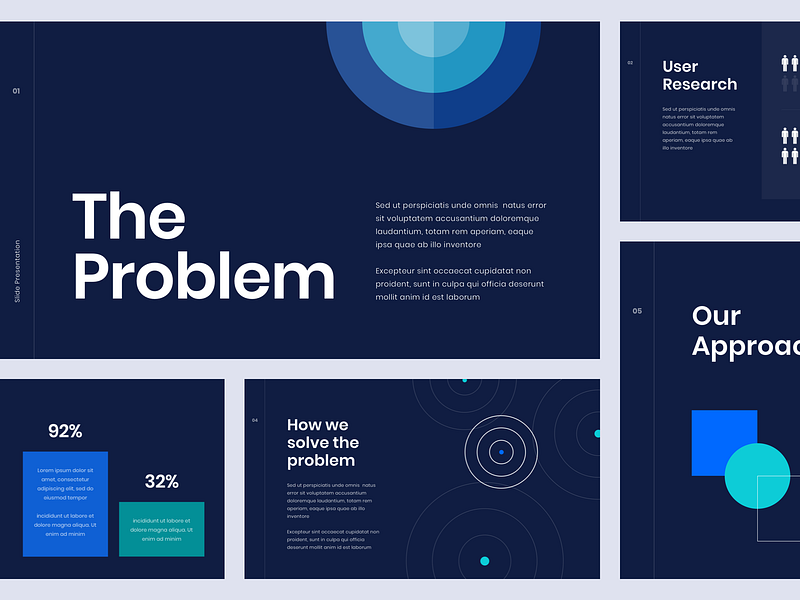
3. Outline the problem(s) you helped solve.
The problem statement is arguably the most important part of your project tied with your designs. Hiring managers want to learn why your work was crucial to your team, including supporting evidence to justify the existence of the pain point(s).
You should also include who you’re helping to solve it for, quantitative and qualitative metrics, insights from team discussions, business objectives, measurements of success, and/or user research trends in this section.
4. Dive deep into your design process.
This is where the bulk of your slide-deck should lie. Your process should show:
- “Before” snapshots
- User research insights
- Explorations
- User studies findings
- New designs
You should be able to answer questions about your design decisions and why you ultimately chose your solution given specific constraints and scope.
Some questions you should be prepared to answer are:
- How did you validate the new designs?
- How did you involve stakeholders in your design process?
- What did you learn from your participation in this project?
- What methods or techniques did you use to inform your decisions?
Additionally, interviewers love to learn what the ultimate impact was from the designs you helped create. Try tying this back to the indicators for success you outlined earlier in your presentation.
5. Be prepared to answer follow-up questions.
Common questions from former interviews include:
- What would you do differently if you had more time?
- Were there any challenges? If so, how did you navigate around them?
- What was your biggest takeaway from this project?
Your answers should reflect how you grew as a designer from the project. It should also showcase how you work with other collaborators on a team to help solve the problem at hand.
6. Visual design counts.
Select appropriate typography, colors, and a grid structure to help format your work in the best light. Visual design is an important pillar of product design and how you design your slide-deck also reflects your style and aptitude in this area.
7. Don’t sweat it! Relax.
Succeeding at interviews takes practice. Don’t take it personally if you get rejected—continue to get feedback from reviewers and use it to refine your presentation. Best of luck with your hiring process!
Thanks for reading! Follow my newsletter to receive links to provoking reads I’ve found helpful for my career and keep up-to-date on my newest blog posts. If you’d like to reach out, follow me on Twitter to continue the conversation. You can also check out my photography journey on Instagram or learn more about me from my website.
Other helpful reads:
- “A framework for communicating (or designing) any project” by Weston Karnes
- “Common questions related to UX/product design portfolio & interviews” by Geunbae "GB" Lee
- “5 steps to nailing your portfolio presentation in design interviews” by Peter Herbert Barnaba
