
How to Absorb New Information Like a Sponge
Yes, you can memorize anything without being a genius.

Have you ever crammed for a test, gone on to crush it, and then had the information escape your brain within a week?
I’ve been there.
You’ll be pleased to know that this doesn’t make you unintelligent. It’s merely a result of poor study habits. The reality is, cramming or passive review isn’t powerful enough to consolidate information into the cerebral cortex, the long-term storage facility of the brain.
We must study smarter, not harder.
I never struggled during university, but I’ve forgotten far more information than I’d like to admit. Regardless of how many hours I would grind out, my long-term retention didn’t seem to improve. Something was missing.
It wasn’t until after my degree that I decided to study… how to study.
Four months into this journey, and I can confidently say that I’ve never been a better learner. I’m memorizing material quicker, remembering it for longer, and enjoying the whole process. Thanks to these five study principles, the way I see and absorb the world has been revamped.
The beauty is that this shift isn’t rocket science. Commit to subtle changes in your habits and you too can reap the benefits of active, insightful learning.
Five Hacks to Help You Become a Learning Machine
Feynman’s Technique
Have you heard of the brilliant Richard Feynman? He was an American physicist with a god-like ability to take complex subjects and translate them into layman’s terms.
This technique is all about being curious, like a five-year-old. If you’ve ever been around a young one, you know that they won’t stop asking questions until they achieve an understanding of their big, electrifying world.
To practice Feynman’s technique, ask yourself these two questions:
- Does this truly make sense?
- Could I explain this to a five-year-old?
For example, you could memorize: “A myocardial infarction is the necrosis of myocardium due to ischemic conditions caused by atherosclerotic buildup”. Although this is technically correct, try simplifying it down further.
“A myocardial infarction is a heart attack that happens because gunk in your blood vessels is blocking your heart from getting oxygen… and it’s not happy about it”. Breaking it down into Layman’s terms will ensure that you’re critically thinking about the material and demonstrating a true understanding.
“I’m smart enough to know that I’m dumb”. — Feynman
The beautiful thing about the Feynman technique is that you start to question everything. This will lead to a natural sense of curiosity about the world, and a humble realization that there’s always something new to learn.
“Assume nothing, question everything”. -James Patterson

Active Recall
If you want to learn and memorize things fast, drop the note-taking (especially re-taking notes). You must set yourself up for test-like conditions instead. Active recall is a powerhouse because it trains the brain to collect information and not just recognize it. Whether it’s using an application like Notion, a tool like Google Sheets, or just simply closing the textbook, find ways to test yourself without the answers.
My favorite way to practice active recall is through the Cornell Note Taking System. Instead of writing down the Prof’s words verbatim during a lecture, I structure notes into questions that can be answered later. Here is an example:
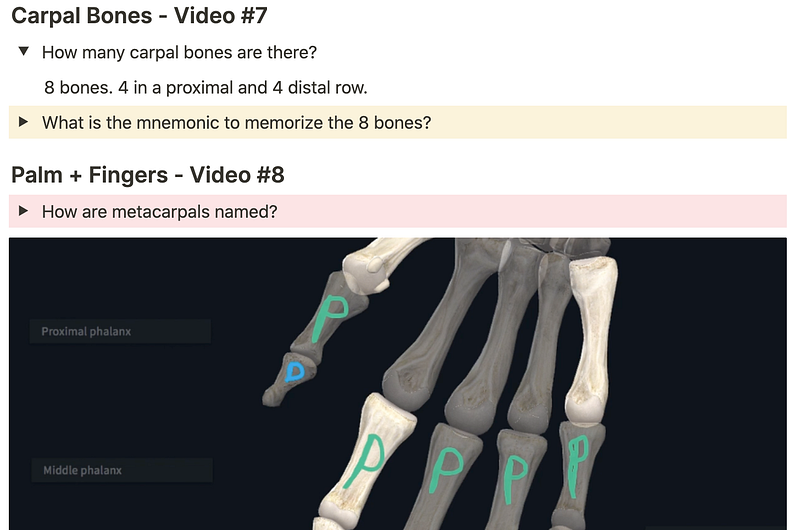
Notice how I’ve utilized a toggle system for active recall. I’ll answer the question in my head, and then drop it down to check if it’s correct. I also color coordinate each question based on past difficulty. This helps me focus on the hardest material first — efficiency, efficiency, efficiency.
Images are a great tool for recalling information as well. Try and plaster them all over your notes, but don’t spend too much time looking for the perfect picture.
Spaced Repetition
The forgetting curve is real. Your struggle for retention is completely normal and does not mean you have low intelligence. The good news is, the more you repeat something, the longer it will take to forget. For some subjects, it may require up to seven or eight reviews for full memorization. Don’t get discouraged — just keep at it!
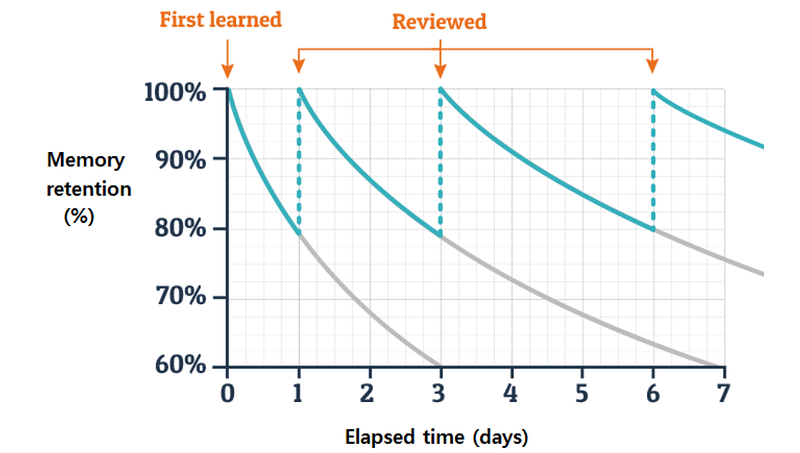
There is a method to this madness too. A retrospective revision table will ensure that you’re prioritizing whatever information is most unfamiliar to you. This is a great tool for last-minute preparation as you can quickly touch on your weakest material.
Each time you pass through a subject, quickly date it and rate the difficulty out of five. By doing this, you’ll be able to quickly see what information needs prioritizing the next time around.
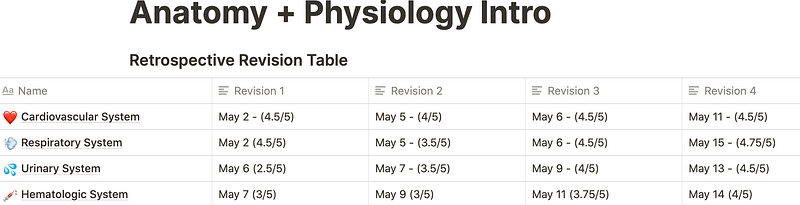
Based on this table, I would choose to study the hematologic system first based on the rating (4/5) and date (May 14th). I would then look at the cardiovascular system as it’s been a few days since a review.
Mnemonics
I’m sure you’ve heard of mnemonics already, but hear me out. Are you actually using them? They’re an absolute lifesaver. When I took anatomy, I used codes whenever I was stumped, and it greatly reduced the ‘brainpower’ required to collect answers during my exams.
Just make sure to only use them if you need to. Studying is all about efficiency, so save mnemonics for when something isn’t sticking. I could never memorize the eight bones of the hand until I heard this mnemonic:
Some Lovers Try Positions That They Can’t Handle.
Four years later and I can still rattle those bones off.
Parkinson’s Law
This is the phenomenon that the more time we have to do something, the longer it will take to do it. That’s why creating proactive schedules and to-do lists are so critical to keeping things productive. Within my notes, I will block off time windows for each task.
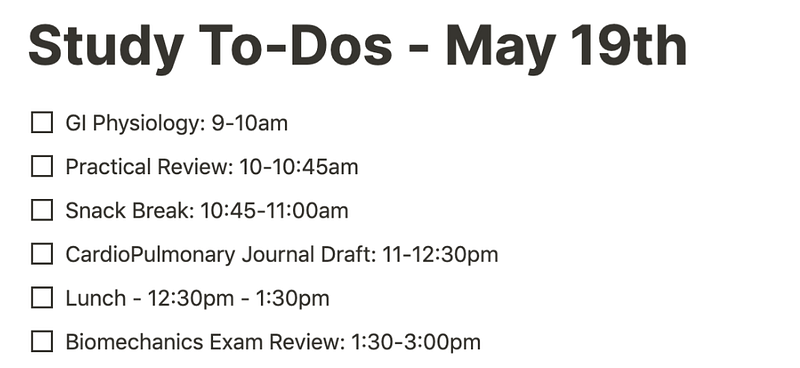
Another useful practice to combat Parkinson’s Law is to use the Pomodoro Technique. In short, start a timer for 25 minutes of studying, give yourself a 5-minute break, and repeat. This can do wonders to keep you engaged and on track.
Just remember to keep things realistic. Don’t study for twelve hours straight — you’re a human being for goodness sake. Taking breaks is so critical to keeping your spirits up and your productivity high.
BONUS: Environment Check
There’s a syndrome we often carry called the fundamental attribution error. This is our tendency to under-emphasize situational (environmental) explanations for an individual’s behavior while over-emphasizing personality-based explanations for the behavior.
You can be a genius, but if you’re in a space that doesn’t suit you, you won’t succeed to the level that you could. Be extremely picky about where you study, when you study, and who you study with. It will all contribute to your success!

In Closing,
Study smarter, not harder. Forget about cramming for an exam, and build a practice that will have you learning and remembering for life. By doing so, you’ll foster an everlasting joy around obtaining knowledge — the kind that makes each new day more exciting than the last.
“Never stop learning, because life never stops teaching” — Unknown


