
How This Substack Writer Scaled to 150,000 Subscribers and Now Earns at Least $350,000 Per Year
By writing 4 times a week

Many writers dream of making the kind of bank that Judd Legum does. Even more dream about making that kind of paycheck creating content about their passion.
And by all accounts, this seems to be exactly what Judd Legum gets to do — with a hell of a lot of hard work and consistency.
Judd quit his job and started writing the hard-hitting Substack publication Popular Information in July 2018 and hasn’t had to look back since.
Now he has around 10,000 paying subscribers, at least 150,000 free ones, and way more Twitties following along too.
That’s a lot of peanut butter tuna sandwiches.
TLDR of Popular Information
Timeline:
- July 2018 — Judd Legum started Popular Information with all free content
- September 2018 — Went paid with 2 free articles a week and 2 behind a paywall
- March 2020 — Got rid of the paywall and instead asked for support/donations/patronage subscriptions
- Today — 153,508 free subscribers, around 7500 to 15,000 paid, with earnings estimates of $350,000 to $1,080,000 per year
Payment options:
- Free
- $6 per month
- $50 per year
- $150 ‘Founding Member’ option (or a custom amount filled in)
- No paywalled content
Source of Growth:
- Unique journalistic content
- Twitter threads
- Reaching out to other Twitterers that might like/spread his content
- No paywalls help spread his work
What does he write about?
Judd’s slogan probably sums it up best:
“News for people who give a damn.”
While one might expect he’s offering news to people who love donating to beavers, it seems his principles are more focused on helping out American humans.
His ideals for the newsletter are simple:
- No ads
- No algorithms (thus the email subscription model)
- No paywall (anymore)
- Unique opinions
- Unfiltered facts
He talks about issues that aren’t normally covered by popular news sources. Stuff like which corporations support and donate to politicians banning abortion or how other news organizations are manipulating Facebook to popularize their content in detrimental ways.
In short — politic s— but angling for the corrupt side of things.
What's Judd Legum’s payment model?
He started Popular Information as being absolutely free for the first 3 months. He then switched to the usual pay model in September 2019.
That’s where newsletters will offer 1–2 free newsletters a week while having a couple more behind the paywall.
A lot of popular Substacks use it, so the method clearly works. But I love how Judd went against this model in the end, to share the word more.
In March 2020, he decided to go down the patronage path. He may have even been heard saying “F*ck paywalls!” in the hall of his living room. But who knows.
Either way, from that point forward, he decided to make his 4 weekly articles free for those who couldn’t, wouldn’t, or didn’t want to pay.
And I think that’s awesome.
Instead, he offers a simple choice for those signing up:
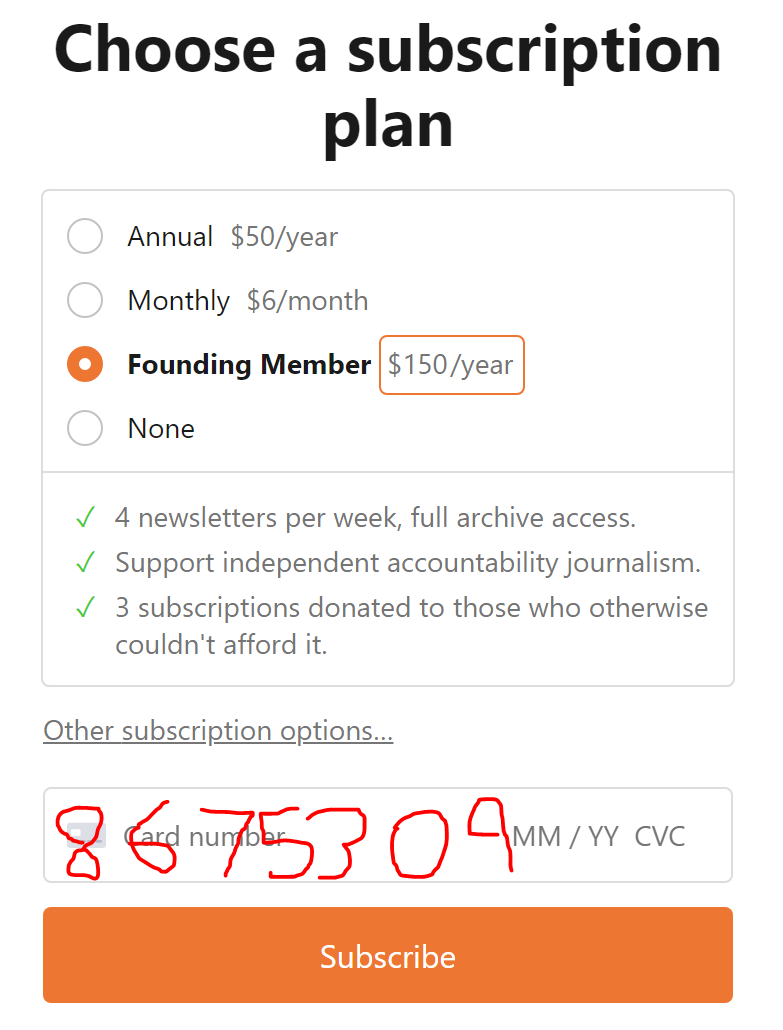
Oddly, the messaging is slightly off. If you select anything other than the ‘Founding Member’ option, the sections below it get crossed out.
But I checked after signing up for the free subscription and no paywalls existed, so I’m guessing/hoping he just didn’t update the signup screen.
How did he grow his subscriber base?
From what I gather, Judd Legum has a few principles and guidelines that he followed to grow his massive base.
1. He emphasized the importance of providing value
If you look at his work, it’s trying to cover topics that aren’t flooding our newsfeeds. And also topics that we probably would/should care about.
He’s filling a gap in our modern media.
While doing this amazing research and writing — he continually reminds potential readers/subscribers of this part of his mission.
In marketing terms, the benefits are twofold:
A) It’s scarcity and uniqueness. (ie. You can’t get his kind of content elsewhere.)
B) It provides value to the user. (ie. Instead of asking to receive yet another email in your inbox, here’s why you would want his.)
2. He Tweeted his heart out
It seems Judd Legum is a big fan of using Twitter to get his name and content out there. He even credits it with being somewhere approaching 50% of his paid subscriber base.
That’s nuts.
It makes sense though, he now has over 500,000 Tweetlings following him.
The man knows what he’s doing.
His favorite go-to strategies on Twitter?
A) Tweet threads.
“I use it…to give people essentially a thesis statement of what the newsletter is about that day. And I’ll do that in a thread of tweets. It might be 5 to 15 tweets where I lay out my main points or the things that I’ve learned. And then I try to use that to build up to a period where one of those tweets — not the first tweet and not the last tweet but somewhere in there — there is an organic place where I can ask people to sign up for the newsletter and that that’s the best way to get the information.”
B) He occasionally reaches out to other Twits.
“If you don’t have a huge following to begin with, you can still be successful. And one of the ways to do that is to reach out directly to people and tell them about what you’ve written if you do it in a thoughtful way. So you’ve got to think about what your topic is, what you’ve discovered, what you’ve written about and think about who does have a large audience on Twitter and might be interested in that, and send them a nice polite note about that thing.”
Does he use a call to action?
Yes and no.
In Judd’s own words:
“The most effective pitches involve emphasizing the impact of the work and the importance of accountability journalism.”
It seems in the earlier days, Judd would include a header and footer byline describing what his newsletter does and how it can help. It appealed to the nature/emotion of the reader and how they could help support the mission.
Looking through more of his recent pieces, the only thing that stands out is a small but clean ‘Subscribe’ button situated either in the middle or at the end. But interesting to note, this is how the articles appear if you go to Substack.com itself.
Nice and simple.
Over in the email versions, there’s a nice little pitch about the impact of the newsletter at the beginning of the email before the actual article.
He also keeps a list of his previous messages as he likes to vary the pitch. He can then feasibly go back over them and see which ones performed better or just sounded nicer/more appealing.
Smart.
Any other tidbits of advice?
I think my favorite quote I came across from him telling Substack was about outliers. Or rather, investing in unique pieces.
“Anytime your work breaks through your core audience to a larger audience, you’ll see growth.”
In an age where any regular blogger can pump out an opinion piece in 1–2 hours, it takes some real bull cojones to take the risk of investing a lot of time in an essay/article.
I’ve been on both sides of this coin myself.
I made 1 uber-successful (thank god) piece about news bias after spending around 50 hours building it. It has garnered almost 750,000 views so far.
On the flip side, I have dozens of articles I spent 5–20 hours on, felt proud of the work and the content, and proceeded to see them get less than 100 views.
That sucks real bull cojones if you know what I mean. As a disappointed cow would say while holding out a thumbs down, “Moo.”
But this is a game of chance, improvement, and consistency in the end. And Judd Legum has certainly found the right mix of all three.
So kudos to Judd!
As for me, after reading his advice I’m off to go make a Tweeter thread about how we’re all going to die of thirst in the future rain wars.
But don’t get wet waiting for the results to come in, I still suck at Twitting.
Caveats
As with many successful case stories, it’s not all just hard work, grit, and grinding.
Judd Legum had his name out there in the world of journalism before starting his Substack:
- He founded and edited ThinkProgress in 2005 then left in 2007 (a successful news website)
- He came back to it as the editor-in-chief in 2011 until 2018
- Through this publication and his other efforts, he grew his Twitter over the years from 2008 to five hundred thousand subscribers — a huge advantage
So, Judd clearly had some bigtime name recognition before starting his Substack — which gives him a huge advantage over any of us starting from scratch.
And just as one last note, from my research, I couldn’t find any instances of ThinkProgress promoting Judd’s new Substack, which probably would’ve been a huge boon if he did.
If you enjoyed this, come have a weekly laugh on my newsletter — A Pryor Life.


