
How This Brilliantly Disruptive Artwork Changed the Course of Art Forever
A combative work that continues to inspire and divide
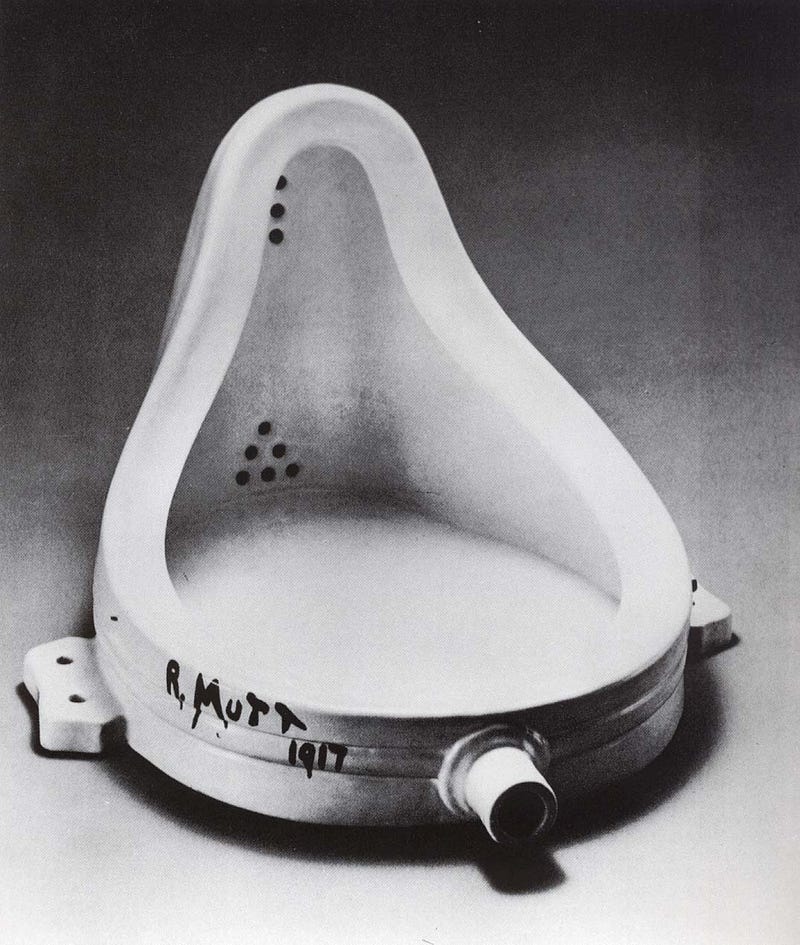

When I was a student of art history, one of the first works that really turned my head and got me thinking about the unusual potency of art was Marcel Duchamp’s Fountain.
It confounded me that a work could reveal so much about what art is “in itself” whilst remaining so resolutely dissimilar to anything I’d ever seen before.
Why so? Because the fundamental motive of Fountain was to call into question how art is defined and to shine a light on the “rules” we use to attach merit and meaning to works of art.
For this reason, I saw it had a strange power, both to affirm and to overturn.
Experts agree: in 2004, a survey of 500 British art world professionals voted Duchamp’s Fountain the most influential artwork of the 20th century.
So what exactly is it about this beguiling and aesthetically unconventional object that continues to inspire — and divide?
Porcelain Provocation

Traditional criteria for good art have tended to revolve around ideas of imitation and expression. Artworks either look like some portion of the world they’re trying to represent, or else they offer a subjective feeling expressed by the artist.
These concepts establish two fundamental pillars of the Western artistic tradition: the unique aesthetic quality of the artwork and the exceptional sensibility of the artist.
Fountain ignores both of these pillars. Indeed, as a porcelain urinal it is provocatively utilitarian, an object the artist merely plucked from a factory production line and presented virtually unchanged. It neither represents anything beyond itself nor expresses any subjective sensibility.
Why then should we be interested in it at all?
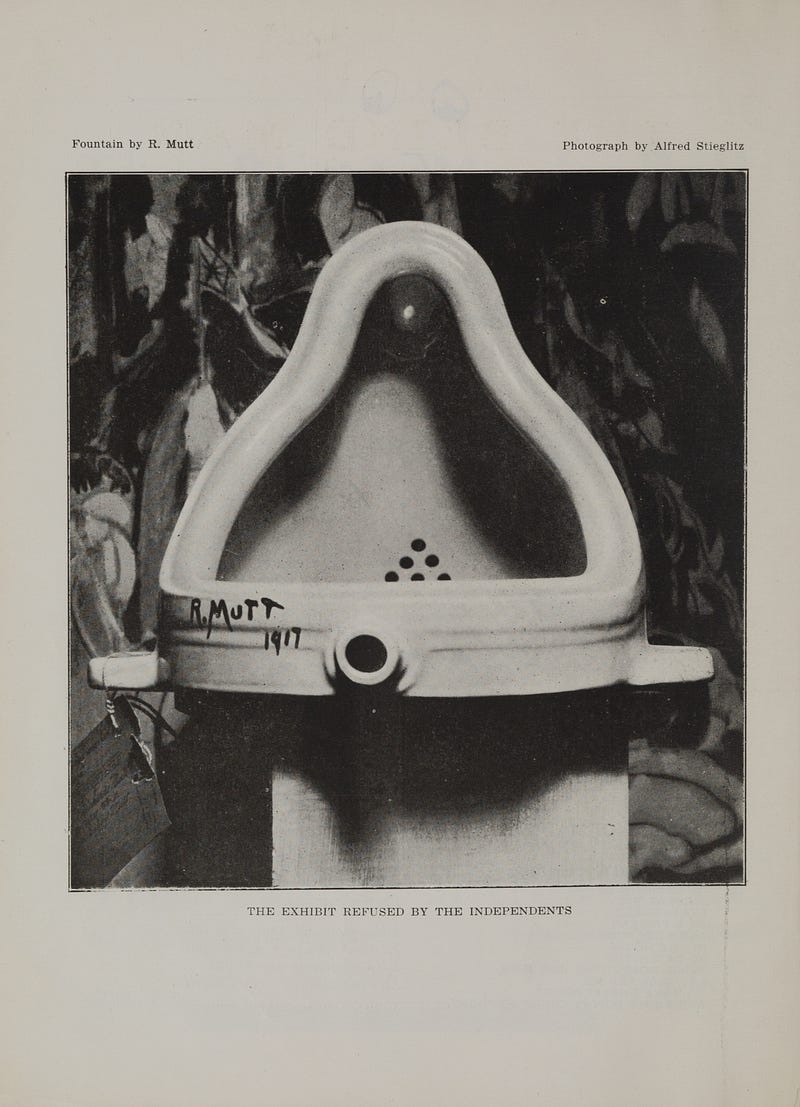
The answer lies in the history of its effects. In April 1917, Duchamp had the temerity to submit the object into the inaugural annual exhibition of the Society of Independent Artists at the Grand Central Palace, New York.
Knowing that, since he had paid the entrance fee, it was against the regulations of the exhibition to reject it, Duchamp’s intention was to test the rules of the society. How would they react to a work that was so unconventional yet had to be accepted?
In the event, the work was kept out of the exhibition of which Duchamp wrote later:
“No, not rejected. A work can’t be rejected by the Independents. It was simply suppressed. I was on the jury, but I wasn’t consulted, because the officials didn’t know that it was I who had sent it in; I had written the name “Mutt” on it to avoid connection with the personal. The “Fountain” was simply placed behind a partition and, for the duration of the exhibition, I didn’t know where it was. I couldn’t say that I had sent the thing, but I think the organizers knew it through gossip. No one dared mention it. I had a falling out with them, and retired from the organization. After the exhibition, we found the “Fountain” again, behind a partition, and I retrieved it!”
Intentionally Disruptive
Fountain is a so-called “readymade” sculpture, meaning that it is an ordinary, manufactured object that the artist selected and in this case modified in some way.
Duchamp made several readymade sculptures — with Fountain becoming the most notorious. These works possess none of the hallmarks of a typical artwork we might expect to find in a gallery. Duchamp made very little alteration to the object, except turn it on its side and sign it with a pseudonym “R. Mutt”.
His point was that he, the artist, had selected it and was presenting it as a work of art.
As one of the first postmodern statements in art, Fountain was meant to unsettle our customary assumptions about what a work of art ought to look like. If something is put forward as art — if the artist says it’s art — then who is to say whether or not it qualifies?
What constitutes art is a question that has consistently foxed philosophers and theorists down the ages. Different places and different ages have found their own answers, which suggests that any permanent, stable definition of art is impossible to pin down.
Duchamp’s act in proclaiming Fountain as a work of art is reliant precisely on the inherent instability of the term. His innovation revealed that anything can become a work of art if it is perceived as such, and that our perception is largely shaped by the artistic setting the work is placed in, controlled by the dictates and conventions of public art institutions.
Such was the argument taken up by defenders of Duchamp’s Fountain: The New York art journal The Blind Man took up the cause and featured an editorial saluting the validity of Fountain as an artwork:
“Whether Mr Mutt with his own hands made the fountain or not has no importance. He CHOSE it. He took an ordinary article of life, placed it so that its useful significance disappeared under the new title and point of view — created a new thought for that object.” (Editorial, The Blind Man, Vol. 2, 1917, p. 5.)
Lasting Influence
Duchamp’s readymade artworks ushered in a new era of self-awareness in art. They operated on a “meta” level, which is to say that their messages didn’t reside in the form or beauty of the work but in the discussion that they subsequently prompted.
The extraordinary thing about Fountain is its lasting influence. As an act of postmodern provocation, it became an exemplar of a new means of inquiry.
What has inspired generations of artists since is the total disruption that Fountain implies to the conventional order of social and aesthetic hierarchy.
The egalitarianism of art that results — a democracy of objects and artefacts — has freed countless contemporary artists to create works that go far beyond the bounds of traditional forms. Whether you celebrate or lament this fact, Duchamp’s Fountain can’t be ignored.

Christopher P Jones is the author of What Great Artworks Say, an examination of some of art’s most enthralling images.
Would you like to get…
A free guide to the Essential Styles in Western Art History? Download for free here.
Join me…
On Instagram for more great paintings on the go!