
How the Zettelkasten Radically Changed My Way of Creating Content (And How It Will Change Yours, Too)
This note-taking method allows to create more (and better) content, faster
3 years.
That’s how long I’ve been using the Zettelkasten note-taking method to create content.
And I treat it as a little revolution in my egocentric universe.
The reason is that I’ve struggled with turning my notes into valuable content for over a decade.
I was jotting down a lot but never revisited my library of thoughts in a meaningful way.
Instead of being an inexhaustible source of ideas, my notes quickly turned into a deep, dark idea graveyard.
The Zettelkasten fixed that problem. Here’s why.
Zettelwhat?
The Zettelkasten is a note-taking methodology.
It relies on index cards to capture the best ideas you stumble across.
Instead of the classical (and dead-dry) classification maze using tags or folders, it encourages you to link information together.
When taking a note, you don’t have to rack your brain anymore which stupid questions like:
- “What tags should I use?” or
- “In which folder should I put this into?”
You simply link the note to something relevant. Boom. Done.
It works because our brain is hard-wired to link information rather than classifying it.
Building your content library
Creating content consistently is damn hard.
But everything becomes easier when you have enough raw material to work with, i.e., your notes.
Before setting up the right note-taking system I was on a constant content treadmill. I had no content library at my fingertips. Everything was scattered amongst my awful memory, bookmarks, and book highlights somewhere on Uncle Bezo’s cloud.
Working like this is stupid. Especially if you want to create content and generate a full-time income.
The reason is that you’re wasting mental energy and bandwidth trying to recall all those tiny bits of information you want to reuse in your content.
Instead, a Zettelkasten allows you to build an endless content library in a convenient, easy, and fun way.
Unleash the power of ideas
Before the Zettelkasten, every piece of content I created was a one-thing affair.
The motto was: Spit it and move on to the next.
But that’s not how it works. Good ideas deserve to be repurposed dozens, hundreds, and even thousands of times!
But without the right note-taking system, spotting those ideas is damn hard.
The reason is that you need to heavily rely on your brain to recognize patterns. But your brain can barely remember 7 things at the same time. So you’re playing a game that you can’t win without external help.
Enter: The graph view.
Zettelkasten tools like Obsidian, allow you to visualize your ideas with a tool called the graph view.
Every dot is a note. The bigger the dot, the more links it has. This allows you to get a 30,000 ft. view of your knowledge.
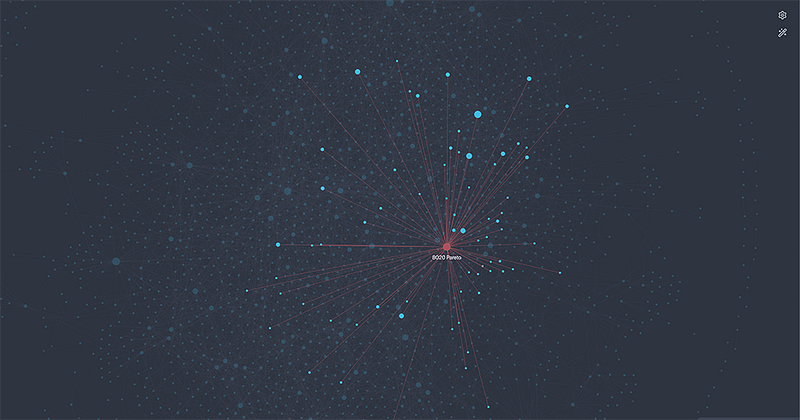
Instead of guessing what I think is important, I now have data that I can visualize. (And it looks damn cool, too!)
This uncovered that one of the most valuable ideas was the 8020 rule. That’s why I dedicated an entire Substack publication to it.
Visuals are powerful.
Learn more by reading less
I’m a repented information junkie.
I used to always keep looking for more information, buying the latest bestselling book, and jumping to the next. I slam dunked my highlights into the abysses of my note-taking apps… and forgot 99% of them.
This is now part of the past.
The Zettelkasten empowers me to go back to my highlights and rewrite them in my own words. This helps developing a greater meaning for collecting information. Collecting is worthless if you don’t take the time to process what you’ve collected.
Many people struggle with clogged inboxes. The reason is that they consume too much and process too little. Your brain needs time to process.
Information is like food. You can’t just consume more. You need time to digest.
One of the biggest Aha moments was dialing down my consumption to get my information digestion right.
Consume less, process more.
Less stress
FOMO is real.
I was once swirling in constant anxiety to catch up with information. When I think about it, that was stupid.
The reason is simple: You can’t catch up on all the information out there. There’s just too much of it available. Google estimates the human information output to 300 exabytes. (That’s 300 followed by 18 zeros)
This forces you to make wise choices and only consume things that are really worth it.
Most content out there doesn’t deserve to be consumed anyway. The reason? Poor ideas, bad structure, and too many filler words.
Don’t be afraid of letting go of information.
Less notes, more output
Most people brag about how many notes they have. I don’t.
In fact, before discovering my note-taking system many of my students complained about the several thousands of notes they took and feel completely lost on what to do with them.
The reason is that the number of notes doesn’t say anything about their quality. Sure, the more notes you have, the more chances you have to find interesting connections (if you know how to organize them.)
But it’s not so much about the quantity of notes rather than the effort you put into creating them.
Sure, you need an initial amount of notes to make the system work for you, but then you’ll play around and see how your ideas collide in a meaningful way.
Yes, creating notes is harder than just saving them. And that’s on purpose. Engaging is key to learning and thinking.
You want to be more mindful about the information you consume, save less, process more, and thus have more time to connect the dots.
Slowing down and chewing on the right content has been a game-changer for me and will be for you, too.
Saving is cheap. Thinking is priceless.
Removing the duplicates
Most content is about the same information presented in different ways.
Was a time when I was unable to connect the dots. I would constantly re-learn things without even knowing. Spending more time on a great book and re-engaging with your highlights is 100 times better than continuing to highlight and consume like a robot.
You’ll boost your learning and understanding.
This understanding pours into my content. It allows me to draw powerful connections between apparently unrelated concepts.
It’s the holy grail of creativity.
Effortless creation
This is the biggest one of all.
My altered version of the Zettelkasten method allows me to create more content faster.
There are three reasons for that.
First, I can directly find ideas related to the topic I want to write about. This makes outlining any article a breeze. Instead of racking my brain and brainstorming, I open the graph view with a keystroke.
And it tells me all:
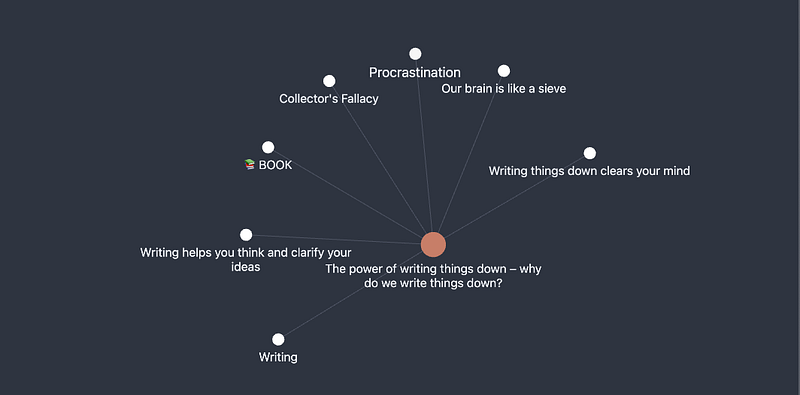
The outline of this article has been done by simply looking at the connections.
Second, every note can be copied and pasted to create a larger piece of content. Your notes act like Lego bricks that you can assemble at will.
Third, it speeds up the research phase and removes the distractions of having to find facts, quotes, or any other elements to add more depth to your content.
If you want to create content faster, you need a note-taking system like that.
Ready to unleash your new content creation superpower?
Those are just a few benefits I was able to pour out of the Zettelkasten.
I can’t imagine creating content without it anymore.
Want to learn how to set up your own Zettelkasten to create more (and better content) faster? Sign up for my free course here (safe link to my website)


