How The US Stumbled Onto a Nazi Treasure Worth $16 Billion
The Kaiseroder Mine haul
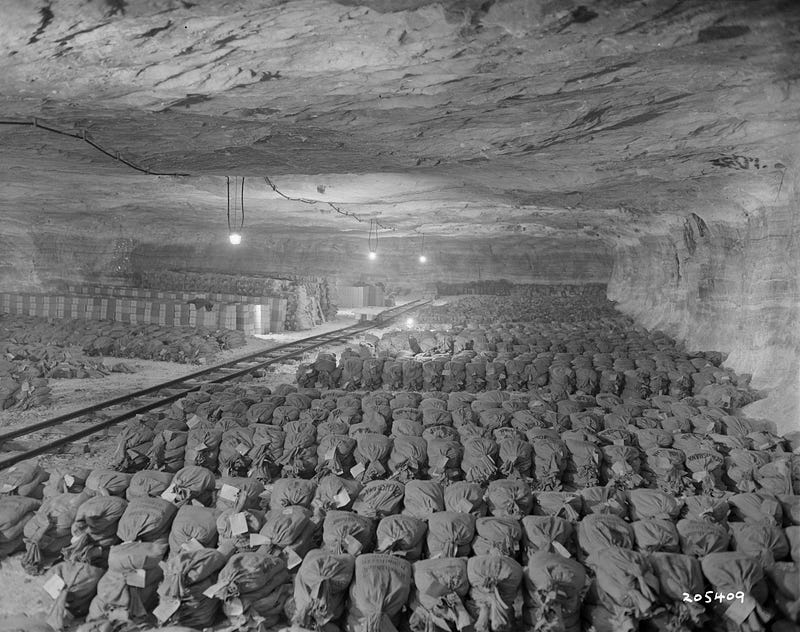
On April 12th, 1945, General George Patton escorted General Omar Bradley and Supreme Commander Dwight Eisenhower to a nondescript mineshaft in Merkers, Germany. The trio, three of the most powerful men in the world at the time, crammed themselves into a rickety elevator and descended over 1,000 feet into the Earth. At the bottom, a group of military police gawked as the generals strode by into the mine complex. Kaiseroda Mine was a potassium mine that had largely been depleted, leaving numerous tunnels and carved out caverns. It was one of many such mines that dotted the industrial heartland of Germany. But this particular mine was different.
Intelligence officers from Patton’s Third Army had stumbled onto the mine after interviewing a number of people from the local area. There were rumors that the mine had been used to store troves of Nazi gold. Such rumors were rife in Europe at the time, and many were skeptical. After a thorough investigation, the mine was found to be stuffed with treasure. Patton was shown the mine, and upon seeing the treasure, Patton immediately summoned Eisenhower.
What they saw in the Kaiseroda Mine was mind-boggling.
The Treasure
According to historian and writer Rick Atkinson, the Kaiseroda Mine was filled with a vast treasure that made up the bulk of the Nazis’ remaining wealth. The treasure was worth over $600 million in 1945 which equates to over $16 billion at current gold prices. Most of the gold was stored in a single room that measured 150 feet by 75 feet.
The room, dubbed Room Number 8, contained the following.
- 8,307 gold bars
- 55 crates of gold bullion
- 3,682 stacks of German bills
- 80 stacks of foreign currency
- 3,326 bags of gold coins
- 8 bags filled with gold rings
- A stack of platinum bars
The officers in the mine estimated that the entire treasure equated to 250 tons of gold, which adds up to $16 billion in 2024.
The always brash Patton said that the gold should be hammered into solid medallions and given to each member of his Third Army who had valiantly crossed the Rhine.
Omar Bradley turned to his fellow four star general and said:
“If these were the old free booting days when a soldier kept his loot, you’d be the richest man in the world.”
Here was the bulk of the remaining Nazi wealth, lying in neat rows under electric lights at the feet of Patton, Bradley, and Eisenhower. The presence of such a vast treasure alleviated Eisenhower’s worries of a prolonged Nazi insurgency. There were some who believed that the Nazi regime had plans to flee to the Alps and hold out in mountain fortresses indefinitely. But their treasure was not in the Alps; it was here in Germany, which meant that the Nazi regime likely had no plans of fleeing for the hills as many feared. They were going to die in Berlin.
Eisenhower denied Patton’s request to turn the gold into medals, but he did understand that such a treasure needed to be evacuated immediately. The Soviets were coming, and the Kaiseroda Mine was located in an area that was going to be turned over to Soviet control.
Where Did The Gold Come From?
During late 1944 and early 1945, the bombing of Berlin picked up to a pace not seen yet. Thousands of tons of high explosives started dropping on the German capital. Most of the Nazi’s gold was stored in the Reichbank in central Berlin, but when the bombs started dropping in earnest, a plan was hatched the smuggle the gold out. Much of the treasure was loaded onto double decker buses and trucks and snuck out of the city along with a flood of refugees. The gold was transported to the mine and secretly ferreted away behind solid steel bank vault doors deep in the Earth.
The gold was moved just in time. It wasn’t long before the Reichbank was struck by bombs and destroyed. The bank was reduced to rubble, along with all of the equipment used to print German currency. But the gold was already gone. The Soviets would then shell central Berlin and loot the city during their final attack, but again, they stumbled on very little gold.
Robbing The Soviets
Merkers was in a part of Germany slated for Soviet control after the war. That meant that the mine was going to be turned over to Soviet military authorities in short order. Eisenhower made sure that the mine was empty when the transfer finally occurred. In a plan dubbed AIRMAIL, thousands of tons of gold and equipment were covertly packaged and shipped westward under the guise of the movement of military goods. Along with the gold in the mine, the Allies also combed the countryside for intelligence officers, scientists, chemists, and engineers, who were also shipped deep behind American lines.
Eisenhower wasted no time. On April 14th, 1945, just two days after he arrived, 32 trucks were dispatched to the mine to begin rounding up the gold and shipping it westward. The gold was shipped to Frankfurt, where it was cataloged and dispersed.
The Soviets were not blind, nor were they stupid, and they protested what they saw as a blatant robbing of their rightful territory by the Americans. But there was nothing they could do about it. The Americans made off with the gold and everything else of value in the surrounding area before the Red Army could get their hands on it.
Footage and Other Treasure
You can see archival footage from the US army of the cataloging and transport of the gold out of the mine in 1945.
In addition to gold, coins, and currency, the mine also held other secrets. There were crates and crates of books, paintings, religious artifacts, and relics removed from cathedrals along with pieces of German cultural heritage. These important pieces of art and literature were stashed here for safekeeping and also fell into the hands of the United States.
The Value
The value of the treasure was worth billions in today’s dollars. The gold alone, 250 tons, was worth $16 billion. Each ton of gold is worth roughly $64 million today. In addition to the gold, there were sacks and bundles of foreign currency. There were also piles of valuable belongings, most of them taken from concentration camp victims.
Between the art, the possessions, the valuables, and the currency, the treasure was likely worth close to $20 billion.
Conclusion
The artwork, relics, religious pieces, and cultural heritage were turned over to various commissions for restitution and restoration of Germany after the war had ended. The gold was largely kept by the Americans, who likely used it to fund the restoration of Europe under the Marshall Plan. Records in the mine pointed to other similar tunnels and mines that held treasure, but none of the other treasures were likely as large as the one discovered in the Kaiseroda Mine. The Kaiseroda Mine treasure accounted for the bulk of the Nazi gold reserves in 1945.
The treasure remains one of the most remarkable things found during World War II, and it was lucky that it was found at all doubly so that it was found and ferried away under the wrathful noses of the lurking Soviets. This is just one example of how war sprouts thousands of stories of all kinds and stories that you would never expect.
Sources
- The Guns at Last Light, Rick Atkinson (2013), Pages 587–589