
How the U.S. Stole Half of Mexico’s Land
President Polk broke the promise of the Monroe Doctrine for gold and manifest destiny.
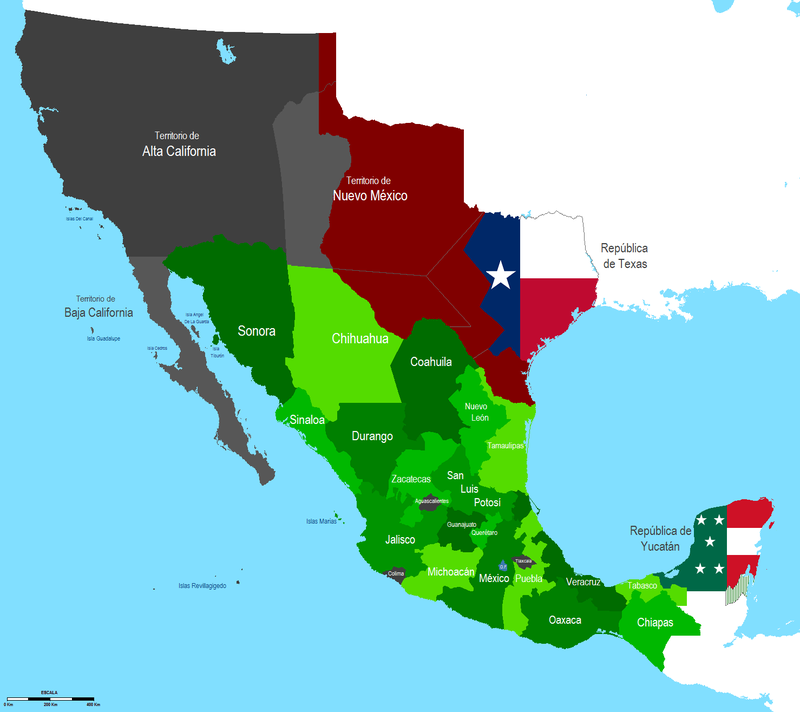
Before the 1848 Treaty of Guadalupe Hidalgo, Mexico’s landmass stretched well past its current northern border into what today is the American Southwest. Then, Mexico’s land included present-day California, Nevada, Utah, Arizona, New Mexico, Texas, and parts of Wyoming, Colorado, Nebraska, and Oklahoma.
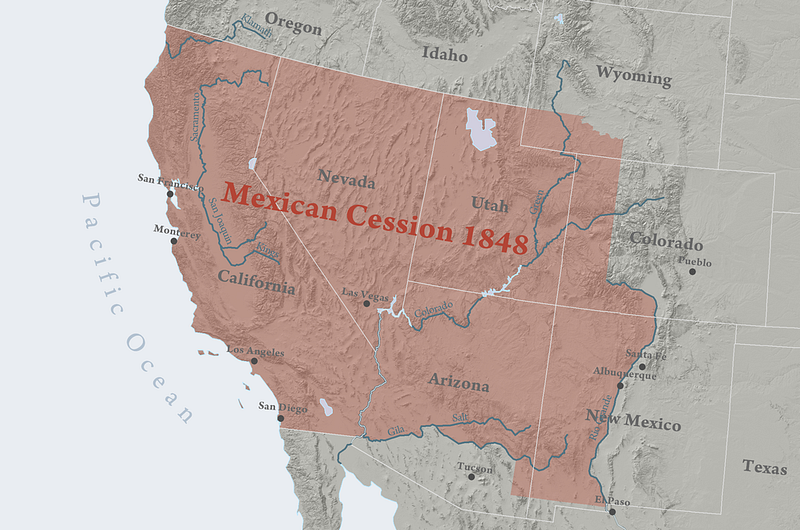
As a result of the treaty, Mexico had to part with all that land. The United States paid them for it—specifically, $15 million, plus $3.5 million in debt forgiveness. Thus, the Mexican government sold half of Mexico’s landmass for less than one year’s budget. It was a steal of a deal, but was the land stolen?
Setting the Scene
Mexico gained independence from the Spanish Empire with the Treaty of Cordoba in 1821. However, the central government of the sovereign nation faced many challenges both domestically and abroad. They were able to repel Spanish and French attempts to reconquer Mexican land but struggled to rule over the citizens of their vast territory. Moreover, government leadership was unstable and changed hands multiple times due to the significant influence of the Mexican military and the Catholic Church.
In 1823, President Monroe famously gave a speech known as the Monroe Doctrine. In his speech, he outlined what became the U.S.’s stance on European powers interfering with the nations of the Western Hemisphere. Any intervention would be considered an act of war against the U.S.
The United States in the 1800s had no problem taking land from American Indian tribes. The government saw them as unorganized savages who were a nuisance in the way of westward expansion. However, to take land from a sovereign nation would take stronger mental gymnastics to get Congress and the American people’s support.
President Polk and California
How did it all begin? What set the U.S. and Mexico on the path to the Treaty of Guadalupe Hidalgo? It all started with President Polk’s goal of acquiring Alta California from Mexico.
Alta California had thriving port cities, including Los Angeles, San Francisco, and San Diego. But Polk wanted Alta California the most because gold was discovered there. A fact that, according to Hogan, he unsuccessfully tried to hide from the Mexican government.
President Polk sent a delegation in 1845 to offer the Mexican government $25 million for only Alta California. However, the Mexicans were in a strong position then and refused to bargain with Polk.
Polk bided his time and waited for his opportunity. Polk knew it was worth the pursuit to complete the mission of Manifest Destiny, but he did not want the U.S. to appear to be “too much” of a hypocrite in light of the Monroe Doctrine. Polk was also correct that the presence of gold made California hugely valuable.
According to Abraham Lincoln and Mexico by Michael Hogan, the California gold rush that followed the U.S.’s acquisition of the territory produced $300 million for the U.S. in 1850 dollars. Thus, the return on investment of acquiring the land was immediate and astronomical.
Polk’s Opportunity
President Polk’s opportunity came in 1847. He managed to orchestrate a situation to allow the United States to attack Mexico. He claimed Mexico shed American blood on American soil when he knew it not to be the case. American troops got into a skirmish with Mexican soldiers near the Rio Grande river. The Americans were defeated handily, and although Mexico owned the territory where the battle took place, Polk found the angle he needed to insight war.
Polk’s propaganda paid off. As detailed by Hogan, a young congressman named Abraham Lincoln even accused President Polk of starting the Mexican-American War under false pretenses. Still, the public had already rallied to the President’s side. Although Lincoln was correct, standing by his morals cost him a lot of political capital. Lincoln’s political career limped through the 1850s until finally resurrecting in the 1860s. Lincoln, of course, became the 16th President of the United States.
Polk’s success in starting the Mexican-American War provided another opportunity. Polk could push for a lot more than just Alta California. He could conquer all of Mexico.
The Mexican-American War
With a superior army and navy, it would be a matter of time before the U.S. would defeat Mexico. Still, in the beginning, the Mexican government resisted peace talks despite defeats.
The Mexican government was dealing with uprisings within its borders, and fighting the U.S. was stretching the army thin. Nevertheless, U.S. forces aggressively pushed through Mexico and, in September of 1847, took control of Mexico City, Mexico’s capital.
Now an occupied nation, the Mexican government was forced to the bargaining table. This time, Mexican officials did not have a strong bargaining position. Their goal was to remain in power, not necessarily do what was best for the Mexican people. Therefore, the U.S. made the deal it wanted, and that treaty became the Treaty of Guadalupe-Hidalgo.
So why didn’t the U.S. take more of Mexico’s land? Polk’s goals were gaining control of the gold in California and completing Manifest Destiny, but there was another reason. According to Hogan, the U.S. did not want to deal with more native tribes. The U.S. considered native peoples savages and too big of a nuisance to add to their plate.
Aftermath
The 1848 Treaty of Guadalupe Hidalgo established much of the Southern border of the continental U.S., including the portions along the Rio Grande River. That border remains a contentious piece of the U.S.’s political landscape today.
The expansion of the U.S. continued, but the tumult plagued politics in the country. The divisions grew increasingly polarizing, especially around the issue of slavery, and the U.S. marched toward the inevitable Civil War. Mexico also had significant problems, experiencing internal wars and intervention from foreign powers.
The U.S., led by President Polk, conquered Mexico and took some of its most valuable resources, breaking the promise of the Monroe Doctrine in the process.
It is no surprise that resentment between the two nations was long-lasting. President Polk’s deceptive actions changed the course of history for the U.S. and Mexico. With the help of resources and wealth from the territory acquired from Mexico, the U.S. cemented itself as a world power. Mexico lost what the U.S. gained.
Did you enjoy reading? clap 👏, comment 💬, share 📢
✔ Join me on my writing journey by subscribing to my stories. Get them delivered straight to your inbox, and never miss a story.
✔ Use my link to unlock all the benefits of Medium and support me directly.
Thank you!


