
How the Rise of AI Language Models Like ChatGPT Could Be a Game Changer for SEO — Or Not?
We’ve all heard the cliché: “Content is King”. But what happens when that content is no longer crafted by the hands of human writers, but generated by artificial intelligence?
One such intriguing topic that’s been a subject of hot debate in recent years is the advent of Large Language Models (LLMs) like OpenAI’s GPT-4, which I’ve been closely following. We’ve reached a point where AI can generate human-like text, almost indistinguishable from content written by us, the Homo sapiens. And this, my friends, is where things start getting interesting from an SEO perspective.

A New Era: The Age of AI-Generated Content
Since the release of its earlier versions, I’ve had the chance to test and play around with ChatGPT. The potential it possesses in transforming the content creation world is mind-boggling. It can write articles, draft emails, write code, and even compose poetry! All of this, while adhering to the provided instructions, maintaining coherence, and most impressively, generating original content based on its training.
What Does This Mean For SEO?
As SEOs, we know that the quality of content is paramount. Google’s algorithms are designed to prioritize content that provides value to users, answers their questions, and gives them the information they’re seeking. But how will Google and other search engines view content generated by AI?
The Pros
Let’s first look at the positives. AI can churn out high-quality content at an unprecedented pace, which could help businesses keep up with the content demand. Moreover, LLMs like ChatGPT can be programmed to follow SEO guidelines, resulting in well-optimized content. AI can also leverage data insights to cater to audience preferences, increasing user engagement and potentially improving SEO performance.
The Cons
However, I believe there’s a counterargument to be made. Will search engines begin to prioritize human-made content over AI-generated content? Could we see the rise of a new ranking factor — human touch?
This isn’t a baseless conjecture. For years, Google has been emphasizing the E-A-T principle (Expertise, Authoritativeness, and Trustworthiness). It values content that has a credible human touch, empathetic understanding, and contextual nuances which, as of now, AI still struggles to fully grasp.
This could potentially lead to a situation where content generated by AI, no matter how good it is, might be at a disadvantage compared to content created by humans.
A Thought to Ponder Upon
In my years of working in SEO, I’ve learned to take an adaptive and anticipatory approach. It’s crucial to stay ahead of the curve and adapt to changes for consistent success. With AI’s foray into content generation, we might be on the verge of a major shift in content marketing and SEO.
This isn’t about demonizing AI or undervaluing its potential in revolutionizing content creation. However, I believe it’s worthwhile to consider how this trend might affect SEO practices, and whether search engines could evolve to distinguish AI content from human content, prioritizing the latter.
This conversation is by no means over. I’m eager to hear your thoughts on this topic. Will AI content be the future, or will the ‘human touch’ retain its throne in the SEO world?
I welcome any viewpoints, questions, or counterarguments you may have. Together, we can unravel the intricate tapestry of this digital revolution. After all, it’s through shared knowledge and lively discussions that we navigate these uncharted waters.
A Paradigm Shift: From SEO to AEO (Artificial Engine Optimization)?
A thought-provoking question indeed. Let’s delve deeper.
The quantity of data in our world is truly astonishing and continues to grow at an exponential rate. According to a projection by Statista, the amount of data created, captured, copied, and consumed worldwide is forecasted to reach a staggering 181 zettabytes by 2025. In this immense ocean of data, traditional search engines, regardless of their power, can only sift through a tiny fraction.
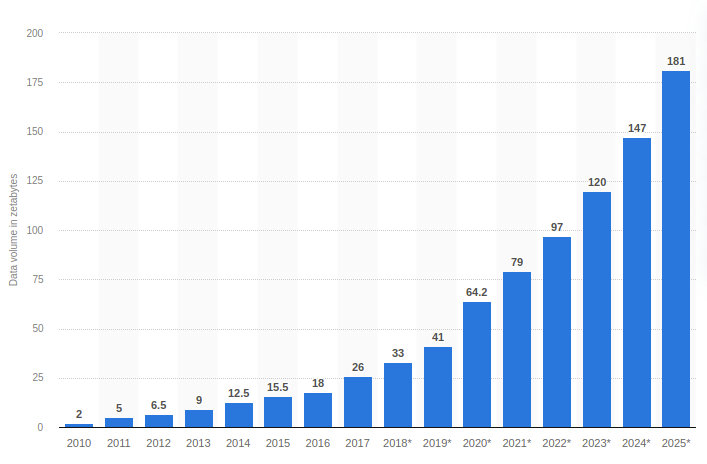
This is where AI, particularly LLMs, can redefine the landscape. Capable of processing colossal amounts of data, LLMs like ChatGPT can generate insightful, contextually relevant responses based on their vast training data.
Now, imagine a user seeking information or resources, and instead of typing search queries into Google, they interact with an AI model. The AI, leveraging its extensive dataset, could potentially provide more accurate, personalized, and context-aware results than a traditional search engine.
In this new era, the focus may shift from optimizing for search engine algorithms to optimizing for AI models, resulting in a transition from SEO to AEO — Artificial Engine Optimization.
The goal will no longer be about ranking on the first page of Google. Instead, it might become essential to ensure your content is part of the dataset an LLM is trained on, thus making it more likely for your content to be referenced in AI-generated responses.
Of course, this is a forward-looking speculation. But given the pace of AI development, such a future doesn’t seem too distant. And this could redefine our strategies, pushing us to adapt once again in the ever-evolving digital landscape.
What are your thoughts? Can you envision a shift from SEO to AEO? I look forward to your insights as we explore this fascinating possibility together.
Wrapping Up
In conclusion, while the rapid advancement of AI and LLMs like ChatGPT presents vast potential for SEO and content generation, it’s essential to ponder the implications and possible shifts in how search engines might perceive and rank AI-generated content. The digital world is on the precipice of a new era, and as always, those who adapt will thrive. The SEO game isn’t getting any easier; in fact, it’s becoming more interesting than ever. As we continue to explore this new frontier, I look forward to sharing this journey with you, learning together, and thriving in this exciting digital landscape.
Thank you for reading, and I eagerly await your thoughts in the comments section below. Let’s continue this fascinating discussion.
- What Exactly Is E-A-T & Why Does It Matter to Google?
- Mastering SEO in the Era of Large Language Models: Evolving Tactics for LLM-Powered Search Engines
- SEO in an LLM World: How Will AI Tools Impact Web Optimization?
- SEO is Dead, Long Live LLMO
- Volume of data/information created, captured, copied, and consumed worldwide from 2010 to 2020, with forecasts from 2021 to 2025
Enjoyed the read? For more on Web Development, JavaScript, Next.js, Cybersecurity, and Blockchain, check out my other articles here:
If you have questions or feedback, don’t hesitate to reach out at [email protected] or in the comments section.
[Disclosure: Every article I pen is a fusion of my ideas and the supportive capabilities of artificial intelligence. While AI assists in refining and elaborating, the core thoughts and concepts stem from my perspective and knowledge. To know more about my creative process, read this article.]