
How the Rhythm of the Breath Activates Different Areas of the Brain
From brainwaves to hormonal secretion, learn what the breath does to the brain — and how to work it daily to produce beneficial outcomes

From the outside, the structure of the brain is simple.
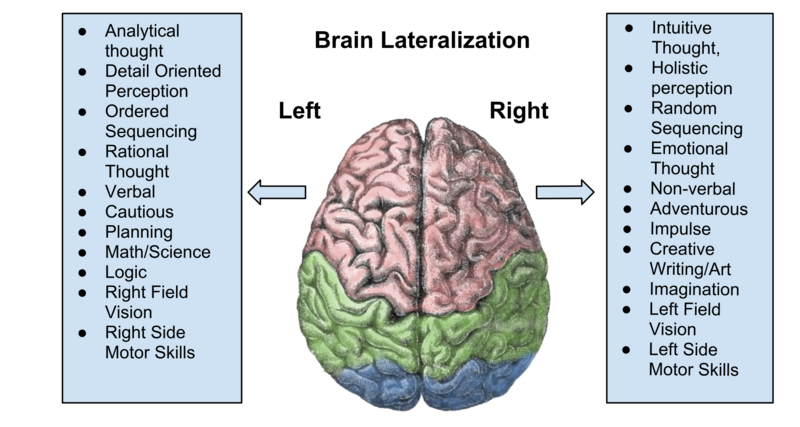
It has two hemispheres that serve different functions. The right side is all about creativity and intuition while the left is more cognitive and analytical. Strangely though, nearly all of the signals from the brain to the body and vice-versa cross over— meaning the right hemisphere primarily controls the body’s left side while the left hemisphere controls the right!
As perplexing as this is, these two hemispheres are in constant dialogue with one another, sending data back and forth via 86 billion neurons.
Neurons use electrical impulses (thoughts) and chemical signals (emotions) to transmit information between different brain areas and the rest of the nervous system.
When these neurons start oscillating together they create brainwaves.
All brainwaves are produced by synchronized electrical pulses that come from neuron masses. These neurons then create neural circuits whose neural pathways generate our thoughts, emotions, and memories.
Interestingly, the breath can reflect the brainwaves’ qualities and characteristics. So, we can use the breath to guide us closer towards and through them, effectively elevating our emotional state and well-being if and when we need to.
“For most of us, the brain is locked into a particular level of functioning. If we ultimately speed up or slow down the brainwave activity, then it becomes much easier for the brain to shift its speed as needed.”
— Harold Russell (A clinical psychologist at the University of Texas)
To get a visual of how these brainwaves may look in real time, check out the below chart.
Notice the five different brainwave groups found in the brain. Pay close attention to when they are most active — and the shape, speed, and qualities of each wave.
Can you guess which brainwave group is active in our day-to-day life?
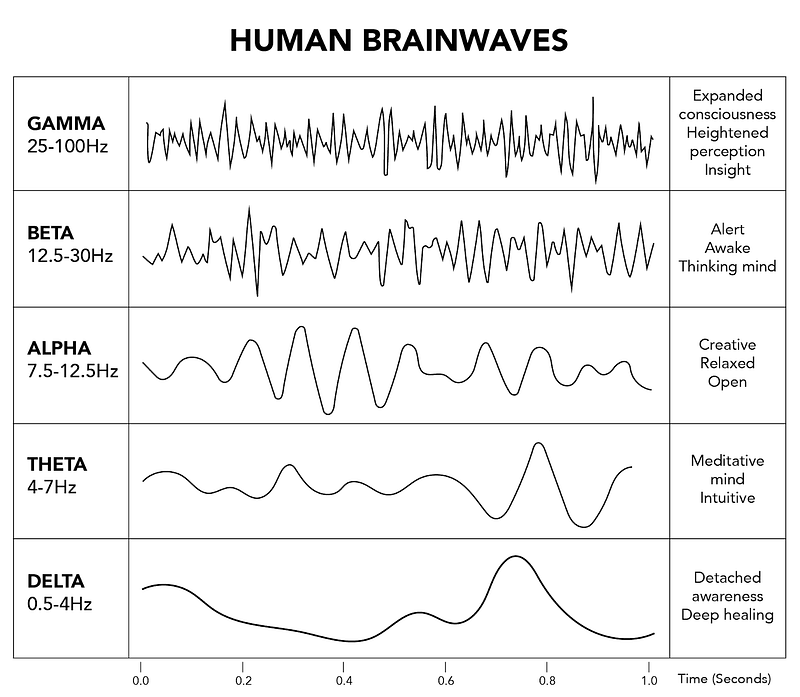
If you guessed beta brainwaves (alert, awake, thinking mind), you’d be right.
That’s because their characteristics are incredibly helpful when navigating the modern world. They help us drive cars, attend meetings, read books, prepare food, wash dishes, follow conversations, etc. That’s why they’re often a little quicker, more scattered, and can operate without breath awareness.
To go from beta to alpha brainwaves, we must calm our breath.
That’s because, like the heart and nervous system, the speed of the brain is also influenced by the speed of the breath. So by slowing the breath down our brainwave activity will also slow down.
- Heart-coherent breathing (inhale for 4 seconds, exhale for 4 seconds) works very well here, as does box breathing (inhale for 4 seconds, hold for 4 seconds, exhale for 4 seconds, hold for 4 seconds).
Other ways to experience alpha brainwaves include spending time in nature, listening to music, reading, exercising, socializing, artmaking, playing games, getting a massage, making love, and sharing food with loved ones. Anything that relaxes the mind and body does the trick.
To go from alpha to theta brainwaves, we must enter a meditative state.
So, naturally, slowing the breath down even further will encourage theta brainwaves more easily.
- A great exercise to practice here is a 4:8 breathing pattern (inhale for 4 seconds, exhale for 8 seconds) as this will soothe and relax the nervous system.
- Another breathing exercise to consider is a 4:7:8 pattern — inhale for 4 seconds, hold for 7 seconds, exhale for 8 seconds. This has been scientifically proven to have a calming effect.
- Try not to get hung up on the number of seconds you breathe here though. If inhaling for 3 seconds, holding for 5 seconds, and exhaling for 6 seconds — aka a 3:5:6 pattern (or any other alternative) works better for you, then follow your body’s wisdom and adjust accordingly.
- Other ways to experience theta brainwaves include deep meditation, chanting, sound healing, binaural beats/brainwave music, hypnotherapy, and more.
Next in line are delta brainwaves.
However, they are more commonly experienced during deep sleep when the breath is very slow and soft. So, they’re the least relevant when working with the breath in waking life.
- If you’d like to learn more about them, checkout dream interpretation work, hypnotherapy, and/or other processes that are similarly interesting in the dream world. This will then provide you with a more direct approach.
Lastly, we come to gamma brainwaves or the upper frequencies of the mind.
Gamma brainwaves require a relaxed mind (alpha or theta brainwaves) and an energized body so they’re more commonly experienced during longer breathwork sessions and/or more intense breath control practices when the breath is deeper and/or faster.
- MDMA, Psilocybin, and other psychoactive substances have also been known to activate gamma brainwaves, as has deep meditation (known as Samadhi in Hinduism and Buddhism), tantric lovemaking, dark room therapy, trance dances, and more.
They’re the rarest of brainwave groups to experience but those who have often say they’re profound.
The Importance of Cerebrospinal Fluid (CSF)
Cerebrospinal fluid is a clear, colorless body fluid that’s found within the tissues surrounding the brain and spinal cord of all vertebrates. Its main functions are:
- Buoyancy: The actual mass of the human brain is about 1400–1500 grams but when suspended in CSF it reduces to a mass of 25–50 grams. If CSF was not present, its weight would cut off the blood supply and kill neurons in the lower sections of the brain!
- Protection: CSF protects brain tissue from light to medium injury/impacts. It does this by providing a fluid buffer that acts as a shock absorber.
- Homeostasis: CSF regulates the body’s temperature, blood pressure, and pH levels by carrying important messages up and down the spine and between brain cells all day long.
- Clearing waste: The brain and spinal cord are constantly cleansed by the rapid creation and absorption of cerebrospinal fluid as it removes toxins and impurities as it goes. If this ever goes awry, CSF can become toxic. This is particularly important as we age because the pressure of CSF can decrease — and result in impaired brain function such as fatigue, depression, and anxiety, and later to neurodegenerative diseases such as Alzheimer’s, Parkinson’s, and ALS.
Cool fact: The entire volume of CSF is replaced 3–4x a day!
A few more important things to note:
- A build-up of stress has been linked to a reduction of CSF while exercise is a great way to get it moving. Exercise also provides a low-dose jolt to the brain’s reward centers — responsible for helping us anticipate pleasure, feel motivated, and maintain hope.
- So, as regular exercise builds this reward system up, there are higher circulating levels of dopamine and more available dopamine receptors.
- Moreover, CSF flows better because our heart pumps faster, our breath breathes deeper, and heat and perspiration rise. As a result, we generally feel happier and healthier.
“It has been established that deep breathing increases the influx of cerebrospinal fluid into the brain and that subsequently holding your breath increases cerebral blood volume”
— Mauro Zappaterra, MD
2 Hybrid Breathing Exercises to Cover It All
Below are two breathing exercises that hold different intentions — one slows everything down. The other speeds everything up.
Exercise #1 — Box Breathing
Box breathing is great for building emotional resilience, relieving stress, and creating a calm inner state. It has gained tremendous popularity in recent years ever since the Navy SEALs revealed it is what they use to cope with stress.
- Breathe in deeply and smoothly through your nose for 4 seconds
- Hold your breath at the top for 4 seconds
- Breathe out softly and calmly through your nose for 4 seconds
- Hold your breath at the bottom for 4 seconds
- This is one complete cycle
- Continue for 25–50 breaths or 5–10 minutes
- To deepen the experience, increase the number of seconds you breathe in and out and hold for (5 or 6 seconds, for example) — if you can.
Exercise #2 — The Silent Pump
This exercise does a bit of everything — it gets the diaphragm pumping. It activates the digestive system and strengthens the lungs. It increases blood circulation and boosts CSF.
I enjoy doing this one in the morning before eating breakfast but it can also be practiced anytime during the day as long as it’s done on an empty (ish) stomach.
As with all breathing exercises, notice how you feel before and after practicing them.
- Sit comfortably with your back straight
- Breathe in deeply through your nose
- Exhale deeply through your nose or mouth and then hold your breath
- Begin to quickly but smoothly pump your diaphragm 15x while holding your breath
- When you’re complete, relax your diaphragm and inhale deeply through your nose
- Exhale and repeat
- Continue up to 10x
- Once established and comfortable, try pumping your diaphragm 20 or 30x with each breath hold.


