

How the Reward Function Is Shifting From Static to Pro-active Decisions Thanks to AI
A seasoned HR practitioner recently proclaimed that Artificial Intelligence (AI) and Analytics are just hyped-up trends and words invented to apply traditional statistics to more data. But this statement is untrue. It is a little like saying that Einstein’s relativity is just Newton’s rules applied to very large or fast-moving objects. However, the equations of these two scientists contradict one another, just as traditional statistics and machine learning serve different scientific purposes and are technically incompatible in many ways.
With regards to the HR function, since AI breakthroughs can only be understood technically, HR needs to express them in terms that can be understood for practical business decisions. As these mega trends in AI and Analytics will inevitably have an impact on the Rewards function, HR needs to know which part of its compensation philosophy, strategy, or design work is no longer relevant when so much more is made possible by technology.
The bottom line is that the Rewards function needs to be more forward-looking to spot trends and job premiums, rather than traditionally looking backward to recommend competitive market pay (particularly for hot jobs) to attract and retain talent.
What the Terms Really Mean
It helps to begin by clarifying these terms in light of the current confusion among them. When Business Intelligence (BI), AI, and Analytics are keyed into Google, the results are 74 million, 110 million, and 1.6 billion, respectively.
- AI, or machine intelligence, simply put, describes machines that mimic cognitive functions that humans associate with other human minds, such as learning and problem solving. Machine learning and, therefore, machine intelligence have made accurate predictions possible due to the availability of a huge amount of big data today, thanks to technology.
- BI, a technology-driven process, analyses data and presents actionable information to help business users make informed decisions. When information comes from a larger variety, volume, and speed, these tools are quintessential in helping professionals understand and appreciate this emerging field, the new jobs that surface, such as BI Analyst, and the market value they fetch.
- Analytics, in essence, allows the integration of a variety of a company’s data from various systems to enable real-time sharing of data among practitioners who need such data to make relevant decisions. Analytics, when ill-defined or loosely defined, just means pattern identification, leading to many non-technical professionals concluding prematurely that it is just another hype created.
Emergence of BI Jobs in the Rewards Function
The Rewards field, traditionally bound to Analytics, is increasingly driven by data-science in the name of HR BI. Rewards management needs to don a new form that incorporates real-time data and unbiased machine insights to be more effective — an effort that supports attracting and retaining valuable talent and requisite skills. Traditionally, backward-looking survey data is the sole authority for benchmarking salaries. Even today, with the exception of a few technology-savvy companies, HR performs year-on-year salary trending and projections with trepidation, without the backing of solid real-time insights. This method puts conservative companies on a downward spiral, as they will never see a need to reskill existing talent or raise their pay points acutely for new jobs, such as the BI Analyst, whose responsibilities include:
- Producing financial and market intelligence by querying data repositories and generating periodic reports.
- Devising methods for identifying data patterns and trends in available information sources.
Viewing the real-time and unbiased machine-learned pay trends of this emerging field of jobs illustrates the need to monitor acute movements in pay. It is not an accident that our real-time sensing of pay trends, using AI technology, detected that this particular job (BI analyst) ranks the highest among all hot jobs. Yet, many companies are unaware of this acute need to pay attention in developing or buying talents for such skill sets, let alone reskilling current valuable employees and paying them competitive salaries.
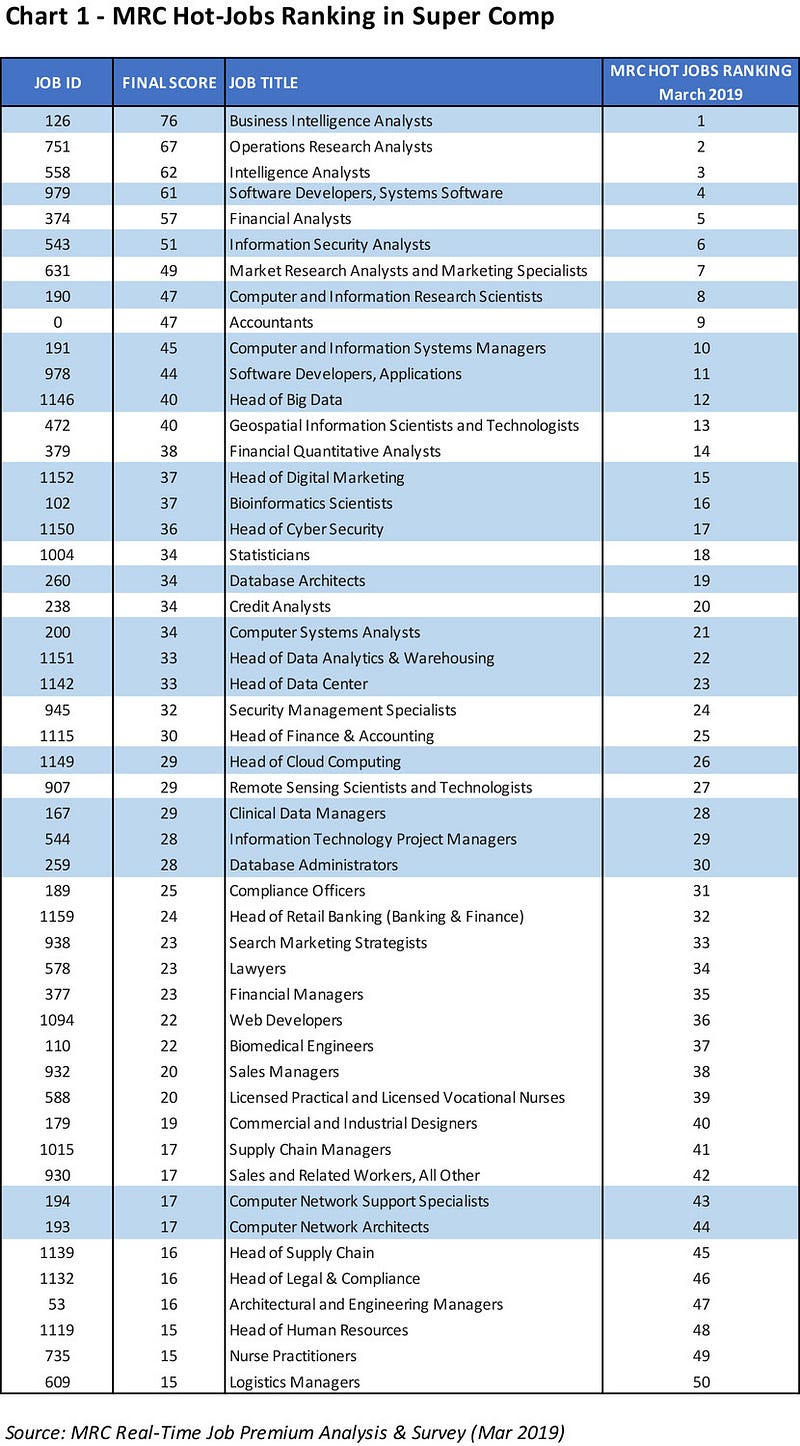
Chart 1 represents a sample of the real-time ranking of hot jobs observed by our AI technology, based on our unique methodology that rates the credibility of the pay data sources, their geographical coverage, and the degree to which job profiles can be standardised and matched. To optimise the value of the data for HR professionals, we collected company data from three diverse sources:
- The latest post-pay increase cycle (mostly, January 2019 to date)
- Job portals that provided job posting information
- News sources discussing hot jobs in various countries
Depicting evidence for rapid movement of pay trends by location, our real-time hot-jobs analysis also considers fresh data coming into our AI-powered compensation system immediately following our clients’ merit increase cycles. The bottom line: Real, practical, and valuable information for pay and job analysis decisions.
Job Premium for BI Analyst
Our analysis expects the salary for the BI Analyst job to increase by 4.95% to 10.15% over the next nine months. The movement of this number-one ranked hot job offers a significant contrast to an out-of-the-top-50 ranked job, Shop Development Manager.
A fresh graduate specialising in BI can receive around SGD 43,000 per year and expect a 13% pay increase annually over 10 years, conceivably reaching SGD 140,000. In fact, our study predicts that the general-industry median annual base salary movement of the BI Analyst is expected to grow from SGD 94,550 to SGD 104,146 from 1 February 2019 to 1 December 2019. The salary of a BI Analyst is already higher at SGD 94,550 than that of the Store Development Manager at SGD 88,454 as of 1 February 2019. In addition, the Store Development Manager salary is only expected to grow between 2.49% to 5.04% up to SGD 92,912 by 1 December 2019, further widening the gap between the two jobs.
Implications for Rewards Professionals
For HR, static presentations based on historical data will soon be a thing of the past. Tools such as Microsoft Power BI and Tableau will become inextricable in the future due to the need to quickly provide answers — supported by real-time data and data-reactive presentations — to leadership. The role of Rewards is bound to shift from annually analysing static data to analysing a real-time moving prediction backed by a wider variety of credible external data.
For optimal results, it is time for HR to tap on AI tools to track and clean transparent data supporting decisions on pay movements and relativity across jobs. This trend is occurring within an increasing granularity of job profiles, geographical scope of coverage, and variety of information platforms — all positive signs of intelligent progress and more effective tools to help attract and retain valuable employees.
This article is a condensed version of the article, Business Intelligence and Rewards — Real-time Detection of Rising Job Premiums, first published by MRC (Management Resources Consultants) and sparkChief & Co. in the February 2019 edition of Executive Business Intelligence.