
How the Qing Dynasty influences Xi Jinping and the Chinese Communist Party
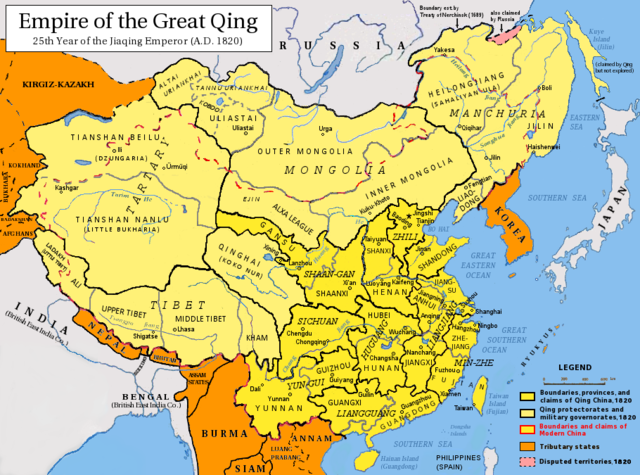
The sprawling Qing Dynasty (1644–1912) marked China’s zenith in the 18th century before a cataclysmic mid 19th century brought its collapse. There are two ways the Qing Dynasty influences the PRC (People’s Republic of China) of today: territorially and politically.
Modern China is a curious nation from a territorial point of view. In 1900 Britain’s borders stretched from South Africa to Egypt and Australia. France’s holdings stretched from Algeria to Indochina. Both nations have now lost all their colonial holdings aside from small islands and territories. In contrast, both China and Russia have similar borders and territorial masses to their territorial peaks under their respective empires (the Qing Dynasty and Russian Empire).
China’s current claim on Taiwan stems from the Qing. Formosa (now Taiwan) was a Qing territory that was ceded to Japan in the First Sino-Japanese War. That war is part of what is known in China as the ‘Century of humiliation’ beginning with the First Opium War (1839–42) and ending in 1945. President Xi Jinping sees an antagonistic West as was the case during the Century of humiliation. In 2015 he told top commanders “Beyond doubt, our country’s growing strength is the most important factor driving a profound readjustment of the international order (…) Some Western countries absolutely never want to see a socialist China grow strong under the leadership of the Chinese Communist Party”. Unifying with Taiwan would be a devastating blow to the American led world order currently antagonising China and would return China to the rank of preeminent power in the Asia-Pacific region as it was under the Qing in its most powerful period.
The Qing influence on Chinese politics is slightly odd; the Chinese Communist Party avows its anti-imperialist credentials yet essentially duplicates elements of Qing governance. Mao essentially claimed the divine authority, the status as ‘sons of heaven’, that the Qing claimed. This provided the basis for Communist dictatorship. The long dead Qing Dynasty mirrors modern China to a surprising extent.