
How The Protestant Reformation Created Witch Hunts
Were medieval peasants more enlightened than we give them credit for?
An enduring cliché of medieval history is that superstitious and vicious peasants hunted down witches with pitchforks. It’s a beautifully vivid way of illustrating the backwardness and absurdity of life in the Middle Ages.
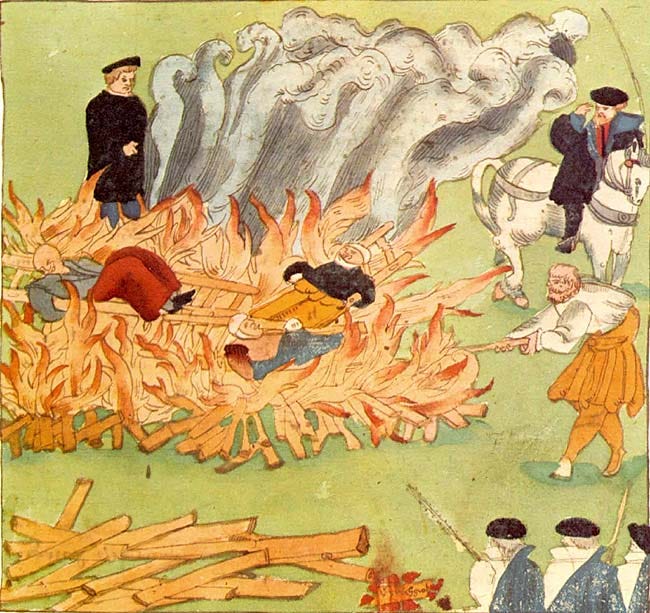

Like many medieval tropes, however, it largely isn’t true. Witch hunts did take place in the 1,000-year period we call the Middle Ages, but they were uncommon and small in scale.
Prosecution and murder of pagans certainly did happen, and pagans were often associated with dark magic, but as the Middle Ages progressed and Christians killed or converted the remaining pagans, perceptions of witchcraft evolved.
Authorities increasingly distinguished pagans and heretics from sorcerers and witches — even in the Middle Ages, educated people viewed overt magic as being rather far-fetched.

The classical image of witches placed them within the wider Christian world, in the sense that they supposedly worshipped Satan. Popular wisdom held that they took part in dark ceremonies that were like twisted parodies of the Christian mass, using stolen communion wafers and involving animals in these rituals.
They could fly using broomsticks, summon demons, curse people, and were strongly associated with motifs like black cats. Hollywood, in this rare case, has done their homework fairly well.
And medieval Europeans did seem to believe in witches. We know this from the many edicts and teachings from the Church and various kings telling the public, in no uncertain terms, that they better not get involved in the witch-burning business.
If you have to tell someone to shower every few days, they probably aren’t washing enough — and if medieval rulers had to tell the plebs every few decades not to believe in or hunt witches, the plebs were probably doing exactly those things.
In medieval Europe, witches were typically associated with crop failures, disease and extreme weather events. Suspicion of witches did sometimes make it into law; although many contemporary kings dismissed witchcraft as nonsense, others like Charlemagne and Athelstan proscribed short prison sentences or periods of forced labour for those practising witchcraft.
Yet popular hatred and suspicion of witches were frowned upon and sometimes furiously condemned by the Christian Church establishment. As early as the Council of Paderborn in 785 AD, the Church decreed death for anyone who burned a witch — that’s right, the Church was punishing witch-hunters rather than witches.
The persecution and killing of witches is popularly associated with the Inquisition, but the Church actually made a point of ignoring cases involving sorcery, on the grounds that witchcraft and sorcery were not real, and were merely representative of misguided peasant superstitions. Even if someone was possessed by a demon, driving it out was as easy as invoking the name of Christ, so why bother hanging and burning people to get rid of it?
On the occasions that someone was punished by spiritual or secular authorities for witchcraft, it usually involved a more serious crime too, like killing babies or worshipping pagan gods. Christians who had psychotic fits or used herbs in healing rituals were generally left alone, and when superstitious mobs did target them, the witch hunts were received with a good deal of skepticism by the authorities.
One letter from 1080 between Pope Gregory VII and King Harald III of Denmark helps explain why the Church was so wary of witch-hunting. In the letter, the Pope is ordered not to let old women or Christian priests be held responsible for storms and diseases. The connection is clear: the Church worried that if they let peasants kill people for their alleged supernatural powers, those peasants might violently hold the Church responsible during hard times.
The real Golden Age of Witch-hunting happened in the early modern period, roughly from 1450–1750. At the beginning of this period, Europeans were starting to colonise the other continents, the printing press was a new sensation, and the formula for concrete had recently been rediscovered; by the end of it, the steam engine, hot air balloon and Kentucky rifle had all been invented.
During this surprisingly modern period, around 40,000–60,000 “witches” were executed after perhaps 110,000 trials. So why did the emergence of the modern world lead to such an explosion in witch-hunting? Why did the Renaissance and early modernity, with all of their artistic and technological progress, coincide with this era of terror?
The most compelling explanation is that witch hunts exploded because of the inability of the Catholic Church to reign in the pitchfork-wielding mobs any longer.
Events like the Black Death and the beginning of the Little Ice Age are sometimes credited with spurring the witch hunts, and perhaps they were factors, but mass witch hunts didn’t begin in earnest until generations later.
One major event quite chronologically close to the peak of the witch hunts is the Protestant Reformation, and this link is also backed up by geography — while most witch hunts took place in France until the 14th century, the Golden Age was marked by Germany becoming their new hot spot, followed by Scotland and Switzerland; all were centres of the Reformation.

Virtually all European witch-hunting was located in regions which were at the heart of the new religious wars, while witch hunts remained reasonably rare in places where Catholicism and Eastern Orthodoxy remained virtually unchallenged, like Spain, Poland, and Eastern Europe.
Should we take that to mean that the new Protestants were being massacred as witches? Or perhaps it indicates that they were more zealous in their pursuit of witches than these older religions had been?
There’s probably a bit of both at play, but recent historical research proposes that witch hunts surged as a result of a religious free market. Commoners had always believed in witches while their rulers expressed skepticism. Now that priests and princes had to compete for followers, it became logical for each side to compete over who could hunt witches more effectively.
Additionally, the Reformation caused a serious crisis of faith for European Christians. Before it, everyone knew they had the right answer when it came to religion.
Sure, there were those Orthodox infidels over in Russia, and those Muslim barbarians in Asia and Africa, but a German farmer in 1300 did not generally question his own spiritual convictions or the local clergy too closely. He trusted his neighbours too — after all, they were just like him.
With the Reformation, everything changed. The cheerful woman who lived just down the street might look like you, talk like you, work the same job as you, and be like you in every way — but she might also be a secret heretic. Suddenly, everybody you knew was morally suspect, even close friends and family.

And perhaps you even began wondering if the new Protestants were right — and if so, could the priests you’d always respected be trusted to ward off demons? Perhaps they were possessed by demons themselves! It is hardly surprising that such a crisis of faith coincided with one of history’s greatest mass hysterias.
It’s also worth remembering that the Reformation did not happen just because Martin Luther stapled some parchment on a Church door; the rapid spread of Protestant ideas was only possible because:
- The public was aware that the Catholic Church was a deeply flawed institution, rife with corruption and decadence
- The end of the feudal era was disrupting the traditional fabric of life. With the end of serfdom came a more competitive economy, one with winners and losers and no guaranteed roof over your head. New technologies like the printing press, and the profound consequences of colonialism and the “New World” forced people to grapple with meaningful economic change for the first time in nearly 1,000 years

In the decades following the Salem witch trials, these hunts largely disappeared, although people are still murdered for being witches in Papua New Guiney and many African nations today. It is thought that more people were killed globally for witchcraft in the 20th century than in the entire period between 1450–1750 in Europe.