
How the Old Folks Shopped
And how the New Folks still do at Cleveland’s Famous Westside Market
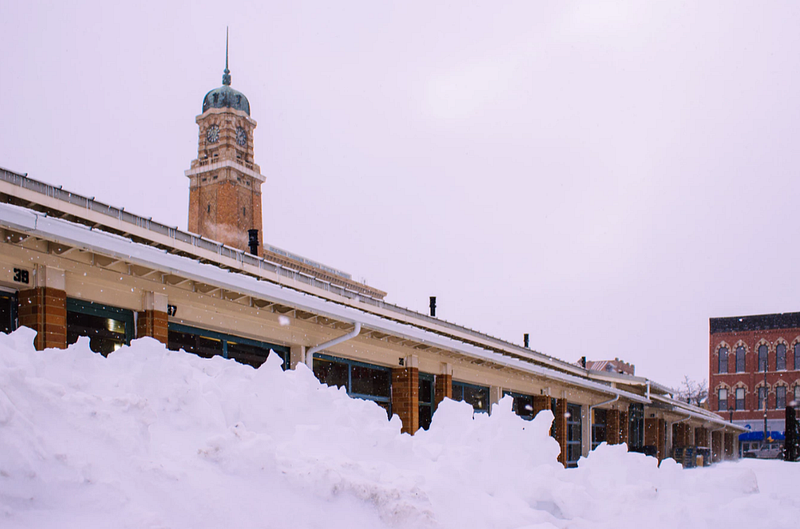
In the winter of 1999, I was studying journalism at Case Western Reserve University with investigative reporter, Ted Gup. One of our assignments was to reach out to a local professional and ask to shadow them for a day. That’s how I found myself trotting along behind Eric Williams who was then the executive chef for the very popular new Ohio City eatery, Johnny Mango.
That first snap of winter pushed dirty leaves and paper around the scattered melon rinds, squashed tomatoes, and cigarette butts that littered the ground outside the long, tarp-covered arcade where vendors sold produce. It was a Saturday afternoon at Cleveland’s famed Westside Market. Men with flashing dark eyes offered juicy pieces of pineapple and melon from the ends of sharp knives; fierce grandmothers elbowed the tourists and the slow out of their way to inspect the mushrooms and asparagus; a skinny kid with a pierced nose and tattoos climbing up his neck argued over a mound of apples. Down further, five-gallon buckets overflowed with carnations, chrysanthemums, and daisies. There were kids everywhere.
Seventy years ago this scene would have been played out in a hundred cities in dozens of countries. In today’s global economy, the Westside Market is among the last of the big, old-style permanent open markets. Unlike the tourist attractions found in other cities, The Market (as regulars refer to it) caters to its city, not to visitors. That said, it still attracts many tourists, even those coming in from Strongsville or Berea or Wickliffe for the day.
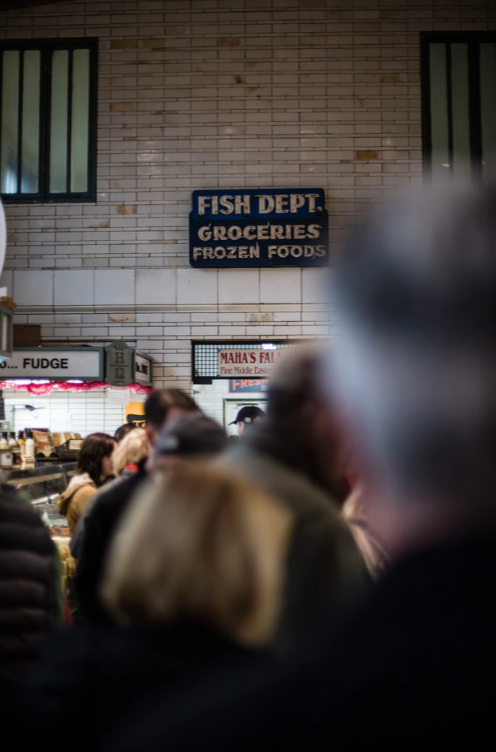
The variety of goods is staggering. Over one hundred vendors offer everything from traditionally prepared ethnic sausages and pastries to exotic spices and hot sauces. There are fresh dairy products, aged prime cuts of every kind of meat, glistening fish, fancy delicacies, hand-made pastas, every imaginable vegetable and fruit, mounds of aromatic breads, candies in shiny wrappers covered in Cyrillic words, coffees and teas from nearly every continent, dried apricots and mangos and apples and bananas, bins of nuts, and more that I can’t remember anymore. Each stand has its specialty and over time the vendors get to know their regular customers and make sure to have what they like in stock. And there wasn’t a vendor in the place who didn’t love when the chefs came shopping.
Eric Williams was committed to maintaining the already top reputation Johnny Mango enjoyed. The tiny restaurant, specializing in Mexican, Asian, and Caribbean foods, opened shortly before I moved away from Cleveland, but I loved the place and often went there with friends. It’s still a vital part of the Ohio City neighborhood, a snug little inner-city enclave just west of the Cuyahoga River. On an average week, Chef Williams would spend hundreds of dollars at the Market, buying only organically grown produce (that he insisted on inspecting himself) and a variety of other ingredients for the menu. Knowing exactly what he wanted, Williams moved quickly through the crowds.
Out in the produce arcade, he approached Ayham Abazab who immediately pulled out a pad of paper and pen when he saw Williams. Abazab’s stand had been open for seven years, making him a relative newcomer to the Market. Writing quickly, Abazab assured Williams that the cases of produce would be waiting on a pallet within half an hour.
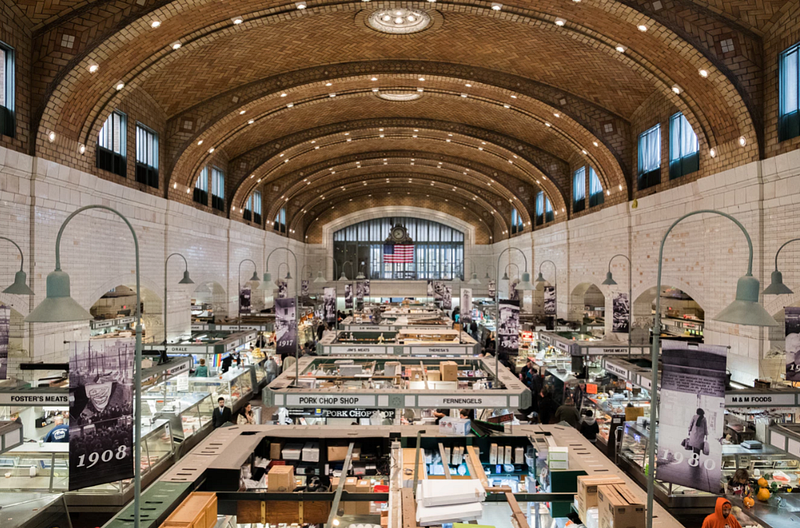
A quick stop by Romano’s produce stand to order out-of-season mangos and then it was time to move indoors. Inside the echoing, cavernous main building voices and laughter bounced around. It was warm and bright and smelled wonderful. Vendors leaned over counters to better hear customers.
Meister’s dairy stand had been there forever. Ed Meister joked with several customers simultaneously while weighing chunks of Parmesan cheese. For 22 years Meister’s had offered what Williams considered a consistently good product. In addition to Meister himself, the tiny stand is staffed by a trio of laughing young women. Williams hefted a large box of feta cheese and moved on to the next stand.
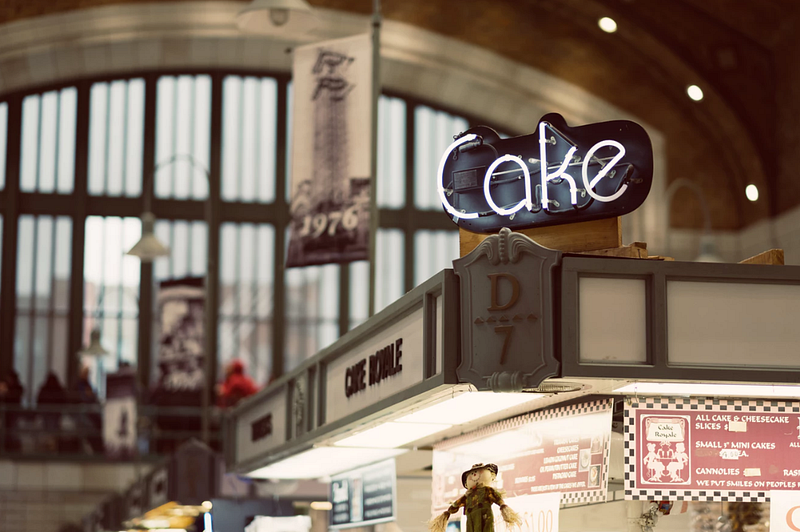
Ohio City Pasta had a stand there (and still does) as well as having several other locations around town including a place in the food court up at the old Halle Building on Euclid Avenue. Pausing to talk, Gary Thomas, wiped his hands on his apron and talked about loving his job. “You never know from day to day what will happen in here. It’s great!” He’d begun seeing an increase of tourists in the past several years, as well as what he called “adventurous diners” coming in from the suburbs. A market cannot survive as a tourist attraction, he maintains; unless it offers what the local community needs and wants, it will not last. The only other place Thomas had seen a Market like this one was in Florence, Italy.
The Westside Market opened in 1912. A commission to draw up plans for the Market was appointed by the city in 1898. The fourteen years between inception and completion were dominated by political squabbling which only subsided in 1910 when construction began. The reported cost: $710,000. The opening of the Market was celebrated with a band concert, parades, masked carnivals, and endless speeches.
The fourteen years of political infighting that preceded the actual building of the Market was being played out again 87 years later as this generation of politicians wrangled over how to modernize the old building.
For decades, produce vendors huddled around space heaters and blew on their freezing fingers with only heavy, black tarps between them and the elements every winter. Construction had finally begun on enclosing the produce arcade as I was starting to get crazy ideas about moving to New York City.
Meister’s is still there as well as Ohio City Pasta and dozens of other long-established vendors. Johnny Mango is still a destination. It’s kind of haunting how little has changed in the 18 years since I left and shocking to make a turn onto West 25th Street where so much has changed. The White Castle where we used to hang around the payphone in the parking lot waiting for very important calls is gone. The old motel that used to be a shelter for battered women is also history. That there is a place selling artisanal gelato on West 25th Street is blowing my mind.
And anchoring that whole part of the city is the Westside Market. Its 137-foot tall clock tower remains a landmark and now the Market is open on Sundays. There are whole generations of new customers who frequent the Market who moved there or were born since I left. They are among an estimated million annual visitors who find the same warmth, deliciousness, and vitality that I so treasured when I lived there.
As long as I can afford it, I intend to stay put in New York City. But with zero retirement savings and the prospect of having to make do with Social Security and part-time work down the road, I wouldn’t rule out moving back.
But then I wouldn’t rule out moving to Tucson either (no winter).
© Remington Write 2019. All Rights Reserved.