
How the Notorious Number Pi Controls the Bendiness of All the Rivers in the World?
During a period in my university life, nothing seemed to be going my way, and whatever I did, something was always missing. While solving a math problem one day, I struggled to get the solution I wanted because of pi’s irrational value. I thought to myself, “If only pi (π) was a rational number, and we knew what it equaled.” Maybe life would be easier then. I don’t know; maybe when someone asked me a question, I wouldn’t have to give an incomplete or sloppy answer. Everything would be clear. Maybe people wouldn’t have to work on the weekends.
We now know more than 62.8 trillion digits of pi, yet we still do not know its absolute value, and we will never know its absolute value. In 1776 Johann Heinrich Lambert found that for every rational non-zero value of “x” in tan(x), the result was irrational. Furthermore, he stated that since tan(pi/4)=1, pi/4 is irrational. In other words, Lambert proved that regardless of what place value of pi you calculate, it will never repeat.
Let us get to the actual topic now, though. The almost intangible but somewhat understandable concept of pi has infinite unique characteristics all around us. Today, however, I will talk about a connection of pi that very few people know about; its mesmerizing relation to the formation and shape of rivers.
In his work on the meandering behavior of rivers, an earth sciences professor from Cambridge University, Hans-Henrik Stølum discovered something incredibly intriguing. Professor Stølum wanted to calculate the ratio of the real length and the bird’s-eye-view distance between the start and endpoints of many rivers worldwide. After observing hundreds of examples, he found that they all averaged pi.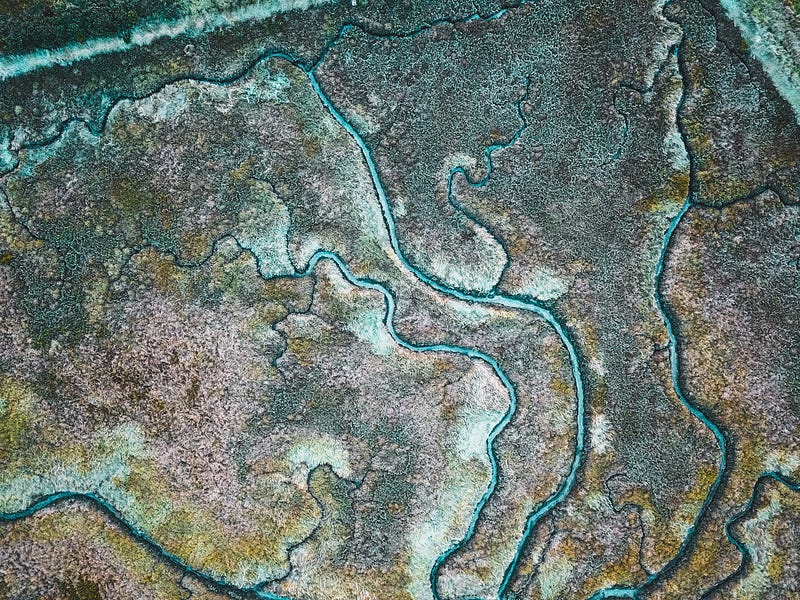
The concept above might be hard to understand, so I will describe it in lamen’s terms for you.
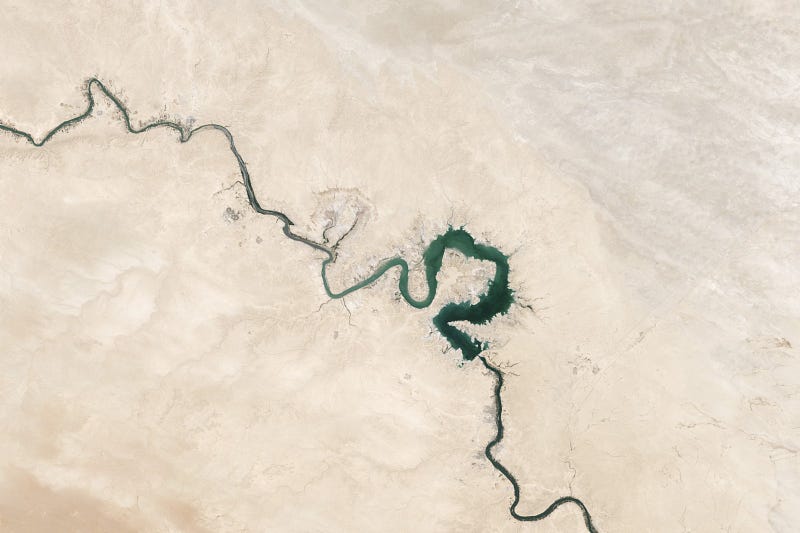
It is no secret that rivers have curves. If you take a map and observe any river on it, you can attain two different distances. The first is its “straight-line” distance. You can think of it as the length of the path a bird who starts at the beginning of the river takes to get to the end. The second distance is the river’s real length. We can think of this as the length of the path an Olympic swimmer would take from the start of the river to the end.The ratio of these two values, straight-line distance/length of the river, will give you the sinuosity or bendiness of the river.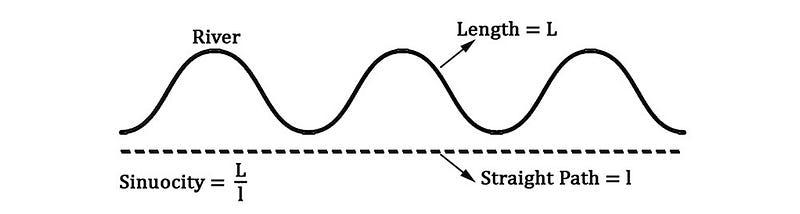
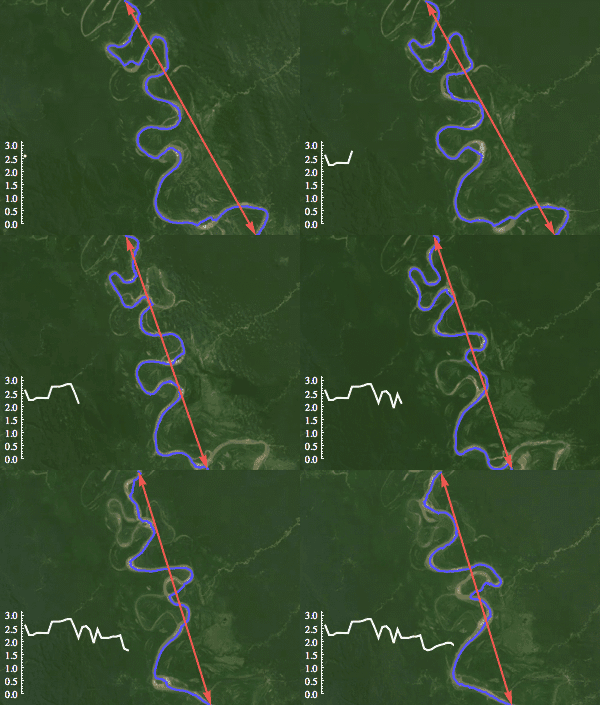
If you take the sinuosity of rivers worldwide and then average them, you will get pi. Professor Hans-Henrik Stølum published this almost supernatural finding that the average sinuosity is 3.14 in “River Meandering as a Self-Organization Process” on March 22, 1996, exactly eight days after pi day. Furthermore, according to Stølum, any given river’s sinuosity ranged between 2.7 and 3.5, and the average of all of the numbers he observed resulted in pi.
At this point, you may be thinking, “the sinuosity of a completely straight river maybe one and one of a very bendy river may be incredibly high,” and therefore, the average of them all being pi may not make much sense. Things don’t work that way in nature, however. The currents in an extremely bendy river will, over time, cause natural disasters through erosion and landslides. Over time, this will lead to the extremely curvy part of the river breaking off from the rest and forming what is called an oxbow lake. After some time, this oxbow lake, which developed from the extreme bendiness of the river, will dry out, and the bendiness of the river will return to normal. This natural phenomenon will resolve the “what-if” question in our minds and further prove Stølum’s theory. Therefore, in the long run, the bendiness of a river cannot be too much or too little. The natural flow of water will not allow it.
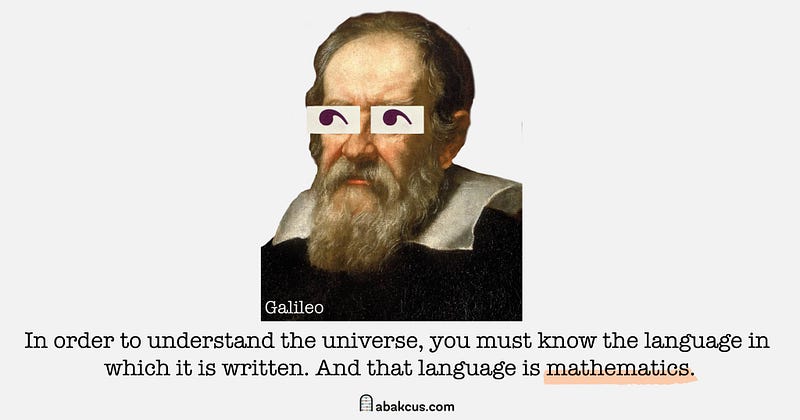
I want to end my piece with the brilliant saying of the great Galileo: Mathematics is the alphabet with which God has written the universe. For the thinking human, this saying has a very deep meaning.
Note 1: Beyond Euclid! is my weekly newsletter that brings you only high-quality math and science stuff to ensure you are having a good week. Please do yourself a favor by subscribing to Beyond Euclid and enjoy it! And if you can be a member and support my work, that would be awesome! Thank you!Note 2: I get commissions for purchases made through links in this post.


