
How the New Pandemic Made me Realize the Catastrophic Results of an Open-Plan Office
It seems that most companies guided by a noble intention of revolutionizing the way people work, made things worse
There is no chance that you haven’t heard about the corona virus since we all try to collectively adapt to the new reality that we entered several months ago, while we keep our hopes up for a cure.
Although there is a much smaller chance that you don’t go to work. Instead, you are working remotely from home. I work in the production planning department of a factory, and since there is no corona virus case and we have taken all the necessary precautions, including separating employees and transfer them to different offices, to diminish even more the possibility of contagion.
As a result, I’ve been moved to a large conference room.
Before the measures for the new pandemic took place, I was working alongside five colleagues (adding the average of five visitors per day, since we are in the production planning department), in a space that was initially built for four employees. Plus, the walls are made of glass from the waist up, providing a view at the corridor and the rest glass-walled offices.

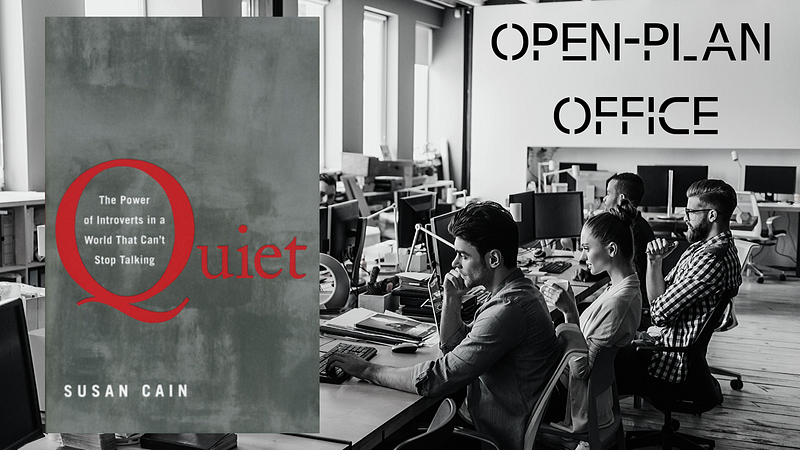
Within the first hours of working at my new badass work station, I recalled a chapter in the book “Quiet: The Power of Introverts in a World That Can’t Stop Talking” about open-plan work stations and their limitations regarding not only the employees but the company they work for, as well. At the time of my first read of the chapter several months ago, I discarded the idea. I thought it as an “overkill”, not that I questioned its validity, but considered it as excessive.
Evidently, some things have to pause for a while, to realize they have been bothering you for years, months, even days. The perfect analogy is the air conditioner that makes a mild repetitive sound. Of course, you can live with it while you enjoy the cold air, but once it stops there is a kind of relief within you.
Below you will find a passage of the book that describes perfectly the disadvantages of open plan offices:
“Open-Plan offices have been found to reduce productivity and impair memory.[…]They make people sick, hostile, unmotivated, and insecure. Open-plan workers are more likely to suffer from high blood pressure and elevated stress levels and to get the flu; they argue more with their colleagues; they worry about coworkers eavesdropping on their phone calls and spying on their computer screens.[…] They’re often subject to loud and uncontrollable noise, which raises heart rates, releases cortisol, the body’s fight or flight stress hormone; and makes people socially distant, quick to anger, aggressive, and slow to help others.” — passage from the book Quiet: The Power of Introverts in a World That Can’t Stop Talking
I have experienced all the circumstances mentioned above. They don’t happen regularly or pose a significant factor in my everyday work, but like that mild repetitive sound of the air condition, now that I work in a way more spacious environment, I can tell the difference.
The book includes numerous studies filled with evidence, posing one of the main issues that are being neglected is privacy. As a result, it’s vital for the company’s growth to build infrastructure that protects visually and acoustically its employees. A case study about a game company was particularly interesting since the administration was worried about installing cubicles. Still, in the end, the staff loved them since the office modifications provided them with more privacy.
If you are working in an open-plan office, you are welcome to share your own experience in the comments.
Is there any upside to working on an open-plan?
In a study titled “The effect of office concepts on worker health and performance: A systematic review of the literature” apart from the drawbacks of open offices, notes that desk sharing improves communication. The flow of information is way easier when everyone works in the same space.
Corona virus: The perfect time to examine the psychological results of teleworking
One of the initial goals of the study mentioned above, was also to examine the “office location,” meaning “telework” versus conventional office. Unfortunately, the data were insufficient. Maybe that’s the ideal time to examine the benefits and drawbacks of working remotely, since due to the corona virus the cases of remote working are skyrocketing.
I guess that it could be great of “IT” companies and way worse for “production-based” companies, since you have to make several phone calls through the day and manage files in the form of “hard copy.”
A final thought
The benefits of the traditional working environment clearly outweigh the open-plan workspace. It seems that most companies guided by a noble intention of revolutionizing the way people work made things worse.


