
How the Murder of Dr. King Changed My Life
And the lives of every young black person in this nation-state
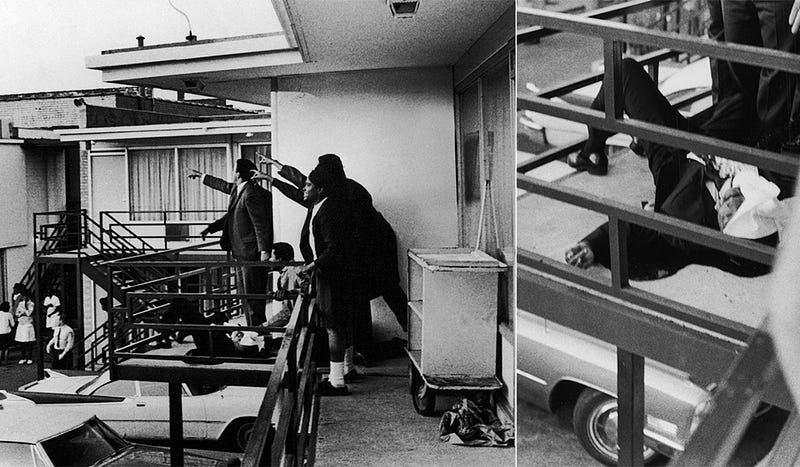

This is a personal memoir of the night Rev. Dr. Martin Luther King, Jr. was viciously struck down in Memphis, Tennessee on April 4, 1968. It’s a variation of the story I have written and previously published many times — always on or around April 4th:
In 1968, I was a 19-year-old, political science junior at Indiana University. I had been following the “career” of Dr. King for as long as I could remember, at least since he successfully led the Montgomery Bus Boycott in 1955.
I was always intrigued and fascinated by the boldness, the audacity, the effortless eloquence of this man. By ’68, I had read all of his books, held as prized possessions tapes of some of his speeches, watched him almost daily on “the news,” and read every newspaper and magazine article about him that I could get my hands on. I had a full-page Look Magazine color photo of Dr. King above my little study desk in my bedroom of our family home in Michigan City, Indiana.
Throughout childhood, my teenage years, and on into young adulthood, I often overheard, but did so intensely, purposely, as my elders spoke of Dr. King. All of my older relatives had been born and reared in the South: Mississippi, Louisiana, Arkansas, and Missouri. All of them — parents, grandparents, uncles and aunts, neighbors, and church members — expressed a mixture of great pride and pending doom every time Dr. King defeated the forces of white supremacy arrayed against him.
They all had grown up under Jim and Jane Crow. They all had sharecropped, tenant-leased, and throughout their lives “down on the farm” in the South, they all had been treated not very much differently from our enslaved ancestors.
They spoke of Dr. King’s courage. They marveled at his youth. They talked about the improbable (and dangerous) wins he somehow and someway consistently racked up. They were absolutely amazed and astounded that he had managed to “desegregate” most of the South by adopting and adapting Mahatma Ghandi’s successful employment and deployment of “non-violent civil disobedience” against the powerful British Empire, and also like Ghandi, by Dr. King’s own sheer force of will.
And, “naturally,” most of these older folks had never been afforded the opportunity to go very far in school. Indeed, my father, Herbert Dyer, Sr. (1922–89), was functionally illiterate. Yet, he was the bass singer and manager of a gospel quartet called The Gospel Tones. I was about thirteen when I first realized that he could not read. That’s because he used to have me sit down with him at the kitchen table while he dictated the “announcements” to be read at church by the “Clerk” as to where and when The Gospel Tones would be singing. This is where and when my interest in writing began. Indeed, I was consistently floored when the Clerk got up before sometimes hundreds of people and read my words to them. Also, whenever we traveled South in the summers, without ever admitting that he could not read, my father always had me read the road signs to him as he drove.
The old folks always also spoke of Dr. King’s sure-to-come demise. They spoke of and marked each and every one of his thirty arrests and twenty-nine jailings. “They ‘gon kill him sure as you born,” my grandmother used to say.
As I write in my essay referred to above, Dr. King’s murder changed my life. Throughout high school and college, I always had had white friends. But after Dr. King was killed, I could not stand to be around them.
I could not think, and I certainly could not study. My grades suffered as a consequence; and in ’69, I dropped out of IU and moved to Chicago where I got a job as a dispatcher for Specter Freight Trucking Company. After only nine months on the job, the truckers went on strike. The company started its layoffs with office personnel being the first to go — including me. I moved back to Michigan City because I could not find a job in Chicago.
One month later, I got Uncle Sam’s infamous “Greetings,” ordering me to report for a physical exam in Chicago, after which I would be required to start basic training with the US Army.
My Dad convinced me to join another branch of the service because it was the Army and Marines who were doing most of the killing and dying in Vietnam. I thought seriously about escaping to Canada as thousands of other young men were doing.
“Well…if you go up there, son, you will never be allowed back in this country,” Dad warned. “Plus, you won’t see us anymore, either, ‘cause I ain’t driving way up there to that cold-ass country.”
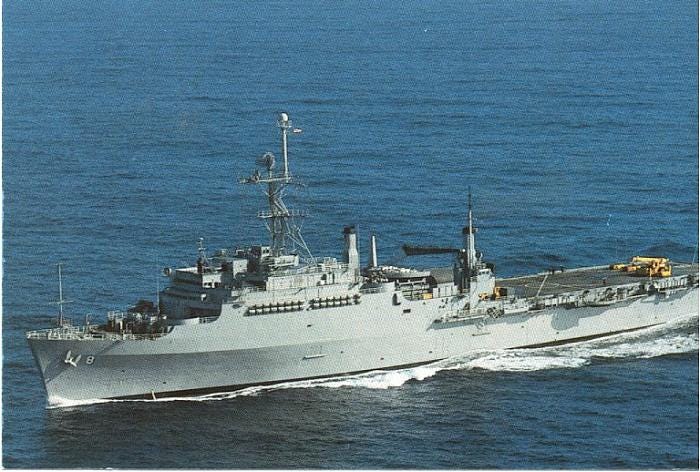
I joined the Navy. But before I signed on the dotted line, I made the recruiters promise me in writing that I would never-never, ever-ever! be sent to Vietnam. After nine weeks of boot camp in San Diego, I was then immediately assigned to and permanently stationed aboard a troop transport ship called the USS Dubuque (LPD-8). The very first port-of-call for the Dubuque, after we picked up 2,500 Army and Marine guys in L.A., San Francisco, and Seattle (and a brief re-fueling and re-supply stop at Pearl Harbor) was….you guessed it…DaNang Harbor, South Vietnam.
Here’s a video of my graduation from boot camp in 1970 — (Company №300).
And here’s the ship on which I served for four years (1970–74). The Dubuque was a new ship then, only three years old. It was decommissioned in 2011.

So, you see, the murder of Dr. King had reverberations from the cosmic to the personal. His murder accomplished and set in motion precisely what his murderers wanted — the dispiriting and disheartening of thousands of young black people. Instead of graduating from college in 1970, I graduated from boot camp. When they killed Dr. King, I unwittingly played right into their hands by dropping out of school. But, I was too young and dumb…and hurt… to see it then.
Thank you
…for reading. Here are a couple of other recent pieces by yours truly relative to Dr. King: