How the Man Box Poisons Our Sons
Mark Greene lays out the price we pay for raising boys in our dominant culture of masculinity

For generations, men have been conditioned to compete for status, forever struggling to rise to the top of a vast Darwinian pyramid framed by a simple but ruthless set of rules. But the men who compete to win in our dominant culture of manhood are collectively doomed to fail, because the game itself is rigged against us. We’re wasting our lives chasing a fake rabbit around a track, all the while convinced there’s meat to be had. There is no meat. We are the meat.
Our dominant culture of manhood is often referred to as the man box, a phrase coined by Tony Porter of A CALL TO MEN based on Paul Kivel’s work, The Act Like a Man Box, which Kivel and others at the Oakland Men’s Project first conceptualized over forty years ago.
The man box refers to the brutal enforcement of a narrowly defined set of traditional rules for being a man. These rules are enforced through shaming and bullying, as well as promises of rewards, the purpose of which is to force conformity to our dominant culture of masculinity.
The number one rule of the man box? Don’t show your emotions.
Accordingly, boys three and four years old begin suppressing their own naturally occurring capacities for emotional acuity and relational connection, thus setting them on the path to a lifetime of social isolation (Chu, 2014). The damage is done before we are even old enough to understand what is happening.
Man box culture also suppresses empathy. The suppression of boys’ and men’s empathy is no accident. It is the suppression of empathy that makes a culture of ruthless competition, bullying and codified inequality possible. It is in the absence of empathy that men fail to see women’s equality and many other social issues for what they are: simple and easily enacted moral imperatives. Instead, our sons buy into bullying and abuse as central mechanisms for forming and expressing male status and identity.
Boys entering late adolescence are shamed into seeing their close authentic connection with their best friends as “girly or gay” Accordingly, they slowly disengage from their closest friendships. It is at this time that suicide rates for boys rise, becoming four times the rate for girls (Way, 2011).
We tell boys to “Man up.” We tell boys, “Don’t be a sissy.” But what we’re really communicating is “Don’t be female, because female is less.” Wrongly gendering the universal capacity for human connection as feminine and then shaming boys to see feminine as less is how we block our sons from the trial and error process of growing their powerful relational capacities, leading to a lifetime of loneliness. Loneliness which in turn leads to dramatically higher rates of cancer, heart disease, diabetes, Alzheimer's Disease, obesity, and more for men.
At a time when boys should be expressing and constructing their identities in more diverse, grounded, and authentic ways, they are brutally conditioned to suppress authentic expression and instead cleave closely to the expression of male privilege as identity. Locker room talk and the denigration of women become central to proving they are “real men” in their social circles.
When we teach our sons “You are better then girls,” instead of teaching them, “Don’t put others down to make yourself feel better,” we prime their vulnerability to all forms of bigotry. You are better than gays, You are better than Blacks, You are better than Jews, You are better than immigrants, You are better than the poor, and so on.
This is why men’s general silence during instances of the denigration of women is so damaging, leaving those who are the most aggressive and the loudest to define our culture of manhood as a culture of inequality.
The end result is violence, isolation and stress related diseases for our fathers, brothers, sons and husbands and all those who love them.
What is remarkable is that in spite of our man box culture, many men continue to fight for connection, community and equality in the world. But this happens in spite of everything man box culture does to us. Imagine a world where we encourage every boy’s relational intelligence instead of suppressing it.
Imagine a world without the man box.
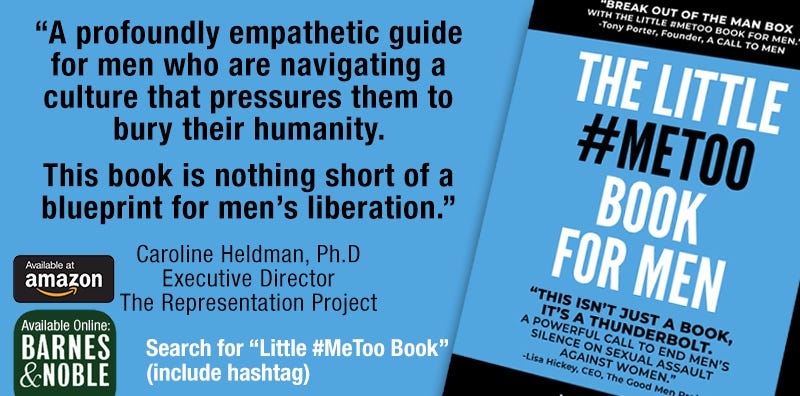
Want to have a powerful conversation about masculinity with someone you care about? Give them a copy of Mark Greene’s The Little #MeToo Book for Men.