
Illumination Publication
How the Gears Turn at Illumination
A peek behind the scenes in a busy publication

While I already have a personal bio on Medium, Dr Mehmet Yildiz has encouraged the editors at ILLUMINATION to come with a bio that centers more on our role as an editor in the publication. That is here:
While I was writing that I realized that there was a technical side of the inner workings of the editors that could use some illumination as well.
So, in addition to penning a quick editor bio, I also took this as an invitation to allow the writers and readers glance behind the curtain and see some of the interworkings of the publication, at least as viewed through my eyes.
A unique type of Publication
ILLUMINATION is different than other publications in many ways. Certainly, the promotion, synergy and cooperation are unique. So too is the rapid growth and focus on inclusion. And, from a technical perspective as far as the editor function goes, it is seemingly different as well.
I am by no means an expert on all things Medium, but my sense is that there are two main types of publications. Those maintained by an owner and maybe one or two editors (or a small handful if big enough), and then publications that act more as a collective where anyone and everyone can be an editor. In those publications, the editor designation means that a person can publish their own work without someone else acting as a gatekeeper.
Illumination is something of a hybrid between those two main models. As such, we have experienced an interesting learning curve as we have weathered all the (what I assume to be) normal things that happen in a publication as it grows.
How the editors interact
Everyone has their own story and lives, so some editors are more routinely engaged in day-to-day issues doing a bit here and there, and others pop in and give their energy more in bursts. I have fallen into a more regular presence able to engage most days.
Typically, I like to write earlier in the day, and then tackle reviewing and releasing stories in the publication and dealing with any issues that have come up recently. On the publication Slack workplace the editors have a locked channel where we discuss any pertinent administrative issues that need an element of privacy.
I have to admit that the little indicator of a new message in Slack can be distracting, so I often turn it off early in the day so I can write, then open it to see what is going on. Typically, I come on just as some of the other editors like Kevin Buddaeus, Dipti Pande, Sylvia Love Johnson, Salam Khan, Besom & Bletherskite and Dr Mehmet Yildiz are headed off to bed (or already there).
Typically, Chris Hedges, Joe Luca and I are online simultaneously and Mary Holden seems to check in about the same time. Mostly the practice of publishing your articles goes very smoothly. When I log into the publication there is a “Stories” link that takes me to the draft article queue. Anyone that has submitted an article to the publication has their article land there first; then an editor will review and publish to the site.
Article publishing workflow
I always start at the bottom of the draft queue since they are ordered by time they come in with newest at the top. I try to tackle the ones that have been sitting the longest and get them out first.
Typically, the process is simple: I open and make sure the title and subtitle (if there is one) are spelled and formatted correctly. Then I look at the primary image for the story to see if it is captioned properly. Then I read the article looking for any glaring spelling or grammar issues and making sure each subsequent image is also captioned correctly.
If everything checks out (which I would say is 90% of the time), I hit
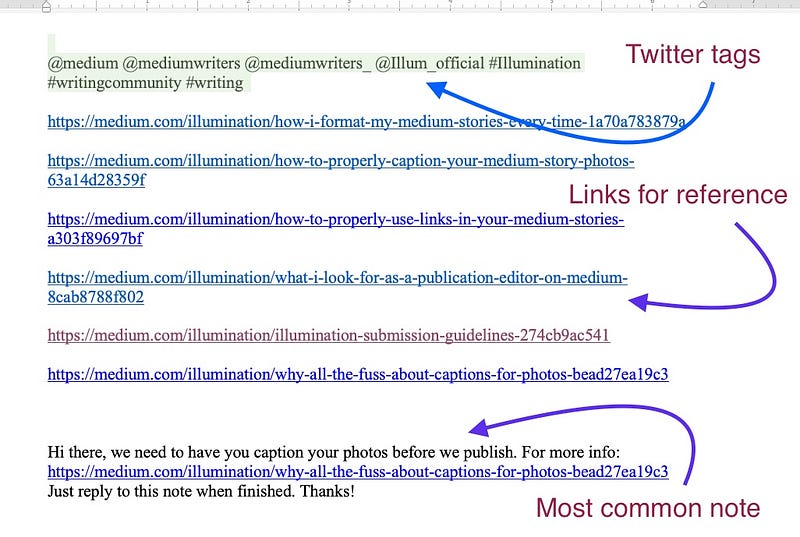
I keep a Word document open that has links to reference articles, my most common private note to add to stories without an image caption and a list of the Twitter hashtags I use with a post. That way it is easy to copy and paste the hashtags and tweet out the article.
Then I clap for your article and highlight anything I noticed while reviewing it. I have to admit to being human and allowing for my interest to dictate how detailed I am in reading your articles as I publish. Sometimes I just skim, particularly at the end of my day.
The workload of how many articles are in the queue also somewhat dictates how much time I can take with each.
Types of submissions
People submit articles two ways to the publication. Some people publish first, then add to the publication. Others submit the article as a draft. From a purely personal workflow perspective, I like to see them in draft form — but it truly does not matter which way they come in.
However, in cases where I am especially pressed for time, I will give preference to the draft versions because they are unpublished anywhere. My goal is to get those out first if there is a chance that I won’t be able to completely clear the queue in the time I have available.
Most common issues
Sometimes we can’t publish your story right away. This 99% of the time is because the story doesn’t completely comply with Medium’s rules, but it almost always is a quick fix. By far the most common reason for delay is a lack of captions on story images. Each image in the story needs to have a caption.
You will have noticed in the image above that I have a pre-written message that I copy and paste into a private note on any story that is missing image captions. Often within a short time I will get a reply saying the article is fixed. I will go right away to confirm and publish.
Other things that we look for is bulk tagging of other writers (somewhat common), massive spelling or format issues (rare), repeat content (very rare) and plagiarism (also rare). In most all of those cases, we will send a private message to the writer and ask them to fix the issue.
In the rarest of cases — those that seem like they might be part of a bigger issue — we use the Slack editor channel to discuss the best way to handle the situation.

Then the magic happens
That’s really about it on the editing side. Not super complex. It is mostly a work of passion by the various editors to make sure your writing gets published and exposed to as many people as possible.
The magic is in no way located in the editing process, but rather in your writing and the interaction and collaboration you engage in with other writers and the editors on the platform. The synergy, positive energy and promotion of everyone on the publication are what manifest from all of us working together collectively to create synergy.
The wheels behind the scene are necessary, but not by any means what makes Illumination the amazing place that it is.
If you liked this article, you may also like:
Timothy Key spent over 26 years in the fire service as a firefighter/paramedic and various fire chief management roles. He firmly believes that bad managers destroy more than companies, and good managers create a passion that is contagious. Compassion, grace and gratitude drive the world; or at least they should. Follow me on Instagram, Facebook, and Twitter, and join the mail list.