
How the Game of Life Is Won or Lost in Seconds
Focus on what you can control
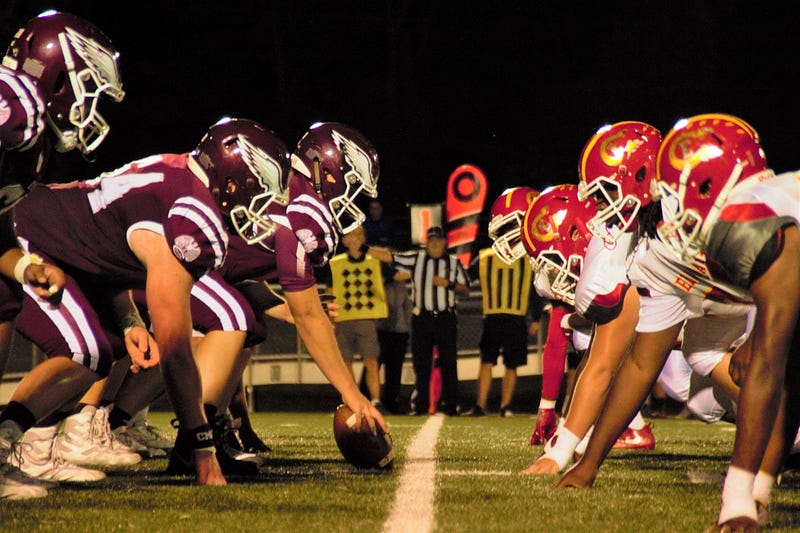
In the movie Any Given Sunday, Al Pacino plays a fictitious American football coach, probably best known by the pre-game speech he gives to his team. The speech, in part, says:
“You find out that life is just a game of inches.
So is football.
Because in either game, life or football, the margin for error is so small.
I mean, one half step too late or too early, you don’t quite make it.
One half second too slow or too fast, and you don’t quite catch it.
The inches we need are everywhere around us.
They are in every break of the game, every minute, every second.”
One doesn’t have to be a football fanatic or even a movie buff to appreciate the wisdom in those words.
Certainly, any American football fan has seen the concept of inches manifest in victory or defeat as the nose of the football was either just barely over, or short, of the goal line.
Seahawks fans, in particular, agonize over the game-ending interception of Russel Wilson in Superbowl 49. Inches made all the difference between Superbowl champions and should-have-been.
But the important part of Pacino’s coach speech isn’t how it pertains to football, but rather where he suggests that the game of football and life are exactly the same. Both “games” are won and lost in inches and seconds.
Most poignant is when he says, “The inches we need are everywhere around us.” So very true.
Think about all the times in your life where the briefest of moments, the smallest of actions, the subtlest of body language forever set a course forward that could have been different absent those moments.
These occasions can be positive or negative, or perhaps indeterminate for the time being.
Inches
One occasion for me that I consider positive was the day I took the written test to be a firefighter. I had just decided that I wanted to try and become a professional firefighter. It was my first test, and I was intimidated by the process.
That year over 2,000 applicants were vying for a spot with this particular fire department. The written test was held in 4 “waves” at a local high school cafeteria. When I arrived, the parking lot was jammed. I circled repeatedly looking for parking with no luck.
Just as I had decided I was going to turn around and go home, since obviously the competition was so insanely fierce and there was no way I even had a chance at a job, a car backed out of a spot directly in front of me.
I got the job. The city hired 17 people that year; I was number 17. If that person hadn’t backed out at that moment, I would be the product of a significantly different history today. The inches matter.
Seconds
In a similar vein, I had a work colleague recently reach out to me and share that she had just completed a double-major bachelor’s degree in Emergency Medical Services Administration and Fire Technology.
I barely remember the conversation we had about five years ago where I shared with her the education program I was pursuing. She seemed disinterested at the time, but apparently a seed of curiosity was planted and that bloomed and flourished into a degree.
She told me that if I hadn’t mentioned it, she would have never pursued that program on her own. The seconds are all around us.
What we Control
Sometimes the inches seem arbitrary. After all, the person pulling out of the parking spot had no idea about the cascade of events in my life that were to ultimately unfold. But maybe that wasn’t the most important moment.
Perhaps it was whatever made me take one more lap around the parking lot. I knew an acquaintance would be taking the test in the same slot as I was. Maybe it was our conversation about possibly meeting up at the test that made me especially tenacious in looking for a spot that day? I can’t say for sure, but I am convinced that it was a case of inches.
So, how do we put this knowledge to use? How do we capture those instances in positive ways?
There are several meaningful ways we can capture those seconds and inches:
- Be present — Last year my wife and I went on our first-ever cruise together. As we got out of the cab at the Long Beach cruise terminal, we were assaulted by what can only be described as chaos. We had no idea where to go, or what to do with our luggage. Everyone was in a hurry, all the employees seemed very busy and occupied. We had to interrupt one young woman loading baggage onto a cart. Instead of just answering over her shoulder or pointing, she stopped, stood up, looked us in the eye and said, “First of all, you are going to have so much fun on this cruise!” We were floored (in the most positive of ways). Partially by what she said, but mostly because she took the time to be present with us when clearly, she was busy and harried. We will never forget that moment.
- Listen — When I was interim fire chief, one of the fire prevention inspectors would come into my office and talk about some of the frustrations of his job. Most of what he shared I could do little about, even as fire chief, as there were conventions and systems that were slow to change. After I left the profession, he reached out one day to say how much he appreciated my listening to him. He knew that I couldn’t fix the problems (at least not right away), but that my listening made it much easier to deal with the frustrations and made his job much more productive and satisfying.
- Reach out — Both literally and figuratively. Several years ago, I was snowboarding at Whistler, BC. As I rode by an area where several trails come together, a woman waiting at the intersection (presumably for friends to come by) put out a hand and high-fived me on the way by. It was totally arbitrary, but it made me inexplicably happy. I still remember that moment, and how an insignificant-seeming gesture has stayed with me all these years. A held door, a fist bump with a stranger or a phone call to someone you haven’t talked to in a while is a great way to claim one of those inches around us.
We have a lot of control over the inches and seconds around us. Choosing to act in moment in a positive way could have an unimaginably profound positive impact on those around us.
Capitalize on those seconds and inches; the margin for error is so small. Even the most insignificant actions can have amazing repercussions.
Timothy Key spent over 26 years in the fire service as a firefighter/paramedic and various fire chief management roles. He firmly believes that bad managers destroy more than companies, and good managers create a passion that is contagious. Compassion, grace and gratitude drive the world; or at least they should. Follow me on Instagram, Facebook, and Twitter, and join the mail list.