
How the Galicia-Volhynia Kingdom Laid the Foundation for the Ukrainian Identity
Exploring this little-known successor kingdom to Kyivan Rus on the Dniester River
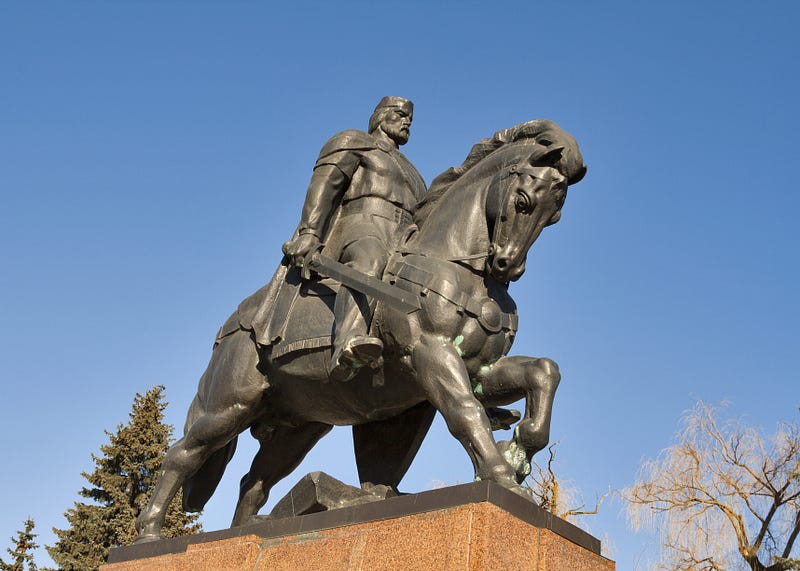
With the invasion of Russia into Ukraine on February 24, 2022, many of us are seeking to better understand the country of Ukraine and why Ukrainians are fighting so hard to retain their independence from Russia and better integrate into Europe. Much of this can be explained by Ukrainian history, which has been little studied beyond Ukraine’s borders.
While the countries of Belarus, Russia, and Ukraine were once a loose federation of Eastern Slavic principalities that formed the medieval state of Kyivan Rus, the countries afterward had very divergent histories, creating a distinct culture and identity for each. While Russia was developing an identity under the Mongols and then the Duchy of Muscovy, Ukraine was developing separately under the Galicia-Volhynia Kingdom, Polish-Lithuanian Commonwealth, and Cossack Hetmanate. In this article, I cover the little-known kingdom of Galicia-Volhynia and its contribution to modern-day Ukraine.
Kyivan Rus and the Mongol Destruction
Kyivan Rus was a medieval kingdom founded by a combination of East Slavic tribes and Varangians (Vikings) in the eighth century from an existing settlement in Kyiv founded in the sixth century. The rulers of Kyivan Rus, the Rurik dynasty, originated from the Varangian Vikings but quickly adopted the Slavic culture, Slavonic language, polytheistic religion, and customs. The kingdom initially raided neighboring lands like the Byzantine Empire but eventually developed trade agreements and alliances. With one of its rulers, Volodymyr (Vladimir) the Great, Christianity was adopted in 988, and the kingdom expanded through wars led by him, his sons, and his descendants.
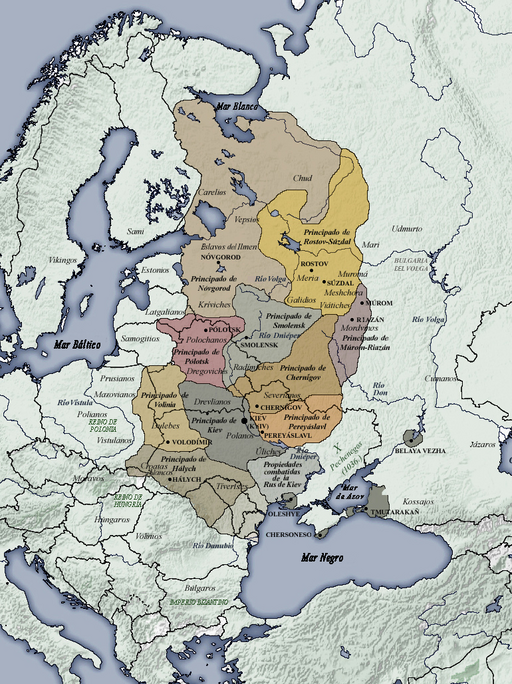
At its heights in the eleventh and twelfth centuries, the kingdom, a loose nation of federated principalities with Kyiv as the capital, encompassed over 1.3 million kilometers. Its borders started from the Vistula River in the West to almost the Volga River in the east and from the White Sea in the north to the Black Sea in the south. However, Kyivan Rus rulers had a problem. It did not develop a system of primogeniture, passing down titles and property to the eldest male, as did medieval Western Europe. It split titles, land, and property between the ruler's sons or made them war for supremacy as Grand Prince of Kyiv. This created a fractured kingdom of principalities and weakened the state with each war of succession.
The Mongols were able to exploit this weakness and successfully attack Kyivan Rus. Any principality that accepted Mongol overlordship survived with some form of self-rule until the Mongols themselves extended too far and were weakened and retreated. The principalities that decided to fight were eliminated and permanently destroyed, including the Kyiv principality and city in 1240.
The principalities who accepted Mongol oversight, including the principality of Vladimir-Suzdal (eventually becoming the Duchy of Muscovy and the Russian Empire) and the principality of Galicia-Volhynia, survived as semi-autonomous states paying tribute to the Mongols as the price of their survival.
Founding of Galicia-Volhynia
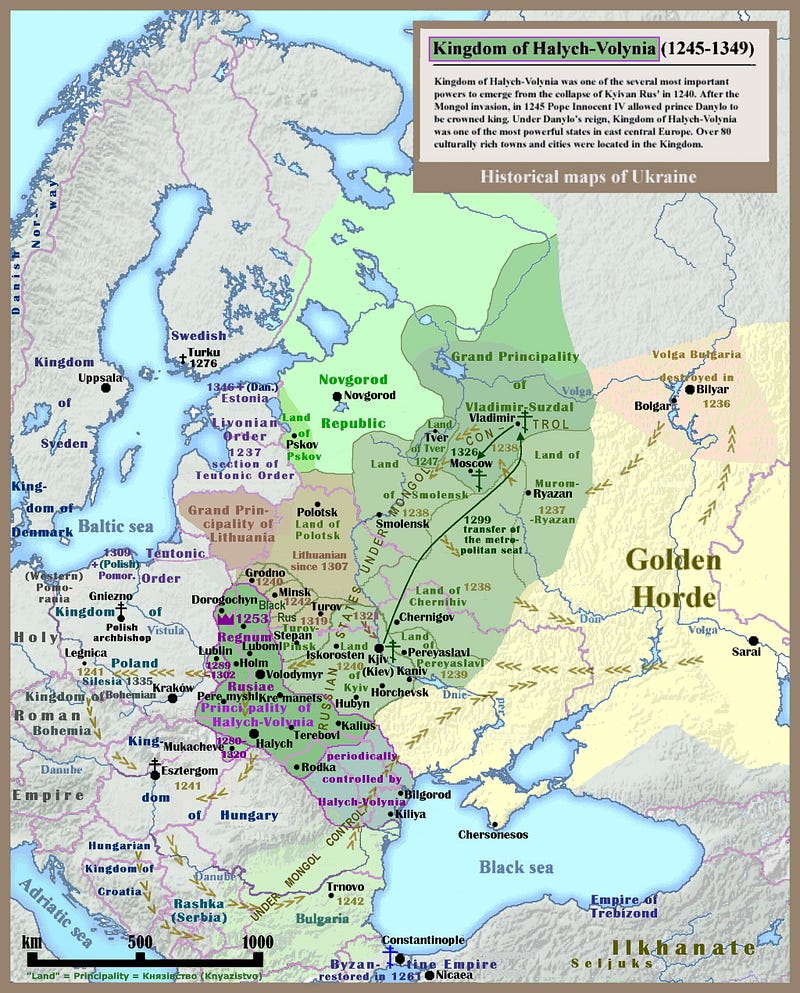
Volhynia, with its seat in Volodymyr, and Galicia, with its seat in Halych, were principalities that arose during Kyivan Rus. Volodymyr the Great had annexed these two land masses from the Poles as he expanded Kyivan Rus. Volodymyr's heirs and his son, Yaroslav the Wise, inherited these principalities. In 1199, the two kingdoms were combined into Galicia-Volhynia by Prince Roman Mystalavych from Volhynia, who moved his ruling seat to Halych.
After combining these two principalities, which encompassed modern western Ukraine, eastern Poland, and southwestern Belarus, Prince Roman moved against his greatest rival, the Suzdalian rulers with their seat in Moscow, to take over the capital of Kyivan Rus, the Grand Prince seat, Kyiv in 1203. Grand Prince Roman died fighting to expand his territory within Poland in 1205 and left two sons too young to rule in his place. It took Prince Roman’s eldest son, Danylo, to spend years retaking the territory his father had won, including Kyiv, in 1239. When Kyiv fell to the Mongols, it was under a military General faithful to Prince Danylo of Galicia-Volhynia.
Galicia-Volhynia as Mongol Vassal
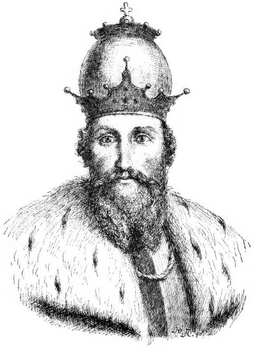
As the Mongols moved westward, Prince Danylo was not strong enough to resist the Mongols and accepted their oversight, became their Vassel state, and agreed to pay tribute. To resist Mongol oversight, Danylo made alliances with Hungary and Poland. He even treated the Catholic Pope, agreeing to accept Papal oversight if the Pope would help him call a Crusade of European kingdoms to attack the Mongols. The Pope crowned him King, but a Crusade never materialized.
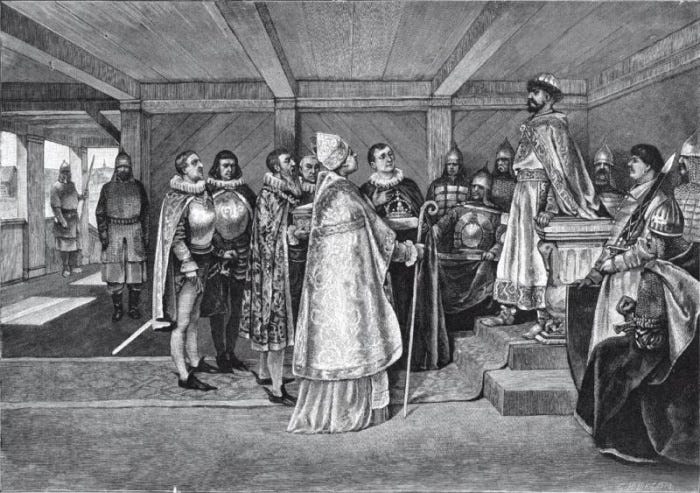
King Danylo tried to unseat the Mongols from Kyiv alone but was unsuccessful. His price to stay in power required him to dismantle the walls surrounding his cities. While not successful in removing the Mongol yoke, he took more Polish and Lithuanian territory and married his children to other European royal houses, including Lithuanian and German. The children and descendants of Prince Danylo continued to expand the kingdom southwest into Transcarpathia (now the Ukrainian Oblast of Zakarpattia) bordering Hungary, expanding its influence through Europe, building cities, and enriching the lands through trade, artisan crafts, agriculture, and salt mining. The cities of Cholm (Chelm) and Lviv owe their existence today to Danylo. Traders and artisans alike were attracted to the stability of the Kingdom versus staying in Mongol-controlled lands. Danylo’s sons moved the capital from Cholm to L’viv, encouraging the growth of this western Ukrainian capital.
The lands experienced stability up until 1323, when the ruling dynasty died out. Initially, a Polish cousin was invited by the local Boyars to rule, He took on the Orthodox religion and a Slavonic name, Iuri. However, his insistence on supporting the cities and merchants at the expense of the Boyars led to his poisoning, depriving Galicia-Volhynia of its remaining royal family members. At the same time, the kingdoms in Lithuania, Poland, and Moscow were on the rise.
After the kingdom’s royal bloodlines ended, Poland and Lithuania annexed the kingdoms, with Poland taking Galicia in the late 1300s and Lithuania absorbing Volhynia in 1430.
Legacy of Galicia-Volhynia on Kyivan Rus and Ukraine
While the Galicia-Volhynia kingdom only lasted approximately two hundred years as a combined entity, its influence and legacy are critical to Kyivan Rus's and Ukrainian identity. Without the kingdom’s existence, the area of modern-day Ukraine may have been absorbed into Hungary and Poland soon after the Mongol invasion, eliminating the Slavonic language and Orthodox religion from those lands. Instead of Russia becoming the only successor kingdom of Kyivan Rus, a Ukrainian successor state also developed a very different culture from Russia with European influences.
Galicia-Volhynia could retain the Kyivan Rus culture in the West and transition it to the Lithuanian state for safekeeping once the lands were absorbed into the Duchy of Lithuania. This gave the Ukrainians an essential bridge of language, religion, and culture distinct from the rest of Catholic Eastern Europe or Orthodox Russia.
Ukrainian history, from the downfall of Kyivan Rus in 1240 to the absorption by the heirs of Peter the Great in the 1700s, proved to be too sticky to enable the Duchy of Muscovy and successor states like the Russian Empire, the Soviet Union, or the Russian Federation to eliminate the Ukrainian language and culture.
This may be why so few of us have heard about this Kingdom when studying history.
Did you study about Galicia-Volhynia in your school? Is this the first time you have heard about this little-known kingdom on the Dniester River?


