
How The Fear Of Humiliation Can Ruin Your Life
And what my dying friend taught me about living
Edgar would have made a great governor or president. He had that presidential aura about him. Whenever he walked into a room, people just assumed he was the leader.
Perhaps it had something to do with his presence. He was tall and good looking — in an old-Hollywood, Cary Grant kind of way — but not too much to be a distraction.
But it was more than just physical.
Edgar never forced his words or ideas on people, but when he spoke, people wanted a seat in his theater. He liked to tell short stories — parables about his life really — that were funny and chock-full of advice.
The Edgar I knew was composed and unflappable.
But the colon cancer had now ravaged his body and drained the color from his hair, teeth, nails, and skin tone.
It tore me up inside to see my hero falling apart like this, but there was nothing any of us could do to save him.
Each morning I’d come to visit Edgar, and as soon I walked in the door, he’d always apologize for how bad he looked. He’d tell me he “hadn’t had time to clean up yet,” but the real truth was that he had no strength to do so now.
“Not to worry,” I’d tell Edgar. “You’re looking pretty sharp today!” as I combed what little hair he had left.
However, what I wanted to tell Edgar was, “Who cares what you look like right now? You’re in the hospital, fighting for your life for Pete’s sake!”
But even on his deathbed, I knew Edgar cared. How he looked to others mattered a lot to him — as it does to most of us.
Our Biggest Fear
Most of us carry around a buffet of anxieties — including fear of financial ruin, loss of loved ones, crime, betrayal, natural disasters, and a general unease about the future — but the biggest fear behind those fears is that of public humiliation.
We worry about losing control, showing our ass, not being able to save face, and embarrassing ourselves in front of others. Some way more than others.
Take something as simple as watching a person trip on the sidewalk. The first thing most people do is to look around to see if anyone else saw it. We do this before we’ve even taken stock of the damage to our knees, elbows, and wrists. But this concern about what others see gets much more magnified when it comes to maintaining the social appearances of life.
Many people will go to great lengths (and actual pain) to avoid being embarrassed— including lying, hiding, faking, plastic surgery, liposuction, hair plugs, wigs, hidden identities, and other “cover-ups” and “get-ups.”
This public presentation of “self” has become an all-out obsession in our society today. Everybody wants to send out the message that “life is great!” — “as I stand here in my villa on the beach in San Tropez.”
And for the recipients of such information, there is this implied comparative question of,
“How’s your life going on the couch, eating potato chips, in the dead of winter?”
They look great. And you feel bad. But that’s not real life. That’s a highly-edited, filtered, photo-enhanced version of life that keeps ratcheting up for a big fall later.
The truth is, none of us—not even the sexy, millionaire couple in San Tropez—can escape the reach of humiliation forever.
It comes for all of us.
No Escape
Edgar knew he was going to die, so saving his life was no longer his concern. What worried him now is what he might look like when it happened. He didn’t want to “frighten the nurse or scar the family for life with the unforgettable look of death in his eyes.”
He’d remind me that if I found him first, “please close my eyelids and make me look presentable.”
Edgar had planned the outfit he would wear at his funeral ahead of time. And he provided me with excruciating details about the suit, tie, shoes, socks, rings, cuff links, and a handkerchief he’d already set aside for that big day.
Talking to your close friend about the last outfit you are going to burying them in is far more emotional than I’d ever imagined.
Edgar caught me crying by his bedside late one night. I couldn’t hide it. So I blurted out how furious I was with the universe, God, and nature for bringing a great man like him down.
But then he reminded me that even the wealthiest, most talented, or beautiful people of his era—Steve McQueen, Farah Fawcett, Rock Hudson, Mohamed Ali, and even his idol, John Wayne—could not escape humiliation in the end. And for my era, he added Steve Jobs and a few others.
He was right! These were all great people, cut down in life. We work so hard to avoid humiliation and to prevent it from knocking on our door. But humiliation doesn’t care what zip code you live in, or if you’re rich, tall, handsome, beautiful, connected, powerful, brilliant, or the kindest person in the world. It does not discriminate.
And it doesn’t just limit itself to death. Humiliation comes in a variety of shapes and forms—such as chronic illnesses, painful diseases, scandalous affairs, divorce lawyer antics, injustices, abrupt firings, kids in trouble, high profile bankruptcies, and the buried deeds of our past selves brought to light.
Acceptance
Some people believe it’s better not to think about such negative things, lest you become nihilistic. But the denial of pain and suffering in life keeps us clinging to false concepts and attached to ideas that are temporary. It also prevents us from experiencing real joy.
As the nightly news proves, humiliation exists and thrives all around us. It just doesn’t seem like it happens to us…until it does.
We tend to delude ourselves into thinking we can avoid or sidestep it by buying or achieving our way out of embarrassment. Some people even try to live near-perfect lives, but it still comes for them as well, often in the most cruel ways.
A wiser approach to life is to learn to live with suffering and humiliation. To accept it, and be okay with it. It can be a healthy thing to see it this way, as just one of life’s natural forces.
Coming to this realization early in your life can save you from erecting grand facades of delusion that make the fall from grace so much taller than it has to be.
Earlier in my career, I had a Thai friend, nicknamed Ben, whom I worked with on select projects in Asia. Ben was born in Thailand and educated at some of the top schools in the U.S. He became a successful CPA and financial analyst in both the U.S and Asia. He flew back and forth between San Francisco and Bangkok, as did I, to conduct business.
He was exceptional at his job and had no time to slow down.
But he’d promised his mother that before turning 35, he would honor the family ritual of spending one month in a Buddhist monastery in Thailand to become an ordained monk.
As his 35th birthday approached, Ben was getting anxious about fulfilling this commitment and asked me for my advice. Not being Thai or a Buddhist, I wasn’t sure what this commitment entailed. But I figured if he made a promise to his mother, and it was only 30 days, he should go.
“Look at it as a sabbatical and meditation retreat,” I said.
So later that summer, Ben and I both flew to Thailand. He went off to be with the monks to get rid of life’s delusions, and I went to meet with a cosmetics company to help sell the delusion of “hope,” or should I say, a $165 “age-defying” night cream to aging consumers.
Ben was not allowed to make any calls or use computers during that time, so I had no idea how things were going for him. I figured they were sitting in a majestic temple, reading, chanting, eating Thai food, and sleeping a lot.
Sounds good to me.
But I wasn’t prepared for what I saw next.
The Beggar
Ben was two weeks into his stint, and I was still working my tail off for this beauty company. I had just finished a critical presentation to their board and was wearing the most obnoxious suit, shoes, ties, and sunglasses I owned.
I looked like a real corporate asshole.
I had just gotten off the Skytrain, which is the elevated rapid transit system that runs around the city of Bangkok. I was coming down the stairs to where the sidewalk met the street and dumped into the chaotic scene of vendors, hawkers, beggars, scammers, smells, and sounds.
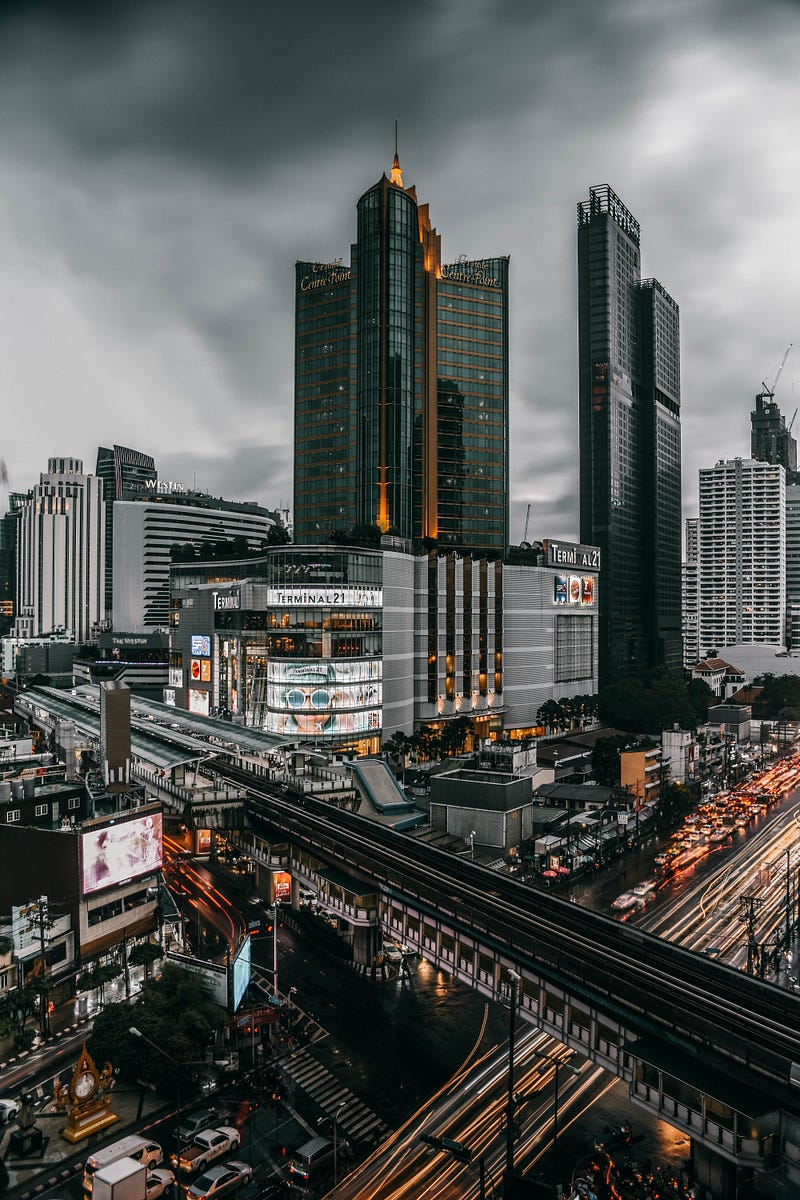
As I pressed my way through the congested crowd, I saw a man wearing one of those traditional saffron Buddhist robes sitting on the curb and waiting for someone to place food or loose change in his bowl. This monk looked vaguely familiar to me—like maybe Ben ’s cousin— except this guy had no hair and no eyebrows.
But it couldn’t be Ben, because he was a “successful businessman” that perfected his hairstyle and dressed to the nines like me, in full pompous, self-important fineries.
However, as I walked by, I heard a familiar voice say, “Sah wah dee khrap!, Khun Kevin,” — which means hello in Thai. As I turned in disbelief to take a closer look, I was shocked to find it was indeed Ben— sans hair, eyebrows, and Armani power suit.
“This is embarrassing,” I thought, as I looked around concerned about who else might see Ben there.
But that was precisely the point.
The Brows
Ben later explained to me that to truly find out who you are underneath the trappings of your ego, vanity, and attachments, you have to go through a process of shedding your worldly identities.
“The hair, in particular, represents a prominent aspect of vanity,” he said.
“And the eyebrows?” I asked.
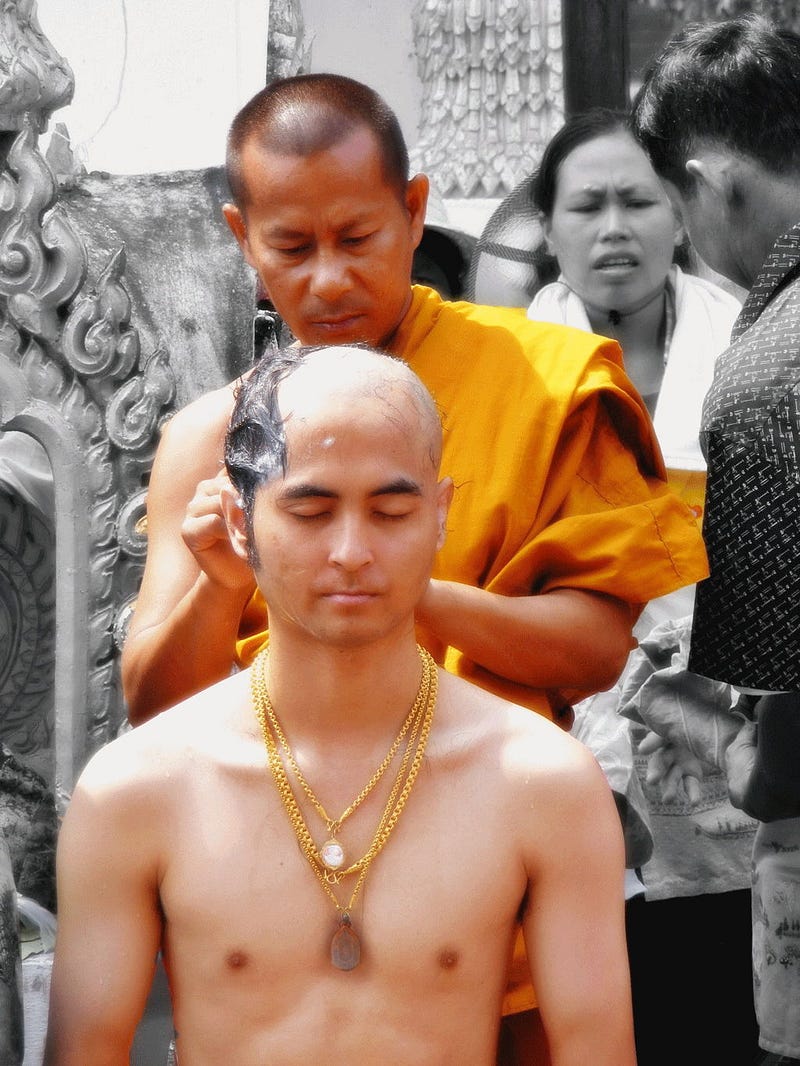
According to my friend’s particular monastery, this is where the ego and pride reside, “like that of a bull,” he said with his fingers motioning the shape of horns on the head.
The mere act of shaving the hair off your body is a symbolic moment because it represents the breaking down of your subconscious and the dismantling of your ego.
But it gets worse.
On specific days, Ben was expected to go out and sit on the dirty, polluted, smelly, and sweltering hot sidewalk all day while self-absorbed corporate A-types like me walked by him. His teachers wanted the students to feel how the busy pedestrians looked down upon them, sometimes with pity, but more often with disdain or no human acknowledgment at all.
But little did the people walking by know that Ben was a highly sought-after strategic thinker and financial expert for some of the top corporations in Asia.
If they’d only known who he was—and that he charges $500 an hour—they would’ve given a lot of food to try to get his advice about their businesses. But Ben let me know this is part of the problem with projections, resumes and ego.
It was important for Ben to know what it means to feel unimportant and insignificant, and to be humiliated by life.
(Note: Buddhism encompasses a wide variety of traditions, beliefs and spiritual practices. And each monastery has its own monk ordination process.)
“My experience of sitting on the street—with no hair, eyebrows, or food in my belly—was one of the most revealing moments of my life,” Ben told me on the flight back to the U.S.
By being stripped of all his comforts, pedigree, resume, wardrobe, and looks, Ben got much closer to his real self, less attached to things, and on the right path toward enlightenment.
Did Ben want to live his whole life this way?
No. But it was an experience that helped him think more clearly about the struggles of life, and to be more mindful of the many layers of conditioning society wraps around us each day.
It had been many years since I’d seen Ben. We both got busy with our jobs, and our lives had gone in vastly different directions. But the nurse told me someone was in the lobby waiting for me. When I went downstairs, there was Ben — with a head full of hair and those strong bull eyebrows.
Ben and Edgar had only met each other briefly a few times at events, but he said his primary reason for coming was to see if I was okay. He knew how much Edgar meant to me as a mentor and friend. And it was such a meaningful gesture of friendship to see him there.
Since Ben was now an ordained monk, I asked him if he would be willing to give Edgar a prayer, some blessings, and perhaps even a talk. He agreed, and so I let the two them spend some time alone while I walked down to the cafeteria to fill my empty stomach. When I came back to the room later, Edgar had a peaceful look on his face.
Ben and I said our goodbyes, and he headed back to his family in Oakland.
The Inevitable
As hard as it was for them to deliver the news, the doctors let us know that there was nothing else they could do.
The end was near.
Edgar and I made sure he had all his final affairs in order. Then we cried, prayed, talked about old times, looked at pictures, had a few laughs, and discussed his final thoughts about a remarkable journey.
That Saturday morning, Edgar let me know, “This is the day….”
I was devastated, but Edgar was at peace with it. He even managed to muster what little smile he could from his fading body. He whispered to me that this day — his last day — was one of the best days of his life. And the confused look on my face said “How can this be?” to which he answered,
“Because I’ve finally let go.”
“Your Thai friend reminded me of how silly it is to cling to appearances.”
“I’m not trying to be anyone anymore. Thank God!” as his eyes looked up to the heavens in gratefulness.
“Chasing vanity, fame, success seems so trivial now. Why did I ever care about impressing anyone? And why did I worry about what they thought of me?”
“I’m not worried if I look bad now. Put me in the casket with those red jogging pants and Nike shoes on if you have to,” as he pointed to a gift someone got him.
“For the first time in my life, I feel free from not worrying about what anyone else thinks of me.
And I’m finally living life — on my last day here on earth.”
But then he looked me directly in the eyes and said, “But you, my friend, still have many days left on earth to live. You can spend them building up a grand facade in the delusion you can avoid humiliation, or you can just accept it as a natural part of life.”
As I held Edgar’s hand and listened to his final words, tears rolled down my face at how profound his message was, and how much I knew I was going to miss this remarkable soul.
Later that night, Edgar died.
I was sad beyond belief, but I was also comforted that his last day was his best.
Edgar left me with a treasure trove of memories and many pearls of wisdom about life.
I no longer spend my days trying to erect a facade of ego. Nor do I kill myself trying to “make it” in life. I used to believe I was “achieving something” in life. But now I realize I was really trying to “avoid something” that is a natural, unchangeable part of life.
I feel much more unencumbered now that I have accepted humiliation as a natural part of my life. Oddly enough, it allows me to be more present and feel joy more. It’s not nihilistic, as some would say. Instead, it enables me to see life more clearly.
Of course, I am not free from stress or worry. Far from it.
I worry about money, health, love, loss, betrayal, and failure, just like everyone else. It’s a natural impulse.
But when I do find myself consumed with worry, I make it a point to take out the thoughts that have shame and embarrassments as part of the equation. Removing these unhelpful parts allows me to examine the issues with a clearer mind.
The Exit
On the day of the funeral, I wore a nice suit, but it was the last time I ever wore a suit again. I was done with trying to impress people or maintain appearances.
I no longer bought into the concept that “clothes make the man.” Just one of the thousands of ideas we believe.
But I must admit, Edgar looked pretty darn hip and stylish in those red jogging pants and silver Nike running shoes—his final request—on the day we buried him in the ground.
Before they closed the lid, I combed his hair for the last time, and we said our final goodbyes.
As much as Edgar knew how to enter a room, he also knew how to make an exit.


