
BLACK HISTORY
How The Electoral College Became a Relic of America's Chattel Slavery Era
A debate about enslaved people contributed to its development
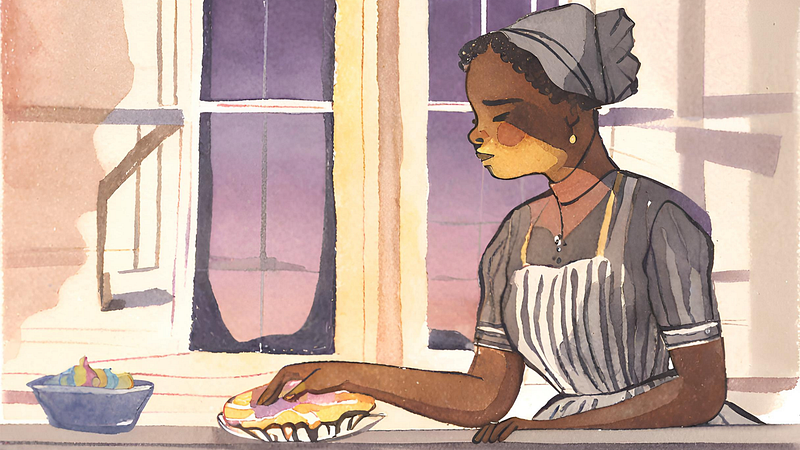
While many students are taught about the function of the Electoral College in our political system, they rarely learn about the racist underpinnings of this instrument. However, just like sweet potatoes, racism is baked into the pie. "Standard civics-class accounts of the electoral college rarely mention the real demon dooming direct national election in 1787 and 1803: slavery," Akhil Reed Amar, a professor of constitutional law at Yale University, wrote. Many would much rather keep this information under lock and key, like a skeleton in America's closet. Still, there is no way to learn about the history of the Electoral College without a discussion about the role slavery played.
Here's a quick refresher for those needing clarification on the Electoral College's function. While many colloquially refer to America as a democracy, this nation is technically considered a constitutional republic, where citizens vote for representatives. While all fifty states use a direct-voting system to elect their governor, the Electoral College determines who becomes president. No matter who an individual votes for in the state of Texas, for instance, the candidate with the most votes will win all the electors for that state. The candidate with more than half, at least 270, becomes president.
This, of course, disenfranchises everyone in the state who selected another candidate, exposing this system as less than democratic. However, this is how the Electoral College functions. It's how Donald Trump became America's forty-fifth president by winning the Electoral College despite losing the popular vote to Hillary Clinton. Rutherford B. Hayes in 1876, Benjamin Harrison in 1888, and George W. Bush in 2000 also won using this relic. So, if you ever found yourself wondering why winning the popular vote isn't enough to become president, the Electoral College is your answer. Our system allows a candidate to win the presidency, even if the majority of voters reject their leadership.
Donald Trump won the presidency because of two artifacts of slavery: the electoral college and our post-Reconstruction legacy of state voter suppression and disenfranchisement efforts. The electoral college was created in the Constitution to protect the interests of slave owners. And current voter suppression efforts are a direct legacy of white efforts to prevent blacks from voting after the Fifteenth Amendment prohibited race discrimination in voting. — Perea (2018)
Racism and anti-democratic values go hand-in-hand.
Where racism is found, anti-democratic values are never far behind. The only way you can maintain power in the hands of a few is by disenfranchising others. To understand why America uses the Electoral College system, consider the congressional debates about slavery and the representation that led to its creation. James Wilson, a Northerner and "the only person who signed the Declaration of Independence, the United States Constitution, and served as a Supreme Court Justice," initially proposed in Congress that the country adopt a direct presidential election process. However, his efforts were quickly curbed by James Madison, often referred to as the "Father of the Constitution," who bemoaned how unfair this system would be for White slaveowners. "The right of suffrage was more diffusive in Northern than the Southern states, and the latter could have no influence in the election on the scores of Negroes. The substitution of electors obviated this difficulty and seemed on the whole to be liable to fewest objections," Madison argued.
Since only White men had voting rights, Madison proposed that numerically speaking, if the country adopted a direct national election system, the South could not win a presidential election against the North because enslaved Black people, who made up nearly half of their population, did not have voting rights. As a result, the population of voters in the North far outnumbered those in the South. To compromise with Madison and other Southerners, Wilson, the Northerner who first proposed a direct presidential election, suggested Southerners count three-fifths of their enslaved population. "The Three-Fifths Compromise seemed to guarantee that the South would be strongly represented in the House of Representatives and would have disproportionate power in electing Presidents," so they gladly accepted. Under this system, enslaved Black people were counted but deprived of political representation.
Given the history of its creation, the Electoral College was a pro-slavery instrument from day one, helping to hold all the other ingredients together, codifying this barbaric system as legitimate in the eyes of the federal government. That is further proven by South Carolina's secession documents, dated April 26, 1852, when state representatives argued they had the right to maintain slavery because the federal government was "burthening them with direct taxes for three-fifths of their slaves." What this compromise shows is that, despite early White Americans claiming to believe in democracy, they quickly abandoned a direct national election process for picking the president because this system would disempower slave owners. Of course, another option would have been to abolish slavery altogether and ensure Black people had voting access, but White Southerners who relied upon free, forced labor and used their slaves as collateral for bank loans were unwilling to consider this measure.
In a direct democracy, citizens would vote for a presidential candidate, their votes would be counted, and the person who earned the most votes would be the winner. Still, America's Electoral College system impedes democracy. Students need to understand that our nation wouldn't use this method of picking a president if it weren't for the systemic oppression of Black people during chattel slavery. Counting three-fifths of the enslaved population doubled down on the idea that Black people were not citizens, or even human beings for that matter, just property to be bought and sold on an auction block.
The reason why millions of voters have their votes suppressed every four years is because of an archaic system designed to ensure White people, particularly slave owners, maintained an unnatural racial hierarchy. By keeping this system in place, they preserved power disproportionately in the hands of White Southerners. As Wilfred U. Codrington III, an assistant law professor at Brooklyn Law School and a Brennan Center fellow, wrote about the Electoral College, "More than two centuries after it was designed to empower Southern white voters, the system continues to do just that."
Codrington referred to the Electoral College as the "oldest racial entitlement program" since it was explicitly designed to benefit White people over that of Black and Indigenous people. Ironically, the same group that has been complaining about the unfairness of affirmative action programs has been benefiting from them all along under this policy. When Black Americans talk about the lasting legacy of slavery, they're often accused of being out of touch or stuck in the past. However, the fact that we're still using a relic of slavery to determine who becomes president proves we're not far removed at all.
Indeed, as long as the Electoral College stands, our nation will continue to fall short of its democratic values. And we've seen the consequences play out. When someone can become president without winning the popular vote, it enables them to appoint Supreme Court justices, as was the case with Trump, whose values were contrary to those of most Americans. For instance, a Pew Research Center study suggested that 54% of Americans view the conservative-leaning Supreme Court unfavorably. This is a political travesty, to be sure, but it's emblematic of the flaws in America's federal structure.
When slavery was abolished, the country failed to eliminate the Electoral College, despite this system being created to keep disproportionate power in the hands of White Southerners. Racism is baked in, so we must bake an entirely new pie if we're looking for a different outcome. Perhaps a constitutional amendment abolishing the Electoral College in favor of a direct voting system could alleviate this problem. And yet, there is a lack of imagination or bravery by many, depending on who you ask, to propose a legislative answer to the Electoral College. Perhaps that would change if more people realized this system was a byproduct of the chattel slavery system, if they understood how racism has been baked into the process.
Reference
Perea, J. F. (2018). Echoes of slavery II: Slavery’s legacy distorts democracy. Loyola University Chicago, School of Law. https://doi.org/10.2139/ssrn.3015302
🌹Learn more about the author here.