
How The Dutch Invented the Modern World
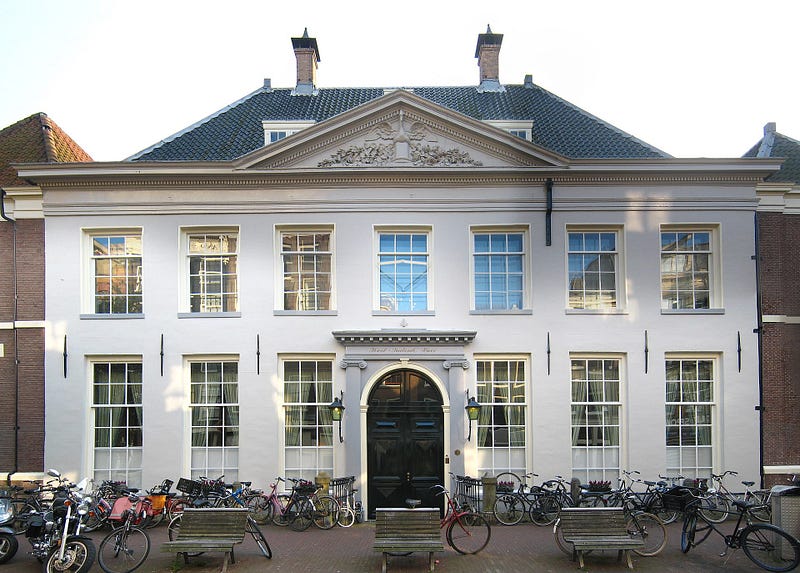
The Dutch didn’t make just America, but the modern global capitalist world. The Netherlands is a covert, pocket superpower whose financial and legal model other societies have copied, and prospered from, or failed to and didn’t. The long story is in Why Nations Fail: the Origins of Power, Prosperity and Poverty (Acemoglu and Robinson). Herein you’ll read the short version: the Dutch created the modern world and its trading networks, the English copied them and the Americans and the rest of the Anglosphere copied the copy. Everybody else had to adapt and play catchup to prosper (France, Germany, Italy, the Nordics, Japan), or fall behind (the Ottomans, Chinese, Arabs). Vast empires that had been the western world’s teachers became students. Dismissing foreign western ways due to not invented here syndrome became geopolitically suicidal. How did such a tiny underwater country precariously built on land wrested from the sea do so much with so little?
The Dutch republic found the sweet spot between limiting state power enough to allow contract-based financial and trading markets to flourish free from rulers’ interference, while building a unified national state strong enough to ensure sovereignty and the stable, predictable rule of law investors always look for. Like the future USA, the Dutch United Provinces were formed from a voluntary union, an invented nation. Here’s the early 17th century English ambassador on Dutch liberties:
“For deciding those between the great Towns; For raising a militia for the defence of their Countreys in the wars of their Neighbours; For advice in time of Dangers abroad, or Discontents at home; But always upon the new Succession of a Prince, and upon any new Impositions that were necessary on the people. The use of this Assembly was another of those Liberties whereof the Inhabitants of these Provinces were so fond and so tenacious.”
Here’s how the Dutch did it and how they gave us modernity:
- The first war of national liberation.
It took 80 years from 1568–1648 for the Dutch to free themselves from the theocratic Habsburg monarchy of Felipe II, III and IV and create the world’s first modern republic. Determined to subjugate the heretical Protestant Dutch, the Habsburg Empire obtained the exact opposite of what it intended. The Peace of Westphalia of 1648 recognized Dutch independence and religious freedom and enshrined the principle of national sovereignty and non-interference in the internal religious affairs of states. The modern international state system dates from the Peace of Westphalia. How did the Dutch defeat the largest and richest empire on earth?
2. Asymmetric guerilla warfare fought by citizen soldiers.
The Spaniards said they fought like ghosts and devils speed skating on frozen canals. It helped that the 17th century was still in the grip of the Little Ice Age instead of today’s global warming. The sense of teamwork created by the collective effort of holding back the sea with dykes built over five centuries prepared the Dutch very well for citizen soldier insurgency warfare. Rembrandt’s Night Watch is a portrait of this citizen soldiery.
3. Dutch Finance: the Bond Covenant’s Rules Are Above the Rulers
Bill Clinton’s campaign manager, James Carville, once said he wanted to come back to life as the bond market because you can scare everybody. The origins of his joke that’s no joke: the Dutch invented the modern bond market and stock exchange to finance their war against the Habsburg Empire. Spain’s gold from the Americas was no match for citizen and (domestic and foreign) investor-financed war through the bond market. In one battle off the coast of Matanzas, Cuba the Dutch Admiral Piet Hein plundered 11.5m guilders worth of Spanish gold and silver, financing the war effort for eight months and netting the Dutch West India Company’s shareholders a 50% dividend in a single year. This is just one example of how the Dutch invented the fiscal military state, establishing the virtuous circle of profitable credit-financed warfare later perfected by the USA ‘s Lend Lease program in WWII.
How did the Dutch improve on professional armies’ medieval and early modern war financed by Italian bankers’ loans? Bond covenants superseded rulers’ power to default, and investors who bought Dutch government bonds knew it. The Amsterdam stock exchange provided investors with a liquid secondary market which Medici loans never had. The Dutch had the last laugh after they lost New Amsterdam in 1664 to the English with William of Orange’s 1688 invasion to overthrow King Charles II with an armada twice the size of the Spanish one. This imported what Alexander Hamilton called “Dutch finance” into England. The Dutch invented contract-based debt-fueled bond covenant capitalism with rules-based limits on state power, and the English copied it. This is the origin of the Hamilton-inspired clause in the US constitution “the debt of the United States shall not be questioned.” Hamilton knew the new republic needed to convince bond buyers that “the full faith and credit of the US government” was as good as that of the Dutch Republic that lent the American revolutionaries $7 million in 1781. This loan convinced the British to throw in the towel and sign the treaty of Paris in 1783. John Adams lived in Amsterdam for two years and learned Dutch to negotiate this junk bond deal with a very high yield 7% coupon.
Liquid financial markets in which investors could trade securities attracted speculators, and created the world’s first bubble and crash, in tulips in 1637. At the peak tulips were traded for or served as collateral for Amsterdam canal houses. The Dutch called it “windhandel”, selling wind. The crash was made worse by speculators buying tulips on credit, expecting to pay back their loans after selling tulips or tulip futures at a profit. A foretaste of the roaring ’20s and ’90s internet bubbles. Bubbles’ assets may vary, human behavior never.
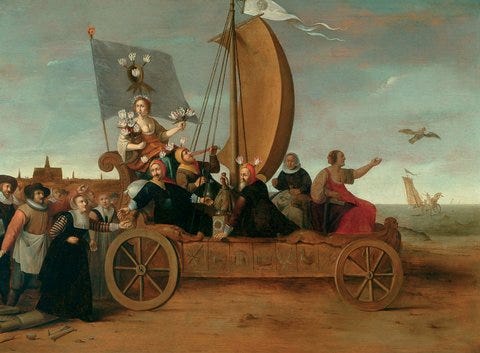
4. Trading, Painting and Drinking: The World’s First Meritocratic Mass Affluent Middle Class Society
The Golden Age Dutch painted, bought and sold 10m paintings, another decorative market-driven boom and bubble of the world’s first mass consumer society in which money meant more than aristocratic or social rank. Artists painted secular themes for the market, not the church or aristocratic patrons whose power exercised a monopoly over their talents. Nouveau riche or just bourgeois clients commissioned portraits to show their new status or to decorate their houses — and taverns:
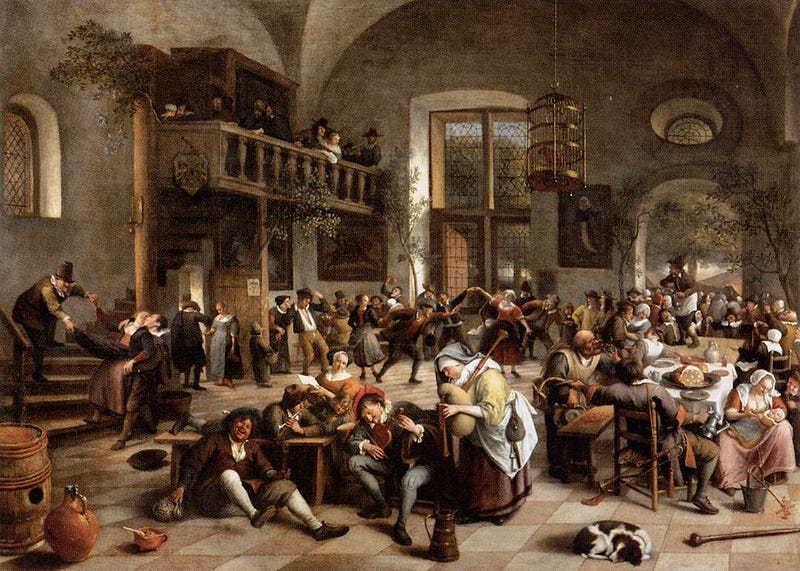
Steen knew his hard-drinking countrymen as well as anyone. The artist lived upstairs from the tavern he owned.
How important was, and is, money, and stark directness about it, in Dutch society? A Dutch yachbuilder client of mine once joked, “how do you fit 20 Dutchmen into a Mini? Throw a Guilder into it.” He also said, “why have the Dutch persisted for so many centuries in living below sea level? Becoming German was the only alternative.” But that’s another, longer, 20th century story about my Dutch family.
5. Revolutionary Idea Exported by Example
Voltaire visited the Netherlands, and was astonished by the new, egalitarian, post-feudal society the new Dutch Republic had created. He also fell in love with a French Protestant refugee and then wrote in favor religious and intellectual freedom and civil rights. The result: “Italy had a Renaissance, and Germany had a Reformation, but France had Voltaire; he was for his country both Renaissance and Reformation, and half the Revolution.” (Will Durant). The Dutch republic’s example also inspired encyclopiste Diderot and the French Jacobins’ philosophical godfather, Rousseau. Books censored in France could be published in the Dutch republic, undermining the ancien regime’s legitimacy. From Diderot’s Voyage en Hollande:
●“It’s become the 2nd fatherland of the French intelligentsia and one feels at ease here in the United Provinces which is documented in Paris’ libraries…Amsterdam is the great market of the world; its buildings have in them all that’s possible to imagine from the four parts of the world that is useful and agreeable…Nothing else on the entire face of the world reveals so prodigious an opulence.”
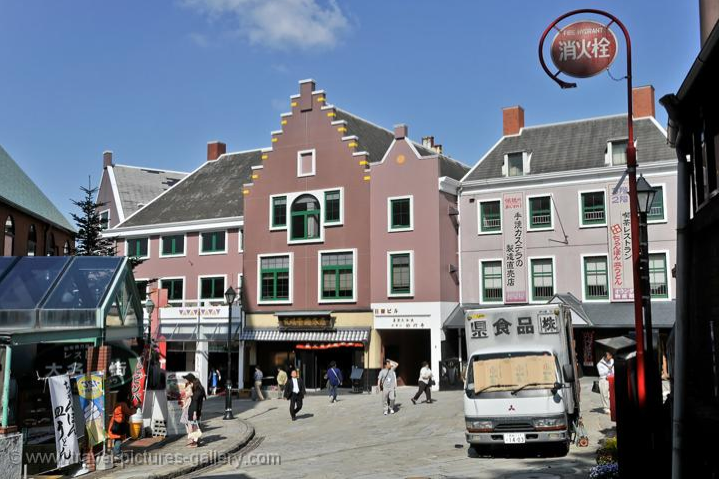
The point is to think of the bond market and mass affluence as a Dutch Treat exported to those parts of the world capable of imitating Dutch rules above the rulers financial and legal institutions, as far away as the trading outpost of Nagasaki.
6. Religious Freedom and Jewish Emancipation
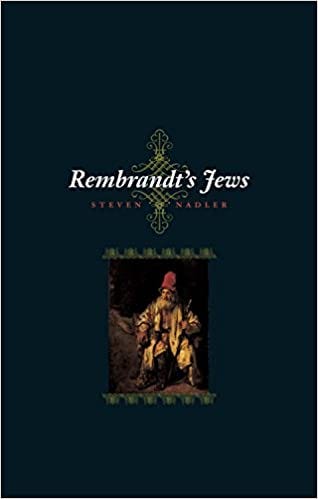
The Dutch welcomed Spain and Portugal’s expelled Jews, as did the Dutch governor of New Amsterdam in 1654 when 23 of them arrived from Recife, Brazil, fleeing the Inquisition. Rembrandt van Rijn, the greatest of Dutch painters, lived in Amsterdam’s Jewish neighborhood and painted his Jewish neighbors with individuality and humanity, not with vicious medieval stereotypes. Unlike the Frankfurt ghetto the Rothschild family lived in and was locked into every night, Amsterdam’s Jews were free to move about, engage in commerce and employment and practice their religion, as were the Puritan refugees from Charles I’s England who sailed to North America in 1620.
6. Technology Transfer: Peter the Great goes to Zaandam
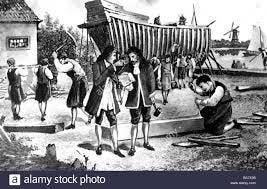
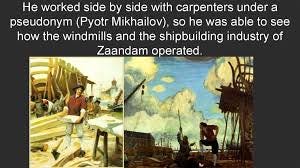
Zaandam is a yachtbuilding town northwest of Amsterdam. The Dutch build the world’s most costly megayachts with some of the world’s best paid shipbuilders. This is a heritage built over centuiries, and where Russian Tsar Peter the Great learned shipbuilding and naval warfare from the Dutch. Peter learned his lessons well, applying them against the Swedes in the Great Northern War, ensuring Swedish neutrality and Russian dominance of the eastern Baltic and Estonia, Latvia (where I live) and Lithuania. Russian victory and Swedish defeat gave a resurgent serfdom another 150 years, further dividing eastern from western Europe. Part of the deal the Baltic German barons made with Peter to switch sides: close the free public schools the Swedes had established for Latvian peasants to keep them as illiterate as black slaves in colonial Virginia.
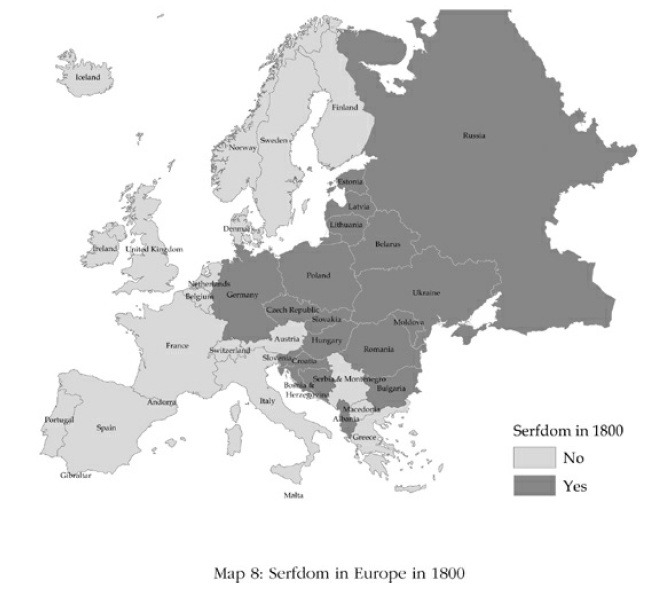
Dutch naval and navigational prowess was a boon to Russia, England, Sephardic Jews and French Huguenot refugees who sailed to New Amsterdam and South Africa….and a disaster for Latvians, Native Americans, enslaved Africans and the sugar growing Caribbean and the future Indonesia. The Dutch loan that helped end America’s Revolutionary War with Britain delayed slavery’s abolition in North America and ensured a more violent and genocidal displacement of Native Americans. Like all of human history, the Dutch story is morally double-edged. It was a boon to states and societies that successfully emulated parts of the Dutch model and disastrous for those that wouldn’t or couldn’t and were colonized. The aggressive imperialism of states such as Germany, Japan and Italy, that cherry-picked the convenient financial and contractual parts while dispensing with the model’s tolerance and pluralism, was also catastrophic. Today’s authoritarian populists— Russia’s Putin, Hungary’s Orban, Turkey’s Erdogan, India’s Modi, Saudis’ MBS, Trump— also think they can cherry-pick the parts they like while leaving the rulers above the rules. Let’s hope they’re wrong and that those who think they can acquire legitimacy because they’ve acquired power have it exactly backwards.
___________________________________________________________________
Full disclosure for questioning my objectivity: my brother married his Dutch wife in 2003 in the Amsterdam HQ of the Dutch West India Company and I have a Dutch niece and nephew. I met my Latvian wife, an importer of Dutch flowers, at the Queen’s Day celebration of the Dutch embassy in Riga, attending with my brother’s unused ticket. He met his Dutch wife at my Italian wedding in 1997 and was returning the favor. The maternal side of my sister-in-law’s family from Maastricht hid a Polish Jewish family in their attic for 22 months until Maastricht was liberated in October 1944. As an 18 year old my sister-in-law’s mother, Truus Rijnbout, guided the family across a muddy field to the allied lines through artillery fire. Her parents, Jacobus and Eelkje Rijnbout, parents of eight children, have a tree at the Yad Vashem holocaust memorial, an honor granted to them by Israel’s ambassador in April 2004 at a televised posthumous ceremony in Maastricht on the edge of that field.