
How the Coronavirus Pandemic Is Helping Women Find Their Power
Being quarantined just may make us realize we are beautiful and lovable without all those costly self-improvement routines
We’re in the middle of a pandemic, when people are stuck at home alone or with partners and maybe with children, possibly unemployed or working at home or putting themselves at risk as essential workers (and thank you).
If you’re a woman, you may suddenly find yourself in uncharted territory. You can’t go to your hairdresser, get a mani/pedi, hit the weekly SoulCycle class, re-up the Botox, have your eyebrows microbladed, dye your eyelashes, schedule your facial, have your lady parts waxed.
In other words, we’re unable to attend to all the beauty routines we’ve been told are essential to be our best self. Which is why Karen Karbo’s Yeah, No. Not Happening: How I Found Happiness Swearing Off Self-Improvement and Saying F*ck It All ― and How You Can Too (Harper Wave, May 19) could not be coming out at a better time.
We are in a time of Beauty, Interrupted, but whose version of beauty? Karbo makes it pretty clear that consumer culture has made huge profits by convincing women that we aren’t “all that” on our own, but if we just bought X, Y and Z and did X, Y and Z, we might finally be our best selves. Until, of course, they find another thing we need to improve. And, even in a pandemic, we are still being sold products to “embrace the natural look” while in quarantine, which can’t be all that natural if we need products to achieve it!
Her book goes into many areas of how “self-improvery” has messed with women — and there are many ways. But it made me think about how much women do to themselves to attract a man (assuming we’re hetero women, and not all are). The many beauty routines we indulge in to fit into a narrow version of what’s considered beautiful is a way to not only be worthy of the “male gaze,” but also to perhaps be feminine enough to get the ultimate prize — a man of our own. It also sets up women to constantly compete with other women.
As Karbo notes,
“The amount of time, energy and money women of privilege spend on self-improvement rivals solar as a power source. Imagine what the world would be like if we directed even half of that toward lifting up other women and doing our bit to save democracy, not to mention the planet.”
I do like the idea of lifting up other women (and saving democracy and the planet, too, of course).
One woman who is doing that is ad exec and founder of MakeLoveNotPorn.com Cindy Gallop, who told me how she came to that realization:
“One of the best moments of my life was the day I stopped looking for The One. As girls we grow up being told that our entire life is the search for The One. In our teens and 20s, every social event we go to, ‘Will he be there?’ … This dynamic forces us to compete with other women, which I don’t want, and at some point in my early 30s, I said, fuck this. Oh my god, the liberation. I could just go to social events and enjoy myself.”
Could the stay-at-home orders during the pandemic force us to rethink the choices we’ve made and why we made them, and lead us toward living a much more authentic life? And could it finally convince women that we’re beautiful and lovable even without our costly and never-ending beauty regimens?
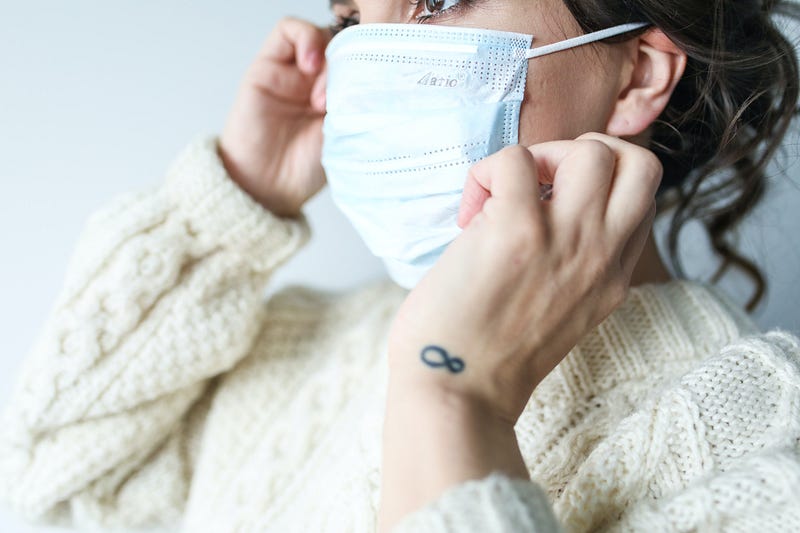
It’s likely that we’re going to be wearing masks in public for a long time to come. Your plump lips from Juvederm injections? Very few people will see them.
As Karbo writes,
“For millennia we’ve been forced to function within a society created by and for men. How we come across to men has determined the quality of our lives.”
That’s giving men — and consumerism — a lot of power over us gals. I’m ready to reclaim mine. Are you?


