How Dead Publications Can Be Revived in A Day
Possible solutions to the closing of publications

It hurts when I see the glistening, bloated dead bodies of PS I Love You, the Ascent, and the PGSG.
When you nurture a publication, it’s like raising a child. Let’s see how this crisis unfolded.
The mess at Medium — The Verge story on March 24, 2021
“President Joe Biden is Being Served Erotica on Medium.com,” the Whitehouse staffer complained in an internal post.~ the story
Ten ‘garbage publications’ had added Joe Biden as a writer as well. It was beyond embarrassing for Ev Williams, who was already cutting the budgets of publications. It was the last straw, and he fired a dozen or more editorial team members politely.
The Medium publications, like OneZero and Forge, were run by professional editors and Medium employees. Many of them earned more than $100,000 a year.
I think a significant factor is that the role of publications — in the world, not just on Medium — has decreased in the modern era. ~ Ev Williams on March 23, 2021
In an email, Ev Williams says, “The bet was that we could develop the Medium publications into brands with loyal audiences that would grow the overall Medium subscriber base. What’s happened, though, is the Medium subscriber base has continued to grow, while our publication’s audiences haven’t.”
In simple words, writer stories brought more subscribers than Medium-funded publications.
But publications are a vital part of the Medium experience if you are a writer. The process starts with a choice: the red pill or the blue pill.
Be a writer or publication owner — the choice
The writer writes and gets the money. The owner of the publication reads, provides feedback, and publishes the story but gets no money. Okay, life is not fair.
But you have to choose. Either you write like Tim Denning or Sinem Günel, or you run a publication like Steve Campbell.
But you don’t have infinite time or energy. Suppose someone starts a quality publication, their writing time will go into running and maintaining the standard of the publication. They can’t write.
If you don’t write, you don’t get money. Steve Campbell has 9000 followers, but many of the writers of the Ascent have more followers.
Medium-supported or funded publications are proof that if you pay someone money, they can maintain a high standard for their publication.
Various models for tipping publication owners
What can we call it? We can call it tipping the publication owners.
If the platform pays its publication owners, say 1% of a story’s earnings, what does that mean? It means that a writer gets 99 cents instead of a dollar. Every writer can tip 1 cent to a publication that gives it writing advice and reading time.
Suppose a publication has 100,000 minutes of reading time every day. Its owner will get 1% of approximately 200,000 cents or $2000. That is $20 a day or $600 a month. It’s not much, but it can be an incentive to keep doing what they are doing. For small publications, with 1000 reading minutes, they get $6 a month — almost nothing. But it pays the membership fee.
For popular publications, with 1 million minutes of reading time, the owner would get $6000. That could be a huge incentive to continue expanding the publication and not leave Medium — or talk against Medium.
Now imagine the case of 2% of the story earnings going to the publication owner. The owner of 1000 minute reading time gets $12, for 100,000 minutes, it is $1200, and for a million minutes, the figure goes to $12000 a month.
Give publications the option to choose 0%, 1%, 2%, 3%, 4%, or 5% model.
Give publications the option to choose 0%, 1%, 2%, 3%, 4%, or 5% model. Writers will know they have an option. Publications can move from 0 to 5 percent as they muster a large readership after years of growth.
Writers of PS I Love You, the Ascent, and PGSG will be willing to tip their owners 2% ( or even 5% ) for providing them with a regular readership. (Readers are clients of writers, and the publication is a shop for placing products. Medium is the shopping mall in this analogy. )
Writers who don’t want to tip the owner can choose the publication that adopts the 0% model.
Let me know in the comment what you think about these models. If enough writers are willing to tip publication owners, then it wouldn’t effect Medium’s reputtion.
If publications could advertise on Facebook or YouTube
If publication owners got such an offer to earn money, most would opt for it.
I know it takes time to read and publish stories. Popular publications have lots of submissions and what finally shows up is only a part of the effort.
Financially satisfied publication owners would try to expand the reach of their publication by advertising. Suppose a publication like the New York Times on Medium, starts advertising itself on the New York Times main website. What if CNN creates a publication for political opinions on Medium and starts advertising it? Or HBO starts a publication for reviews? These could bring new memberships for Medium as well.
Why writers are leaving?
Francesco Rizzuto says, “When my monetary rewards plummeted by 80% in a single month since launch of the new business model but without any change in output on my part (minimum 2 articles per day, at least one achieving distribution per week), I just can’t ignore the writing on the wall.”
Is it for views only? Probably not. But how can a writer leave Medium until there is no platform like it? WordPress blogs are hard to maintain with no traffic.
Some people are leaving to move forward in their careers. They have other opportunities. Frustrated but motivated to move on.
Everybody is not going to leave. Most writers still love Medium. But if the writers are actually leaving, it may have something to do with publications shutting down.
What the publication owners felt and said
Publication owners cannot expose the real reasons for shutting down. Politically correct responses of owners are not exactly straight. Still, you can read between the lines:
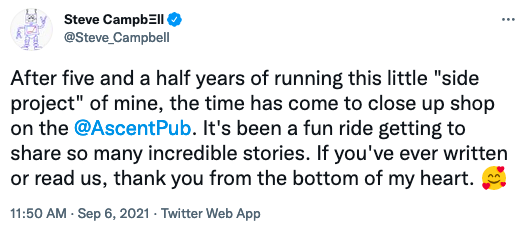
The Ascent Publication
Steve Campbell said:
PS I Love You
Dan Moore, Kay Bolden, Tre L. Loadholt, and Scott Muska said:
“A few weeks ago, we were informed by Medium that they would be pulling their funding for PS I Love You. This was not all too much of a surprise, given the larger changes that have been happening around editorial at Medium.
Still, it sucks. And after some difficult conversations among our team about how to proceed, we’ve decided we have no real choice but to shut down the pub. Our last day publishing new stories will be June 30. We’re going to miss all y’all deeply.” ~Goodbye from PS I Love You
The Post-Grad Survival Guide
Tom Kuegler said:
“It’s just that I can no longer financially justify paying our Editor-In-Chief Stephen to continue looking over submissions from everyone. For a long time, Stephen and I both thought that Medium might offer us a contract (like several other pubs have received), and while we were close NUMEROUS times, it never fully materialized due to matters out of our control.”
Medium wants to focus on writers but…
Medium used to feel more like a slick magazine; now it feels like my Facebook newsfeed. ~ Tony Yiu
From spring 2021, when Medium has fired most of its editors, the emphasis on publication is gone. And the relational model is to be between writers and readers — one to one. But when Zulie Rane tried to self-publish her stories, her views took a nosedive.
Medium is paying bonuses to writers and announcing writing competitions to attract writers who never heard about a place called Medium.
But publications are like nests. In the sea of Medium writers, some writers can more closely bond together. Just like the writers of a print publication who go to the same bar in the evening.
The first viral story of most writers was published in some respected Medium publication. The publications were the launchpad for many successful writing careers who resigned from their day jobs (like Amardeep Parmar.)
Writers can immediately get an audience from niche-based publications. If you are writing about brain fog, you can send the story to Invisible Illness.
But Medium is going all relational. In the relational model, you’ll have to write for years before the readers know you can write about the brain fog or other psychological problems. And if you want to write a story about happiness, your audience can feel irritated by that story — they only want to read what is wrong with us.
In other words, you’ll have to create new Medium accounts. Every single account would focus on developing a relationship with one particular set of readers. But it is going to take years to develop a relationship with enough readers to pay you a respectable amount.
What is the relational model?
“Among other ways, the internet has changed media consumption along a spectrum that you might call relational to transactional.” ~ Evan Williams
In simple words, the readers on the internet just read a story— a one-time transaction — and forget the name of the writer — they don’t create a relationship with the writer.
Through Medium, Evan Williams wants a relationship between readers and writers. If people love a writer, they’d easily pay for a subscription fee — like Substack. (The writer gets a 50% cut of the subscription fee every month.)
Ev says, “Navigating from homepage to homepage — the digital equivalent of picking up a magazine — feels very antiquated and inefficient when the headlines can all be aggregated and presented to you, personalized. Or, depending on your need, when you can search for a specific topic and be led directly to a reasonable set of answers by the authority of Lord Google.”
What he is saying is that when people know a writer, they can trust their wisdom. They can trust their sources and conclusions.
He says, “The relatively limited number of outlets and the gatekeepers who controlled them in the pre-internet world let a very small number of perspectives be heard.”
When a reader goes to a publication, they are forced to read the content which the publication editors have selected. But if there is a one-to-one relationship between the reader and the writer, no intermediaries are needed.
A purely transactional world has a ton of downsides. ~ Evan Williams
If a reader is influenced by the “headline+image” combo, then relationships cannot form. A reader should discover a trustworthy writer — not an editor.
Television analogy
Evan Williams believes: “Different consumption modes drive different content. If you’re flipping through channels, you’re not going to stop at a show where you need to have watched the 12 previous episodes to appreciate. Or even the whole episode. The worst of TV today (and there’s still plenty of it) optimizes for no context required — recaps after every commercial break and teasers before to keep you tuned in, which you probably won’t, because you don’t care. It’s transactional.”
He says, “the way to succeed in that world is to make something so good people tell their friends about it. You hear people obsess about GOT enough, you have to subscribe to HBO. That’s the game.”
A reader may read a few articles but she’ll be a regular subscriber. Good writers get reads and other writers — with clickbait headlines and misguiding images — get nothing.
“Our reading has gotten more transactional while TV has gotten more relational.” ~ Evan Williams
He says that podcasts, newsletters, tweets, and even Instagram/Snap-style Stories are relationship-driven media.
Blogging has to be relational
“One of the things I loved about blogging back then — and that people enjoy about writing newsletters today — is the feeling that you’re publishing to a relatively consistent group of people who care what you have to say.” ~ Evan Williams
Medium writers will have a small and loyal readership. People will read whatever they write.
“Your success is less dependent on your latest headline and more on delivering on the trust your readers have given you by showing up”. ~ Evan Williams
When Medium is paying 50% of the subscription to you, it means if you bring in 100 subscriptions, $227 is yours whether you write a single story or five stories. If you bring 1000 subscriptions, your $2270 is secure even if you write no story in a month.
This brings a name to my mind: Zat Rana. He left Medium for Substack. He could have brought Medium 10,000 subscriptions, and his share would have been $22,700 a month.
Seth Godin can do that as well. If he brings Medium 10,000 subscriptions in a year, his monthly income would be $22,700.
Imagine Suzanne Collins — the author of Hunger Games — creates a Medium account. Or J.K. Rowling creates a Medium account. If Suzanne Collins or J.K. Rowling brings 100,000 subscriptions in a year, their monthly income would be $227,000. Don’t think about Stephen King. Please, don’t.
In simple words
The idea behind Medium was to give the writers a platform to publish detailed thoughts and unique points of view — without grasping the technical side of blogging.
Medium thinks everyone has at least one great story to tell. Every great story can have millions of views. Medium gives sensitive human beings — otherwise known as writers — to show the world what they went through in life.
Occasional writers bring a flavor to the readers that nobody can match. This gives the platform its edge.
On the other hand, Evan Williams wants to reward regular writers with writer fellowships and bonuses.
Our distribution system encouraged a one-time read more than building a relationship between the writer and the reader.
The readers were lost in the lists of curated stories. Now they will evaluate a writer and follow him or her if they think they want to read them. The focus is on regularly reading and paying subscribers.
The vision of Evan Williams is to create a network of thinkers and perspectives. He wants both the content and the network to evolve into greater density and complexity over time.
Here are three more suggestions:
#1. Just one ad at the bottom of every story
Medium hates ads. I hate ads too.
But I won’t mind one ad on a Wikipedia article if a paid team checked that the contents of the Wikipedia article were reliable.
I think readers won’t mind one ad at the bottom of every story if it never disturbed their reading experience.
Remember that Twitter has sponsored tweets now.
What are Promoted Ads? — Twitter for Business
Promoted Ads are ordinary Tweets purchased by advertisers who want to reach a wider group of users or spark engagement from their existing followers.
#2. Let new writers boost their stories
On Facebook and YouTube, content creators can boost their posts or advertise their videos.
Let new writers boost themselves or their stories by paying $5 or $10 — at the bottom of a story. (It is a free feature at this time for a selected few.)
Medium apps can provide an option to a reader to turn the advertisement on or off.
#3. Let new publications boost their stories
If publication owners earn money using their valuable time, they can be allowed to boost their publication or publication stories by paying $5 or $10.
At this time, at the bottom of every story, there is an ad for buying membership of Medium anyway. How would a proper ad hurt if it provided money or resources to grow the platform?
Final thoughts
Medium entered the year 2021 with more than 700,000 paid subscribers, putting it on track for more than $35 million in revenue, according to two people familiar with the matter. ~the Verge in March 2021
I hope I know nothing. And I want the Medium team to succeed in doing whatever they want to do. I pray they don’t mess things up.
In the first week of lockdown, I found Medium, and I loved it. I felt busy and engaged, and it was a blessing. It helped me stay sane. I want Medium and its writers to flourish — above everything else.
To Ev Williams Medium is first and foremost a technology product, his colleagues say.
Just like I love Medium, Ev Williams loves Medium, the publication owners also love Medium. If the tipping system is built into the system app, you’ll see the publications opening their doors to new submissions. It would be foolish not to restart operations tomorrow morning.
At present, most of the publication owners use Patreon or Ko-fi to ask for tips. Some writers are going to Substack for a more loyal readership.
I leave you with this comment:
But I’m sure enjoying myself and communicating with many nice and some very interesting people whether they agree with me or not. That’s worth a lot . . . ~ Mike Meyer
You can read my curated stories here.
Special thanks to Dr. Mehmet Yildiz, Dr. Preeti Singh, Britni Pepper, Josh Balerite Acol, Marcus, and other editors for their support.