
How the #Black Lives Matter Forces Us to See What’s Wrong With D&I Programs
Black writers point out the flaws and failings
Fellow Medium writer Rebecca Stevens A. penned a piece the other day which really got me in the feels, not only because of work I’ve done in this area but also because of the ache of lost opportunity:
She points out a terrible reality, which has dogged corporate America (largely still owned and run by White men): they largely simply don’t have a clue.
This of course doesn’t speak to the Instagrammer-Do-it-cuz-it’s-trendy culture that led so many individuals to show up with BLM signs, but that’s another article. After all corporations are made up of flawed individuals, who are just as susceptible to such foolishness ( do I need to mention the Pepsi ad with Kendall Jenner? didn’t think so) But I digress.
Most of us don’t have a clue, even if we mean well, because too many keep hiring and promoting folks who look and think like themselves (as do we all). No matter how well-intended, diversity efforts fail if you only have ONE senior executive of color running them. Worse, when all the other C-suite folks are White, cannot relate, and place their own value set on what that D&I person is trying to direct, change and improve.
In all fairness, this is overly simplified for the sake of brevity. Stay with me here.
To illustrate this, I will offer another smart piece from this same writer which expresses that very point:
We cannot see what we cannot see, and some of us stay blind and in denial for life. To change how we understand the world means that we really do have to own where we are wrong, or misled, or misinformed, or have made terrible blunders. To his credit, Rebecca’s mentor got this. Many do not.
I’ve worked in various areas of the D&I space for years. I’ve also worked in the women’s development space my entire life, and in that arena constantly ran into the very same issues Rebecca did: male mentors who simply did not understand, as she puts it very succinctly:
As a black woman I thought, how can I ever build a network of white men ready to vouch for me, support me, get me stretch assignments, an MBA, and an ex-pat assignment. He had had this support since before he was even born. (author bolded)
When the system is already established from time immemorial to favor a gender or race, it is nearly impossible for those who benefit to understand that a) you and I as women, and Rebecca as Black woman, DO NOT automatically have access to those resources. They cannot imagine any other world, and they automatically assume what works for them is in place for us. This kind of blindered thinking is part of what torpedoes otherwise well-meaning efforts. Then b) other White men have no incentive to force open the hallowed gates to let us into the Club.
Worse, when our (well-meaning, White, often male) mentors promote us, there’s this:
My mentor took me to meetings to introduce me to his network. He gave me assignments and opportunities to be visible among the group. While he commanded the respect of the room whenever he spoke, I realized that the others started fidgeting or typing on their Blackberry phones when I did. As if that wasn’t bad enough, they would speak over me when I tried to explain certain concepts or provide feedback.
Her mentor likely didn’t even see this. You and I do because we see it all the time. This is what we are accustomed to.
Her mentor, had he been far more aware, might well have called out that behavior. He could have created a format or session which required that those in the audience engage, respond to and comment on Rebecca’s material. That would have required that they attend, make note of the quality of what she presented, and forced the acknowledgement. Begrudgingly, perhaps, but without that, people are sneaking a look at their texts as a way to completely ignore Black Excellence.
Why? Likely lots of reasons. Among which is that if White male execs are forced to acknowledge Black Excellence, they might also be forced to acknowledge that their limited understanding of the world is bloody well wrong.
Or at the very least, badly skewed or uninformed.
That’s a huge step. Most of us will fight hard to resist, which is of course one of the reasons the D&I Executive, even in the C-Suite, is one lonely SOB. A voice in the wilderness, if you will. Even if the CEO is socially conscious and engaged, he (more than likely a he) has an uphill battle trying to force engagement among his execs. Worse yet, but even more essential, is getting those execs to live, demonstrate and coach diversity, social awareness.
In my experience, those executive positions in corporate America that do the D&I work are almost always peopled with Black folks, which is fine, but they are not always financially supported. That telegraphs to everyone else in the C-suite that those efforts aren’t serious. Well-meaning if you will, but immediately cut if business experiences a slowdown.
You see the challenge. That’s just one reason why D&I efforts have had such an awfully difficult uphill battle.
The other, which Rebecca points out with terrible truth, is this:
And since there are few roles for minorities at the top, there are those who feel so threatened by another minority taking their place that they do not even want to share their journey or network to help you get there …
I have to expand on this. Kindly: this is precisely what I saw coming up as a woman-a White woman- in those Eighties years when the exact same thing was a truth both in the military and corporate America. There were and still are so damned few female senior execs, and the belief in scarcity so powerful, that those same women actively undermined any and all attempts by junior women to move up.
That scarcity is created by the patriarchy and White males. That manufactured scarcity causes us to war among ourselves, not only White women, but it also means that those White women who finally did make it a bit higher are just as viciously jealous of their limited positions that they will undermine Black Excellence for precisely the same reasons.
This is how we shoot each other in a battle that needs allies, not friendly fire casualties.
To that, kindly, I am going to hijack and adapt that great quote by Madeleine Albright:
“There is a special place in hell for women who don’t help other women (and people of color).” (author edited)
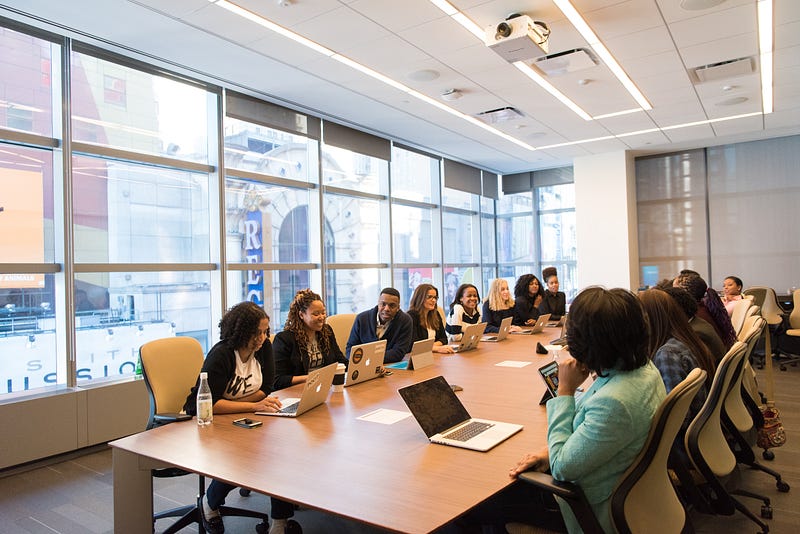
We as White women can no longer be the evil Gatekeepers. As you and I move up in corporate America, and we are slowly, we have the sacred responsibility to that corporate community to reach out, include, develop, engage and mentor Excellence in any color.
This is the particular gift that we as women have: we are community builders.
It has long been my experience that communities of color are inclusive by nature, so this is hardly limited to a gender. Empathy and compassion are not gender-specific. They are, however, powerful traits that are sorely needed in corporations, not only for hiring, but for how those corporations behave responsibly in a deeply-troubled world.
As has far too often been the case, we can become what we in the military, when I was a very young lieutenant, called battleaxes. Embittered, protective, angry, spiteful and jealous senior women, terribly protective of and hoarding what little ground we have gained. Miserly.
In other words we have vaginas and breasts but we act like (patriarchal) men, think like (patriarchal) men, and perpetuate the very (patriarchal) culture that eats its own children.
Shame on us indeed. Just…shame on us.
We can fundamentally overhaul the corporate culture to make it inclusive, compassionate, and engaged. Diverse boards help, but even those corporations which have them aren’t guaranteed better results:
Leadership defines the culture, the culture defines whether or not diverse voices are valued, and an award system also guarantees performance. No measurement, no action. Words are hardly enough. Financial incentives move butts.
From the article:
Many boards continue to recruit directors from the pool of current or former CEO/CFOs, and changing demographics within these pools do present opportunities to recruit more diverse members. For example, our interviewees on the boards of hi-tech start-ups and cyber security firms revealed that women, minorities, and younger board members often hold these coveted roles on boards in their firms and industries.
Still, the real question is the culture. To that, again from the article:
Diversity doesn’t matter as much on boards where members’ perspectives are not regularly elicited or valued. To make diverse boards more effective, boards need to have a more egalitarian culture — one that elevates different voices, integrates contrasting insights, and welcomes conversations about diversity.
To Rebecca’s point: if there are very high-level minority folks in a corporation, then it is incumbent upon them to identify, engage, include,mentor and lift up other talented diverse voices rather than play Katy Bar the Door out of the terrible disease of scarcity thinking. This is the only way we change the conversation.
We FORCE the pie to get bigger, because that has no limits. None whatsoever.
Making the pie smaller makes the pie disappear altogether.
I no longer work in the Fortune 100, although I still have clients there. I still do diversity work, specifically in the outdoor industry. To that, I am hugely fortunate to be working with a C-suite D&I VP who has his CEO’s full support- backed with real dollars (my god how rare) and a serious agenda to get more female and people of color folks into leadership. Real change is driven from the very top, by people who are fearless in hiring extraordinary talent to drive results. That talent is fearless in finding more extraordinary talent regardless of gender, color, age, ability because excellence is excellence.
Fearless leadership finds, develops, supports and expands more fearless talent and leadership.
This is how we expand the pie.
When those corporations start reaping the benefits, and they will, other corporations will sit up and take serious notice.
Until then, this is my gauntlet. If you are a person of color in a senior position, if you are a female in a senior position, kindly:
It is our sacred duty to force the corporate doors that have heretofore always been locked shut wide open. You and I might have been allowed in, but the moment we lock the gate after us out of fear, we become complicit gatekeepers.
Our greatest responsibility to a corporation is who we hire. Who we select, develop, mentor and put in place to take our place and to replace the rapidly-retiring White Boomers who are exiting corporate America in droves. Folks, this is an extraordinary opportunity to rewrite the corporate agenda. It takes genuinely courageous work.
Of course it’s slow. Real corporate change is. Real societal change is. However the bravest among us understand incremental change, back sliding, losses and sidesteps. Those are all part of progress.
Progress is NOT served by those minority and female (and both) folks in positions of power and influence who jealously guard the gates. We are better than that.
We change the world and make it better through inclusion, sharing, mentoring, developing, coaching, sharing.
Tagging Rosennab, Marley K., Deborah L. Plummer, and my fellow writers at the inimitable Zora. Thank you for your continued guidance and inspiration.