How The Battle of Crete Permanently Altered Hitler’s War Machine
The death of the Fallschirmjäger
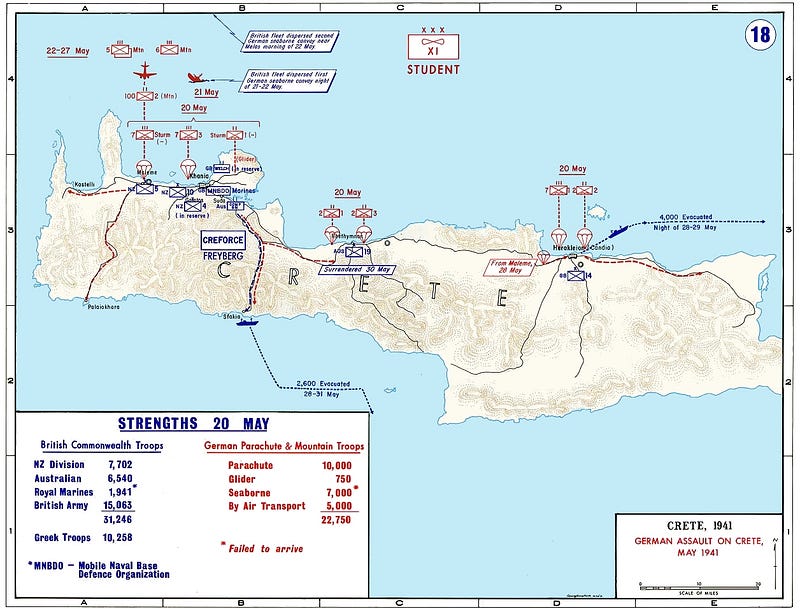
The Battle of Crete lasted just under two weeks, from May 20th until June 1st, 1941. In the grand scheme of World War II, the battle is largely glossed over. It took place just before the start of Operation Barbarossa, which still consumes most of the oxygen in the room. It also occurred at the tail end of the German invasion of Greece, another theater often ignored. Despite its seemingly minor status, the Battle of Crete profoundly impacted the rest of the war. The way the battle unfolded and the casualties inflicted on Germany’s airborne forces caused Hitler and his military planning staff to radically change how they saw the future of warfare.
The German invasion of Crete was called Operation Mercury. On its face, it was a stunning success. Using overwhelming airborne forces parachuting onto the island, the Germans were able to capture the key airfields and cut the island into sectors and capture it. Crete was a strategically crucial military target in the Aegean that was seized in a mere thirteen days.
But many in Berlin didn’t see it that way. The losses at Crete far exceeded expectations, and it changed the way the German high command viewed and subsequently used airborne forces. And that subsequently changed the way they fought the rest of the war.
The Element of Surprise
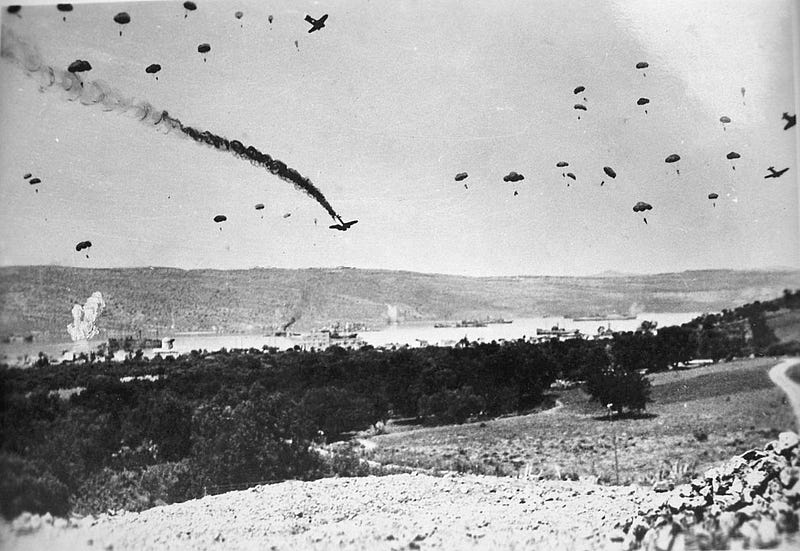
Hitler believed elite airborne units were best used as a complete surprise. He believed that if people knew that a parachute drop was coming, it would vastly reduce their effectiveness. In this, he was partially right. However, parachuters have far more value than the element of surprise alone.
In order to avoid a costly amphibious landing, Hitler opted to invade Crete primarily by air. In fact, Operation Mercury was the first invasion in history to be conducted by largely airborne forces. In the waning days of May, thousands of soldiers dropped all over Crete ferried in by slow transport planes and gliders.
The problem was the British knew an airborne invasion was coming to Crete because they had already started breaking the German military codes. The paratroopers would have been more of a surprise if the British officers in Ultra hadn’t started decrypting the Enigma codes.
With the element of surprise lost, the German Fallschirmjäger suffered severe casualties. But they were also still successful in their mission.
The airborne invasion wasn’t a failure. The problem was more to do with the military codes than it did with the conduct of the Fallschirmjäger itself. But that was not how it was perceived.
Stiff Resistance, Steep Losses
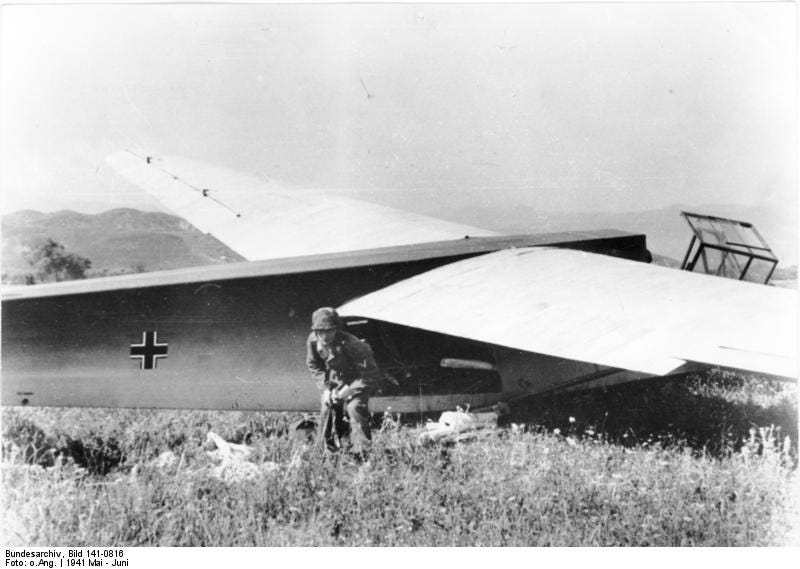
Another thing the Germans failed to anticipate was the level of resistance on the island. The British put up a sharper fight than expected, and the local population also joined in and offered up fierce resistance to the German invaders. The loss of the element of surprise combined with the resistance inflicted high losses on the Fallschirmjäger.
Over the course of the 13-day battle, the Germans lost nearly 6,000 soldiers. The vast majority of these came from aircrews and Fallschirmjäger paratroopers. The Luftwaffe lost 409 aircraft, which represented an 80% casualty rate. Of the 409 planes removed from service, 284 were destroyed outright.
The casualty rate for the soldiers was 27%, with 5,894 casualties out of 22,000 total men deployed.
All of these numbers were shockingly high for the German high command.
The staggering loss of aircraft, aircrews, and gliders soured the view of airborne forces as a whole. Despite the fact that Crete was seized and secured, the losses were deemed unacceptable.
The losses to experienced air crews and Fallschirmjäger soldiers were so great that one general opined that Crete marked the death of the Fallschirmjäger. Crete was turned into an airborne graveyard.
Despite the losses, the Germans held Crete until the spring of 1945.
Effects On Future Planning
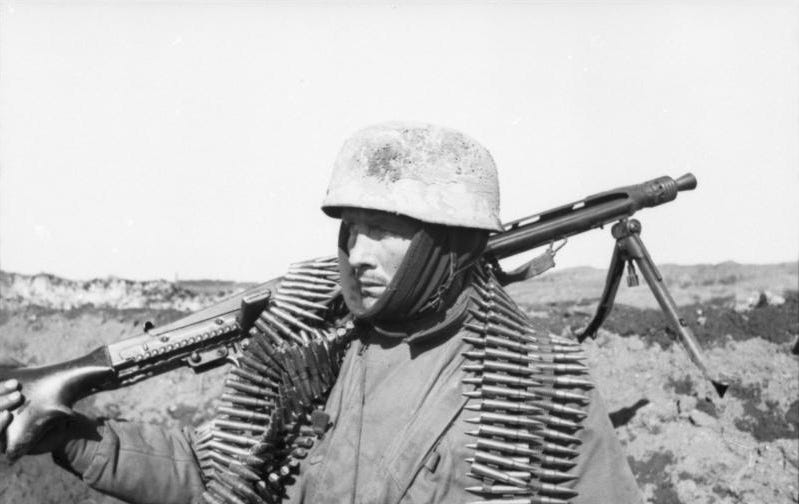
After Crete, Hitler lost all faith in airborne operations. Numerous Fallschirmjäger divisions were rerouted to the Eastern Front, but they would never pursue airborne insertion ever again. Most of the Fallschirmjäger was redeployed as ground units only. Germany conducted its final strategic airborne operations during the Greek campaign culminating in the events during the Battle of Crete. Afterward, Fallschirmjäger forces were deployed as regular ground forces.
The highly trained Fallschirmjäger remained a lethal fighting force for a large portion of the war and served in Crimea, Leningrad, Tunisia, Italy, and more. However, they never again dropped in from the skies.
It is impossible to say whether additional airborne operations would have helped Germany’s military situation, but the fact that they were removed from the table altogether definitely changed the complexion of the war.
Meanwhile, on the other side, as the Germans were backing away from airborne operations, the Allies were warming up to the idea of airborne insertion. This pivot point in 1941 shows two military planners going in opposite directions. 1941 saw the Allies start to invest more heavily into airborne operations while Germany shelved the idea completely.
The Allies would go on to use paratroopers during the D-Day landings during Operation Market Garden in 1944. Airborne forces also featured heavily in Tunisia and Norway, as well as during the final invasion of Germany (Operation Varsity.) Not every parachute drop was a success, but they remained a disruptive and versatile force for the Allies throughout the course of the war.
Germany might have found success with paratroopers during the fighting on the Eastern Front where severing rail lines and encircling isolated Soviet forces.
On the other hand, Allied air superiority quickly overtook the Luftwaffe, which would have made airborne operations very risky. The Germans managed to maintain better control of the skies in the USSR than they did in Western Europe, and there was a window where Hitler could have used the Fallschirmjäger more effectively as an airborne force during 1941 and 1942, but that window rapidly closed. Instead, we can only speculate about how the Fallschirmjäger would have performed in targeted airborne operations from 1941 onward.
Conclusion
While the Battle of Crete was a success for Germany, the losses suffered by the Fallschirmjäger were steep. Germany managed to hold Crete for years after the invasion, but the price they paid made Hitler believe that airborne troops were a gimmick rather than a legitimate military strategy. As a result, the Germans shelved all future airborne operations, and the Fallschirmjäger was never again used as a large airborne force. They were redeployed as supporting ground forces for existing armies in Russia, Tunisia, and Italy. They fought fiercely throughout the war but rarely ever donned their parachutes again.