How Teachers Can Improve Their Mental Health in Only 20 Minutes
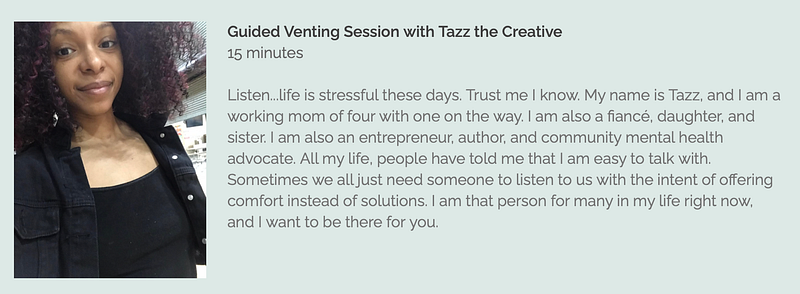
…a venting Session with A’tajene “Tazz” Anderson is the way to start.

Nothing feels better than when someone does something nice for you. Someone in your family or in your workplace or in your neighborhood looks you in the eye and says, “Thank you so much for your help…” or “You are a life saver…” or “You can do this…” and this can completely change the trajectory of your week. A positive interaction, no matter how small or seemingly insignificant, can have a profound impact on a person’s mental stability. Human beings are inherently social creatures, and our interactions with others play a crucial role in shaping our emotions, thoughts, and overall well-being. When someone experiences a positive interaction, such as receiving a genuine compliment, being shown empathy, and understanding, or engaging in a meaningful conversation, several things can happen at a psychological level. We tend to expect these types of interactions from educators when they are working with any member of the academic community — from Pre-K through doctoral programming. Of course, we realize this is not the case. But why? Why are some teachers seemingly rotten to the core in their interactions with students and colleagues? Why might some teachers not be aware that they are treating their students in this way…and yet continue to do it?
We find that the primary reason educators are so stressed out is because they lack the appropriate access to mental support resources. Yes, most schools offer some form of mental health services through Human Resources. Educators — especially public educators — are a suspicious bunch and less than likely to pursue this avenue for support going through any type of life struggle from death of a family member to medical diagnosis to housing foreclosure and so on.
Moving into the 2023–2024 academic year, we are committed to providing all educators and students with the opportunity for a positive interaction during a Venting Session with A’tajene “Tazz” Anderson. There are a million great reasons why someone would need positive interactions in their life, and here are just a few of their benefits…
Positive interactions activate the release of neurochemicals like serotonin, dopamine, and oxytocin, which are associated with feelings of happiness, pleasure, and social bonding. These neurochemicals can help regulate mood, reduce stress, and enhance overall mental well-being.
Positive interactions can provide individuals with a sense of validation, belonging, and self-worth. When someone feels acknowledged, appreciated, or understood by another person, it reinforces their sense of identity and self-esteem. This validation can counteract negative self-perceptions, self-doubt, and feelings of isolation, ultimately promoting a more stable mental state.
Positive interactions can also serve as powerful reminders of the inherent goodness in people and the world around us. In a society that can often feel stressful, competitive, or filled with negativity, a single positive interaction can act as a beacon of hope. It can remind individuals that kindness, compassion, and empathy exist, restoring their faith in humanity and fostering a positive outlook.
Positive interactions have the potential to break negative thought patterns and provide a fresh perspective. When someone is struggling with their mental health, they might be trapped in a cycle of negative self-talk, rumination, or pessimism. A positive interaction can disrupt these patterns by introducing new information, alternative viewpoints, or emotional support. It can help individuals challenge their negative beliefs, reframe their experiences, and gain a more optimistic mindset.
Positive interactions are not limited to face-to-face encounters. In today’s interconnected world, they can occur through various mediums such as online conversations, supportive messages, or even acts of kindness witnessed from a distance. The power of positive interaction lies in its ability to transcend physical boundaries and reach individuals who might be in need of support or affirmation.
In a world where negativity, stress, and competition can sometimes dominate our daily lives, positive interactions become even more significant. They serve as powerful reminders of the inherent goodness that exists within people and the world around us. When we experience positive interactions, they can act as beacons of hope, illuminating the fact that kindness, compassion, and empathy still thrive amidst the challenges we face. Positive interactions serve as valuable counterpoints to the negative narratives and experiences that often surround us. They offer glimpses of the positive aspects of humanity and restore our faith in the goodness that exists within individuals.
One positive interaction can completely alter a person’s mental stability, a fact that should not be underestimated. It has the potential to uplift spirits, improve mood, enhance self-esteem, and provide a renewed sense of hope. As individuals, we should strive to cultivate and cherish these positive interactions, recognizing that our words and actions can be transformative for someone’s mental well-being. Positive interactions act as reminders that kindness, compassion, and empathy are fundamental aspects of humanity. They restore our faith in the inherent goodness of people and the world, providing a beacon of hope in a society that can often feel overwhelming. By fostering positive outlooks, motivating acts of kindness, and nurturing social connections, these interactions contribute to the creation of a more compassionate and harmonious world.