
How Teacher Expectations Influence Student Learning Outcomes

Given my experiences as an educator, scholar, social scientist, father, and Chicagoan, there is no doubt in my mind about the power of expectations. I have seen firsthand how expectations can shape a person’s life, both positively and negatively. Students in my classes have disappeared for weeks because of a negative interaction they had with a Financial Aid counselor. Teachers — colleagues, even — have admitted writing off students due to their perceptions of the students ‘seriousness’ perpetuated by prevailing stereotypes related to the identity of the student. In the current context of education, where teacher expectations and opinions can have a significant impact on student performance and ideology, we need to continue to explore the influence of teacher on student outcomes in the 21st century.
Teachers have always been the custodians of knowledge and the torchbearers of change and knowledge advancement. True, in the United States we have a history of teachers and educational administrators and other agents of the academic community weaponizing education for the purposes of colonization, exploitation, and other purposes of cultural imposition and assertion of dominance. In the interactions they have with their students, teachers absolutely have the power to shape young minds, to ignite passions, and to inspire greatness. By that same token, they have the power to distort, omit, and otherwise ignore certain narratives that may conflict with their own worldview. Power, as with any valuable resource that can bring advantage, can be both a blessing and a curse. The expectations that teachers hold for their students can have a significant impact on their academic performance, both positively and negatively.
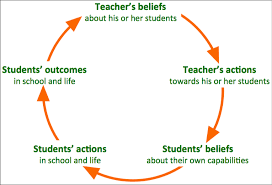
Research has shown that teacher expectations can shape student performance. Teachers who hold high expectations for their students have students who tend to perform better academically. When teachers hold low expectations for their students, those same students tend to perform worse academically. This is not surprising. When students are aware that their teacher expects them to do well, they are more likely to put in the effort required to meet those expectations. Think about the full spectrum of communication about perception of value and worth that are conveyed during an interaction. Even the smallest facial expression of a teacher that signals a sense of confusion or concern or otherwise urgent intervention in the student can manifest into a full-blown disconnection from the learning experience…for both teacher and student. Teachers think they can hide it, but students are aware when their teacher expects them to do poorly. As this realization dawns upon them, they are less likely to put in the effort required to succeed.
What is most curious about the role of teacher expectation on student performance is that it is limited to the classroom. It extends to the entire education system, and society more broadly. When teachers hold high expectations for their students, they tend to advocate for them more. They are also more likely to recommend students for advanced courses and programs, share new and interesting opportunities with to spark their imagination, and designate funds for the advancement of programs and services for their students. All of which can open doors for further academic and professional opportunities. But, when teachers hold low expectations for their students, they tend to write them off. This can happen in an instant when a student walks into a classroom too ‘loud’ for the teacher’s threshold for volume, outwardly express an identity counter to the normative social expectation attached to their appearance, or otherwise steps outside of the frequently rigidly defined identity box the student is placed in. Educators who expect less of their students are less likely to recommend them for these same opportunities, which manifest into diminished educational and related life outcomes.
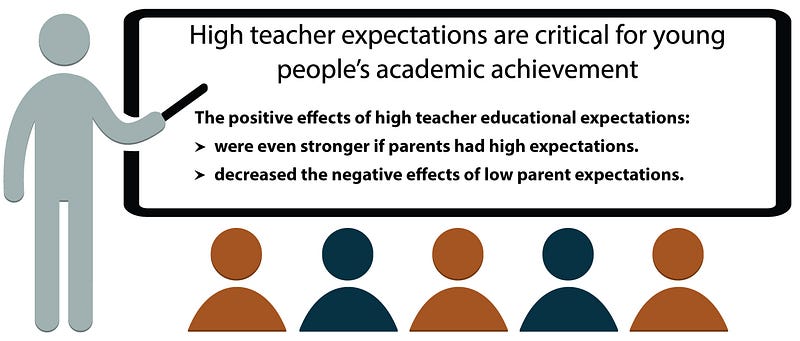
The impact of teacher expectations is even more pronounced when it comes to marginalized students, such as Black and Latino students. Implicit biases that teachers may hold, which are often influenced by societal stereotypes and prejudices. For Black and Latino students, they are far more likely to encounter a white teacher in their classroom than they are to have an educational experience designed and facilitated by someone who shares their identity and background. white educators are more likely to be aware of negative stereotypes related to Black and Latino students that are driven by media representations and infrequent interactions with people from the community. Paired together, educators who fit this profile tend to view Black and Latino students as less capable, which can lead to a self-fulfilling prophecy in the student. Frequent exposure to people in positions of authority who share and reinforce diminished expectations of students truly manifest in the outcomes of even the most resistant and strong-willed student. Self-fulfilling prophecies also do not always begin in adulthood. The seed of low expectations for upward social mobility through education is frequently planted at a very young age. Over time, the roots grow strong through continued exposure to educators and other agents of socialization who consistently and fervently support the narrative that they — Black and Latino students — are inferior to their peers in school. Later, they grow into vines and spread through the entire identity of the individual…and it can be incredibly challenging to pull someone back from that level of instilled sense of low self-worth. In the 21st century, the impact of teacher expectation on student performance is even more pronounced. This is because of the increasing diversity of the student population and the increasing emphasis on standardized testing. Standardized tests are designed to be objective measures of student performance. Technology has the potential to level the playing field for marginalized students, such as Black and Latino students. It can provide them with access to educational resources and opportunities that they may not have had otherwise. However, it can also perpetuate biases and stereotypes, especially when it comes to teacher expectations. When teachers rely on technology to teach their students, they may be more likely to hold biases and stereotypes that are present in the technology itself.
Bottom line, none of us are not immune to the influence of teacher expectation. We place teachers and professors and other varied forms of educator at a rank in the social hierarchy that commands respect and reverence. We rely on teachers to do so much more beyond reading, writing, and arithmetic. Modern teachers exceed the information transmission expectation and frequently work as coaches, advocates, allies, and accomplices at various levels of commitment to serving the needs of their students. When teachers hold high expectations for their students, they tend to perform better on standardized tests and other commonly used measures of academic success.