How Surrender and Action Work Together
In the past week, I have spent a lot of time in front of a computer developing my personal brand — Twitter, website, posting my first story on Medium… and the most dreaded part: writing a personal bio. I’ve been pondering the best ways to promote my individuality and my unique voice. I’ve been really focused on being somebody who is taking action.

Every morning, before I begin this work, I spend time in devotional practice, chanting and praying, resting my head upon the feet of the divine. In that space, I’m entirely focused on surrendering.
Can these two worlds coexist peacefully? Can they actually work together? Perhaps action needs surrender and surrender needs action.
Surrender does not mean inaction. Surrender is a state of being at peace with what is. From that place of peace, actions are less motivated by reactivity and fear. Instead, actions can be driven by thoughtfulness, compassion, and understanding.
At the same time, surrender requires a choice. In making this choice, action is born. In every moment we can choose whether to accept the state of the world as it is (pandemic or not) or to be at war with it. Surrender is action.
It can be easy to dwell in extremes. News outlets constantly remind us of immense suffering, injustice, and divisiveness. The overwhelming nature of modern life causes many people to completely tune out things like politics and social justice. Others let outrage and self-righteousness motivate their actions, which can only lead to more division and anger.
I believe that the middle ground between these extremes requires actions that are motivated by a sense of surrender. Make time in your life for silence and reflection. Question your own motives. Listen with gratitude to those that criticize you. Do not allow a mountain of suffering to paralyze you with fear or lethargy.
My view of action and surrender have largely been shaped by teachers in the Hindu devotional tradition of bhakti and the personal development courses I’ve completed through Landmark Worldwide. The modalities of devotion and personal development might seem like strange bedfellows, but in my experience, they complement one another quite nicely.
Initially, I did have trouble seeing how these two paths fit together. On one hand, my devotional spiritual path was making me more humble and less attached to my various identities. When I started the Landmark courses I was experiencing more self-worth and holding myself to a higher standard. How can self-worth and humility work together? I was discussing this with a friend who told me “you realize that you don’t have to prove yourself anymore.” Suddenly it made sense and worlds opened up. I found myself resting in a place of calm confidence.
To surrender does not mean adopting a mentality of “why bother?” Likewise, devotion does not mean that one must lie down and let God “take the wheel”. My personal spiritual path of devotion to Hanuman and Lord Rama is a very active, in-the-world form of devotion. It is said that Hanuman bestows The Four Fruits of Life upon his devotees. The Four Fruits are Dharma, Artha, Kama, and Moksha which translate to duty and righteousness, prosperity, desire and pleasure, and spiritual liberation respectively. Hanuman does not want his devotees to run off and meditate in a cave. He wants us to live as prosperously and righteously as we can. Hanuman wants his followers to take actions that are motivated by surrender, just as he did.
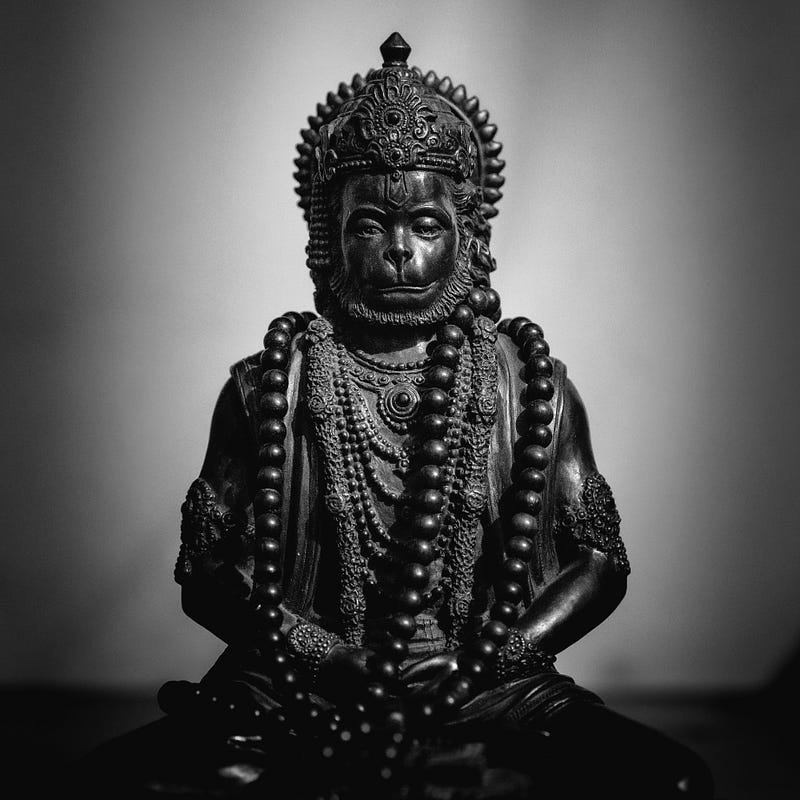
In the epic tale Ramayana, Hanuman is tasked with leaping across the ocean, from India to Lanka, in order to find the kidnapped princess Sita. At first, he is full of doubt and fear. When he focuses his attention fully on the divine, Hanuman remembers his otherworldly strength and power and easily jumps from shore to shore. When Hanuman surrendered, he saw his own abilities clearly and what seemed impossible became possible.
If we, as an interconnected human race, allow our individual and collective actions to be born from a sense of surrender, what seemingly impossible things can we make possible?