
How SPC Went From $17M to $250M in Eight Years
How brands grow businesses
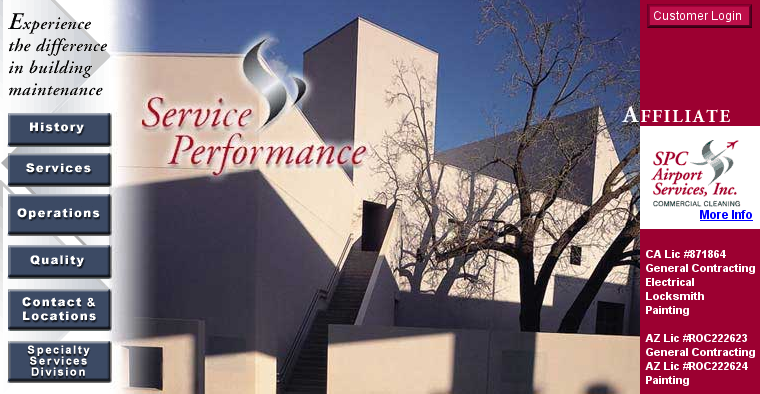
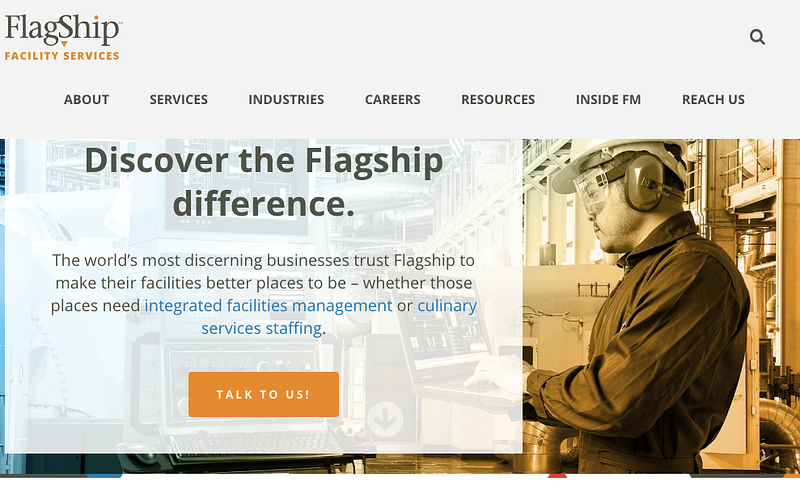
The left picture is SPC in 2012 running at about $17M annually. The right side is Flagship Facilities today, running in the $250M range. This is the story of how that happened.
When we engaged they were “Service Performance Corporation” (SPC).
You tell me; what does a company called Service Performance Corporation do?
Right…that was part of the challenge.
In 2011 (the left picture), when the project started, they were running in the $17M a year range, with the trend flattening somewhat after a few years of rapid growth. They also had a goal: $100M in five years.
Which gave them a good question: was Service Performance Corporation the company that would get them there?
This is the story of how that got answered and, how the answer enabled the company to grow a lot more.
My General Algorithm
As a long-time branding and story guy, I have developed a methodology for dealing with these kinds of complex, multi-faceted problems:
- Uncovering and discovering (use about 30% of your time here): Find out as much about the issue as you can. Be open to data from unexpected places. Talk to people, lots of people. Get meta; context is especially important here.
- Analysis and Synthesis (~25% of your time here): For me, today, there is just no screen big enough. I need to get the data out of my computer and onto a wall, floor, whatever. I need to visualize not only the data, but the relationships between them. Stay meta; look for trends and narratives. I always find this one of the most challenging parts, having to think both granularly (at the individual data level) and integrally (synthesizing the Big Picture).
- Creation and Production (25% here): I have found that the best outcomes are produced when Design and Development are included in the prior steps and, if that’s just not possible, falling back on the tried and true Creative Brief (CB) is fine. Just don’t shortcut this; this is a highly critical juncture.
- Launch and Implement (use the rest of the time, do it forever): Take it live and promote, promote, promote. Marketing and Sales need to work closely (especially) here, if the brand-story change is large or dramatic. Be prepared for some friction from the field (you can’t please everyone and no one likes it when you do).
Your customer (the business; whether that’s a client or your company’s team) needs to have visibility into the whole process and ability to provide feedback as needed. Branding-messaging is performance art and your clients or colleagues need to see results and milestones hit.
Some background
Is needed here before we continue. In 2011, when Service Performance Corporation (SPC) engaged us, they were providing a large suite of facility management services to major clients in the Western U.S., including major airports, offices, and public spaces.
When SPC started, in the 80s, it consisted of the founder (Dave) and five janitors. In the almost two decades following they grew the company substantially, to $17M in revenue and a much larger service footprint, doing everything from recycling to major TI (tenant improvement). They were, in fact, no longer a janitorial company at all, they were a Facilities Management company.
But no one had ever told their marketing that. And now, that lack of communication was demonstrably affecting their performance as a company.
How we did it
Uncovering and discovering. We interviewed the entire executive team (SPC was of a size, then, that this was practicable), and at least some staff from every department. I never cease to be amazed at the variety of narratives within a single team with a single purpose. Exposing that and including it in the process is both enlightening for the team and valuable to the outcome.
While the interviews proceeded, lots of primary research was being done. We knew that market intimately in the first month.
Then more interviews, this time with SPC’s clients. Yes, personal, one-on-one calls or meetings with their top clients (~30 of them). There is nothing like actually talking to people. The cost is the time and difficulty, but in 30 years of doing this, it has never failed to pay off in spades. Digital tools are fine for acquiring and distributing information, but they suck at tonality, emotionality, and nuance. Brand-stories are emotional tools, so you need to capture the qualitative as well as the quantitative to build them well.
Analysis and synthesis: After a month of this there was a lot of data, of all kinds. The walls and surfaces of our offices quickly became covered and we became immersed. Daily meets, both planned and spontaneous; what now would be called design sprints; a tornado of creativity. And, on one wall…the ideas began to take shape.
Creation and Production: As the ideas began to gel on the “idea wall,” three trends started emerging:
- SPC was loved by their clients, but pretty much no one got the name
- Growth had brought them new competition, and SPC as a brand was lost amongst a sea of larger companies with other alphabet soup names.
- No one could tell what SPC really did from their marketing, so they were losing out on a lot of business; janitorial companies don’t do facilities management, and no one will trust it if you try.
Almost all of their new business came from personal contacts and referrals. Their marketing just wasn’t working in their best interests.
From this we could see three paths forward:
- Stay with SPC and we’d work our heinies off to make it work
- Make up a name (we came up with several: one of them, Facilogistix, was so unliked that they still joke about it today, apparently)
- Repurpose an English word
Thus it was that SPC became:
FlagShip Facilities
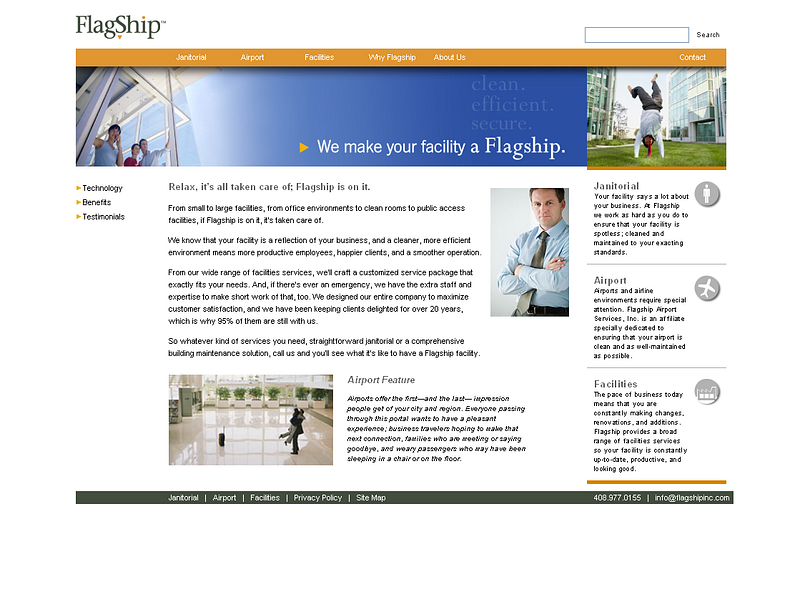
What do they do?
“You guys get an A+ for the branding,” Dave Pasek, CEO and Founder
And then the real work started.
Everything, everything had to be touched. Everything that said, or had ever said “Service Performance” had to be changed. Every notepad, billing statement, invoice, bid response, digital asset, vehicle, safety vest, and uniform; everything had to be found, evaluated for its value and relevance to the new brand, then tossed or reused.
Every employee needed to understand and come on board, too. Along with the new brand came new messaging; a new narrative for the company, and every employee needed and deserved to be brought into it.
Strategy was set, timeframes established, art created, copy written, events planned, website coded, meetings arranged, media bought, printing done, and…the date arrived.
The developers turned the key on the website and it all started. Dave, the CEO, traveled a lot over the next 90 days, seeing every office, just about every employee, and every A-ranked customer.
At first, there was a bit of employee churn, especially in the sales department, and it turned out those were growing pains. For the team that was left and then grew over time executed against the brand promise superbly.
An old marketing adage is that “nothing ever killed a bad product faster than good marketing.” Dave and his team at Flagship delivered and continue to deliver a superb product and, with a strong brand as their base, are continuing to grow the company which is now in the $250M range, a CAGR of 45%.
Metrics
Time from conception to launch; ~ 18 months
Cost:~$250,000 (~1% of current revenues)
Value: you tell me.
Conclusion
Marketing and branding might just be the least urgent things you work on, day-to-day, and they likely have the highest long-term pay off of anything you work on, ever. Ignore them at your peril (like SPC); use them (like Flagship) and facilitate your win.