
HISTORY
How Some Slave Owners Received Reparations, But Not Black Americans
The District of Columbia Compensated Emancipation Act
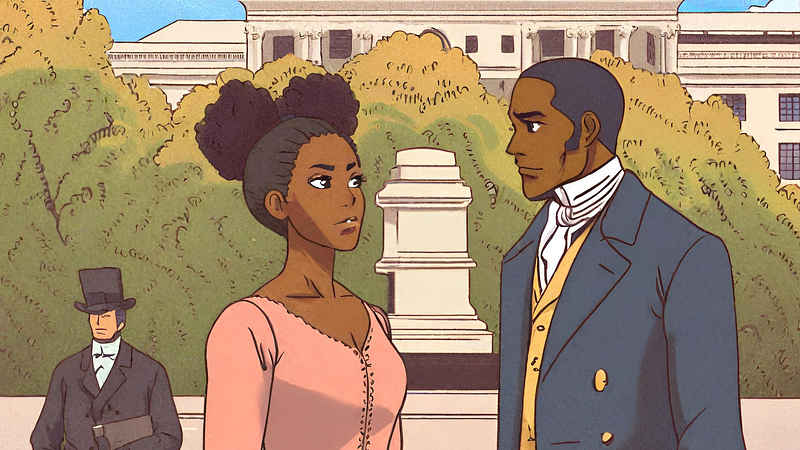
January 1st is the anniversary of President Abraham Lincoln signing the Emancipation Proclamation, an executive order declaring "that all persons held as slaves" within rebellious areas "are, and henceforward shall be free." However, fewer people know that Lincoln signed the District of Columbia Compensated Emancipation Act into law eight and a half months earlier, on April 16, 1862. Since enslavers in the nation's capital were unwilling to abolish slavery out of a sense of morality, the legislation enticed them to do so monetarily. Commissioners received 930 petitions, legally granting freedom to 2,989 enslaved people and paying $300 for each. While enslavers received financial compensation for their so-called "loss of property," newly freed Black Americans received nothing for their "loss of wages." Not one red cent. Zilch. Nada.
The whitewashed narrative of Abraham Lincoln as a bastion of racial justice, a hero responsible for abolishing slavery, comes crumbling down under critical analysis. In correspondence with Horace Greeley, an anti-slavery advocate and founder of the New York Tribune, Lincoln proclaimed, "If I could save the Union without freeing any slave, I would do it, and if I could save it by freeing all the slaves, I would do it; and if I could save it by freeing some and leaving others alone I would also do that." In short, Lincoln was more concerned with doing what was politically advantageous rather than rectifying the inhumane conditions Black people endured as enslaved people. Whether slavery persisted did not matter to Lincoln as long as the Union could be repaired.
While Lincoln did not support the institution of slavery, he did not believe the government had a responsibility to ensure Black people were treated equally to White people. Lincoln made that much clear in a speech on September 18, 1858. "I will say then that I am not, nor ever have been, in favor of bringing about in any way the social and political equality of the black and white races — that I am not nor ever have been in favor of making voters or jurors of negroes, nor of qualifying them to hold office, nor to intermarry with white people." If Lincoln had his way, there would be no Black Reconstruction Era senators because, as he suggested, he did not believe in their social or political equality. The 14th Amendment, which ensured "equal protection" and "birthright citizenship" for citizens regardless of their race passed after his assassination, in July of 1868.
Once you realize Lincoln harbored racist attitudes, it's hard to ignore the implications of the District of Columbia Compensated Emancipation Act. Lincoln authorized legislation that provided enslavers with financial compensation, consigning the idea that Black people were indeed property, and the government asking them to emancipate enslaved people was a financial burden they were responsible for paying. If Lincoln were an abolitionist, he would have demanded they release enslaved people, but instead, he bargained. The irony wasn't lost on the black community that this legislation also refused to acknowledge the financial loss and burden experienced by enslaved people, left with nothing after emancipation.
Initially, Lincoln didn't envision Black people as full-fledged Americans who had the right to live in the country as free people, despite using their liberation efforts as political steam to win the Civil War and reunite the country. In August of 1862, Lincoln unsuccessfully attempted to convince a delegation of Black leaders to throw their support behind a resettlement effort. As a member of the American Colonization Society, Lincoln thought it would be best if Black people migrated to Libera, a settlement in West Africa or elsewhere. "Your race suffer from living among us, while ours suffer from your presence… It is better for us both to be separated," Lincoln told the delegation." Fredrick Douglas, a Black abolitionist, published a response in The North Star newspaper in 1849. "We live here — have lived here — have a right to live here, and mean to live here." While most students learn in history class that Lincoln signed the Emancipation Proclamation, few realize he was, ideologically, a segregationist.
In Washington D.C., some enslaved Black people built the capital, an injustice abolitionist Jessey Torrey described as an immoral contradiction in 1815. This "temple of freedom" was erected and idolized by those "oppressing with the yoke of captivity and toilsome bondage, twelve or fifteen hundred thousand of their African brethren…making merchandise of their blood, and dragging their bodies with iron changes, even under its towering walls." So, when Lincoln passed a law that compensated enslavers for emancipating enslaved people in Washington, D.C., he realized that enslaved people were not paid for their efforts in the capital or elsewhere. For years, Lincoln committed to this idea of mandatory resettlement instead of restorative justice measures aimed at rectifying the injustice of slavery. Section 11 of the act "appropriated" money only "to aid in the colonization and resettlement of such free persons of African descent now residing in said District" to either "emigrate to the Republics of Hayti or Liberia" or "such other country beyond the limits of the United States as the President may determine."
Despite Lincoln's complicated political legacy and racist attitudes, the federal government, under his leadership, made an effort to provide some Black Americans restorative justice in the form of land. During the Civil War, the Union Army confiscated land from wealthy Southerners, killing two birds with one stone. They confiscated land as a form of punishment for the Confederacy by destabilizing their plantation-based economy, and by proposing this land be allocated to Black veterans who risked their lives to secure victory, they threatened the existing racial hierarchy. Lincoln reluctantly approved Sherman's Field Order №15. after facing pressure from within his party.
“The islands from Charleston, south, the abandoned rice fields along the rivers for thirty miles back from the sea, and the country bordering the St. Johns River, Florida, are reserved and set apart for the settlement of the negroes now made free by the acts of war and the proclamation of the President of the United States.” — excerpt from Sherman’s Field Order №15.
So-called "radical Republicans…Charles Sumner and Thaddeus Stevens, for some time, had pushed for land redistribution to break the back of Southern slaveholders' power," according to Barton Myers, a military historian. The Freedmen's Bureau was instructed to provide forty-acre plots of land to freedmen and others loyal to the Union. Sadly, after Lincoln's assassination, "President Andrew Johnson overturned Sherman's directive in the fall of 1865, after the war had ended, and returned most of the land along the South Carolina, Georgia, and Florida coasts to the planters who had originally owned it." In doing so, the federal government broke its promise to Black Americans and has never made any efforts since to engage in restorative justice for chattel slavery. There were no tribunals to convict enslavers for human trafficking, sexual exploitation, forced labor, and other forms of torture the system perpetuated. Funding dried up for the Freedman’s Bureau, which faced animosity from those with “deeply held racist beliefs,” according to the National Archives.
So, now you know how it is that the federal government managed to provide reparations for some slave owners but not for the Black Americans they enslaved. Providing Black Americans restitution became a mere afterthought, a way of controlling who owned the lands confiscated from the Confederacy. While many people view President Lincoln as a bastion of racial justice today, he should be remembered in the full light of his statements. Lincoln did not respect Black people, nor did he believe they should be treated as equal citizens to White people. However, his persuadability made him a memorable leader, and his focus on bringing the nation together was admirable, although it was stained by his efforts to exile Black Americans.
Separate and apart from whether the Union Army confiscated any Confederate land, the federal government owes a tangible, financial, and social debt to enslaved Black Americans and their descendants. As Dr. Martin Luther King Jr. said in 1963, a century after Lincoln signed the Emancipation Proclamation, "It is obvious today that America has defaulted on this promissory note insofar as her citizens of color are concerned. Instead of honoring this sacred obligation, America has given its colored people a bad check, a check that has come back marked insufficient funds."
In recent years, various city and state-level reparations commissions have begun to investigate the matter of reparations for the descendants of enslaved people. However, this effort lacks momentum in the South, in former slave states. That is why a federal study, the Commission to Study and Develop Reparation Proposals for African Americans Act, is needed — to compile historical evidence, investigate the role of the federal government in establishing, enforcing, and safeguarding the institution of chattel slavery, and make recommendations for remedying lasting disparities. Sadly, as was the case during Lincoln's life, there is substantial resistance to ensuring Black Americans receive reparations. So, our country is left with a moral stain in that federal dollars were allocated to slave owners and none to Black Americans deprived of liberty, wages, and human rights.
For context, $300 in 1862 is comparable to $7,540.30 in 2024, according to an inflation calculator.
Myers, Barton. "Sherman's Field Order №15." New Georgia Encyclopedia, last modified Sep 30, 2020. https://www.georgiaencyclopedia.org/articles/history-archaeology/shermans-field-order-no-15/
🌹Learn more about the author here.