
How Society Influenced Logic and Reasoning for Over 2000 years
The bizarre history of the queen bee
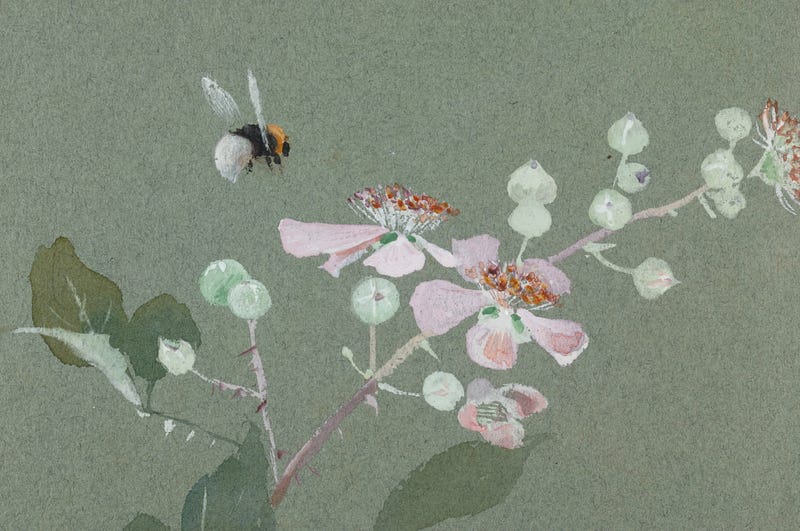
Humans and honeybees have an intimate past. Cave paintings show how our ancient ancestors used ladders and ropes to get to bees. By the 3rd millennium BC, Egyptians had developed sophisticated methods for beekeeping, which has mostly remained unchanged. Despite achieving great sophistication in beekeeping, humans have remained profoundly ignorant about bee biology, until relatively recent times. Our understanding of the queen bee and her role in a beehive has a surprising history.
It is common knowledge today that honey bees live in highly organized colonies. The colonies have a large queen bee, a few drones — that mate with the queen bee, and a few thousand worker bees — which are all sterile females. But, for over 2000 years, the bee that mothered all the bees in a hive was thought to be a “king bee.”
The Saga of the Queen Bee
Aristotle published the first account of the biology of bees in 350 BC in the History of Animals. In this book, Aristotle noted two kinds of bees — kings and drones. He believed that the largest bee in the hive was in some way a leader reproductively, but he did not know how bees reproduce and if they reproduced at all. He noticed bees swarmed and followed a leader bee, their “king” — not queen.
It turns out that Aristotle believed that women lacked authority. For instance, in one of his works, Aristotle stated, “as regards the sexes, the male is by nature superior and the female inferior, the male ruler and the female subject.” This biased view remained the accepted word and shaped bee biology for the next 2000 years.
The likening of human society to bee colonies may have led to perceiving similarities when there were significant differences. In pre-modern societies, a hive-life was used as a model for how humans should live together.
Not realizing that the leader of a hive is a female bee, in 1558, John Knox published a misogynist book titled First Blast of the trumpet against the monstrous regiment of women. He argued against the rule of women such as Queen Elizabeth, because “Nature hath in all beasts printed a certain mark of dominion in the male, and a certain subjugation in female.”
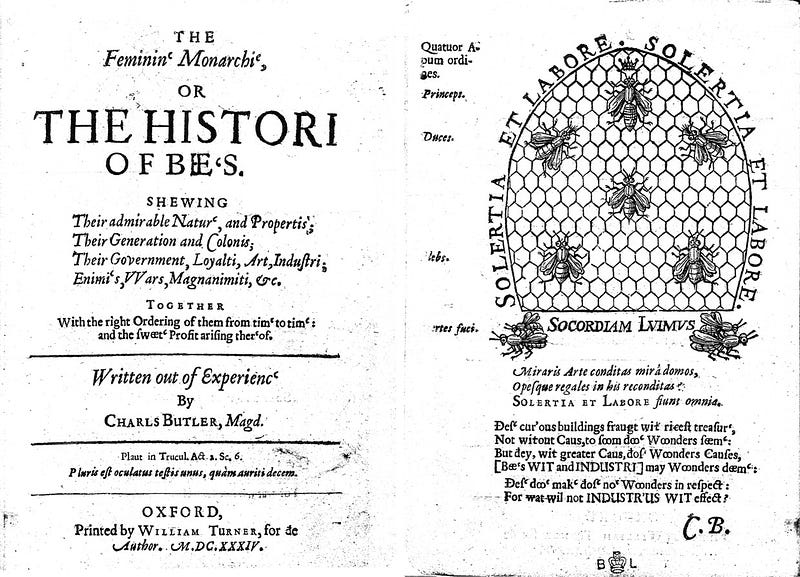
However, in 1609, a cleric and apiarist, Charles Butler, seemed to have made amends. He wrote a book called Feminine Monarchie, which shaped the view on bee biology. His detailed observations of honey bee colonies led him to believe that the hive’s leader is a queen and not a king.
This book was published around Queen Elizabeth’s rule. Therefore it is thought that Charles Butler may have been relatively open to an idea of a queen’s rule. But, it turns out that Butler did not want to believe that the queen bee mated and laid eggs which developed into larvae, as he grew up under the reign of a virgin queen. So he concluded that the workers generated offsprings by mating with the drones.

Pure reasoning and analogies were of limited use, requiring hard evidence and data to confirm the role of a queen bee.
In the 17th century, a notable Dutch anatomist Jan Swammerdam used exquisite experimental techniques and provided evidence that the king was, in fact, a female with ovaries and eggs.
But, Swammerdam did not use the word “queen” and considered bee colonies as a kind of fraternity. He said:
“there is no superiority or pre-eminence among either Bees or Ants; love and unanimity, more powerful than punishment or death itself, preside there, and all live together in the same manner as the primitive Christians anciently did, who were connected by fraternal love, and had all things in common.”
Also, his anatomical observations about drones’ genitalia made him conclude that there was no way they could be used to mate with a female, that “they simply wouldn’t fit.” He concluded that bee sex should involve something more than copulation. He invoked the idea that female bees may be impregnated merely by drones’ odor, which he termed as “aura seminalis.”
The Bee Sex Mystery — Resolved
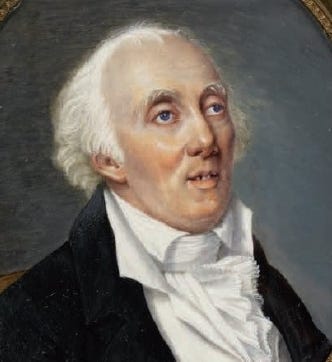
It was François Huber, a blind naturalist and his skilled assistant François Burnens who finally solved the riddle of bee sex. They placed a pierced container with drones in a sealed hive with virgin queens and proved that queens could not be impregnated merely by drones’ odor.
Another common idea during Huber’s time suggested that a noble queen did not actually indulge in a commoner’s act of fertilization, and she could somehow self-fertilize. So Huber and Burnens sealed a drone-less hive with virgin queens, and no offsprings emerged. It gave the same result when they sealed drones and virgin females in the same hive. So they concluded that fertilization must take place outside the hive.
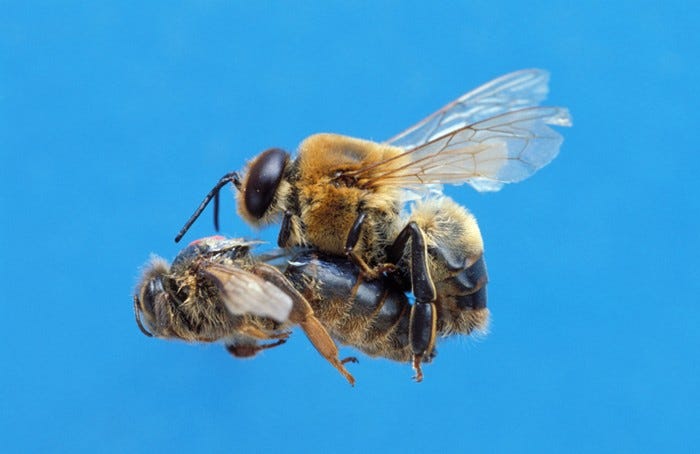
Huber and Burnens (and 15 years prior, a Slovenian beekeeper, Anton Janscha) popularized the idea of the mating flight. They observed that several drones followed the queen bee when she left the hive. She was covered with fertilization marks and filled with male seminal fluid when she returned. So they concluded that drones fertilize a queen bee mid-air, and this finding was published in 1806.
Huber and Burnens also provided a breakthrough in another old theory. Observations in the 1760s showed that fundamentally a queen bee was not different or unique, and nurturing played an essential role in determining which larvae became queens. Back then, it was received with considerable skepticism as it went against the natural hierarchy of rulers, of bees, or of humans. However, when Huber and Burnens systematically proved and popularized the same theory, it was received more openly, perhaps because the world had become a little more accepting.
So finally, a long-standing debate rooted in societal and personal biases was debunked after over 2000 years. And the reproductive queen bee was given her rightful place on the throne. We have since understood the important role bees play in sustaining human life, and the queen bee is at the center of it all.
In this account, a person’s social environment played a significant role in keeping them from seeing what seems obvious to us today. It kept them from reasoning with an open mind and accepting answers.
Directly or indirectly, social influence impacts our personal choices and considerations, even today. And these choices could affect the crucial discoveries of our time. If we want our world to prosper, every individual should see beyond a conventional society and question the norm. As Carl Sagan rightly said,
“If we long for our planet to be important, there is something we can do about it. We make our world significant by the courage of our questions and by the depth of our answers.”


