
How Smart You Are Is Relative
It depends on who else Is there.
I declared in second grade that I wanted to be a teacher and then a principal. That was in 1956–57.
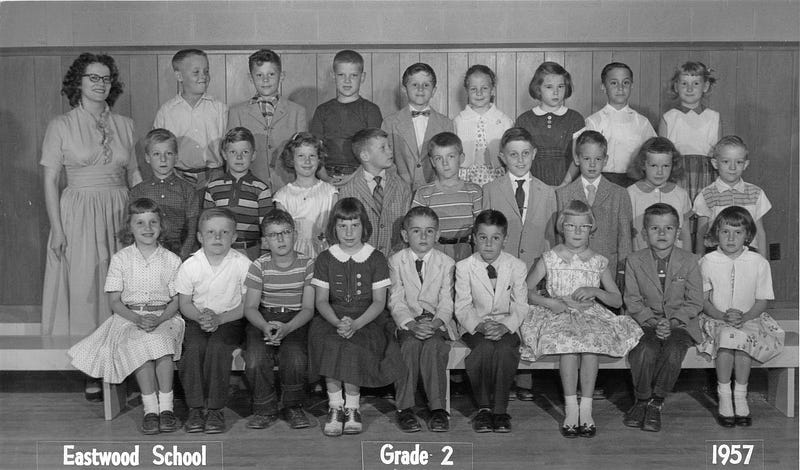
Everyone thought that was fine.
When I took the National Teachers Exam proficiency test in my last year of college, I scored so high that I was confused about what such a score would mean for who else was going into teaching.
The teacher training coursework I’d taken throughout my college years seemed unrelated to what an actual classroom would be like. As it turned out, that was a fairly accurate assessment on my part; learning how to make lesson plans was not at all helpful in classroom management or what children of different ages and abilities would be like.
On top of that, my family background had no examples of women working in careers; they were all corporate housewives.[i] And I learned later, in 1971, when I started teaching, that women’s liberation and equal rights meant that fewer women as intellectually different (gifted) as I were going into teaching. Instead, many were going into higher paying and higher status careers with others who had the ability and potential to do well in such roles, people who might turn out to be “true peers.” There were indeed some, but you get my point here.
Then, as a teacher — a good teacher — I did not fit in. The other teachers with whom I worked were good teachers, too, and we did a lot of excellent work together, some of it at my instigation. But my personality and background led to my not being someone who really joined the group. It also led to my not being attuned to what others thought or wanted. And, not surprisingly, my personality assessment results through the years vacillated with my life’s circumstances.
Here’s the thing: People who create themselves to be acceptable and calming to others will overlook what is good for themselves. So, whatever the context of my life at the time, my MBTI® personality profile results changed. (This particular personality instrument is more fully discussed in Section III of my Big Book: The 5 Levels of Gifted Children Grown Up: What They Tell Us, 2023). My only constants on the Myers-Briggs Type Indicator® were NT — Intuition and Thinking preferences. For more information on personality types, see https://deborahruf.medium.com/smart-kids-personality-types-and-how-they-adapt-or-not-to-school-29a6af198835?sk=95b81e4dcc6b0f3325fd418332870f57.
I was not chummy and had no realization that there are times when one should go to the teacher’s lounge once in a while. It is likely I was a jerk. Not on purpose, but when I had a good idea, it never occurred to me that others wouldn’t automatically sign on. Most of my life, I found working with other people on a project as inefficient and uncomfortable, and “easier to do it myself.” Sound familiar?
All things considered, there is a part of me that is grateful for all these experiences, because they all made me more aware of what highly intelligent people can go through that is negative. If I had gone to an elite college preparatory school or a highly gifted full-time immersion school, I might have a more restricted idea of how highly intelligent people are affected by receiving less. I also see the many positives contained within these experiences and that, without them, I would not be the informed citizen who can speak to what it’s like to feel like an outlier who rarely felt like I belonged or fit.
I saw that, during high school, I was the happiest I’ve ever been and it was the better (for me) teachers,[ii] the coursework, and the other students who made the difference. My home life was still deplorable, but I could count the days until I got out and could make a better life for myself. Unfortunately, we take our troubles with us until we take the time to recover emotionally and psychologically (often with help from others, including therapists).
As I am coming out at the other end of adulthood, I have realized (meaning the goal has come to fruition) a goal I set while in my doctoral program: when I read Erik Erickson’s developmental theories in a psychology class, I saw all the steps I had missed along the way to good mental and emotional health. I saw the generational aspects to it, as well. I also saw that, despite those missing steps, it is possible to discover how one’s interpretations and views about what all of it means can shift us to joy, serenity, peace, and positive forward motions. So, that’s where I’m coming from as I write for you.
[i] A corporate housewife is the unpaid wife, mother, community volunteer, party planner, cook, and executive secretary of a man who works in a large corporation. Although there are still corporate housewives, most highly intelligent modern-day women have their own educations and careers. The tasks previously managed by stay-at-home mothers or corporate housewives is paid for by the combined salaries of the working couple.
[ii] “Better” is relative, of course, but in general the intelligence level of educators rises as people choose a subject to specialize in for teaching high school and sometimes middle school. And being smart does not guarantee being a good teacher, but it is true smart teachers are a better fit for smart school children’s needs.