
How Sir Isaac Newton spent his Quarantine
Wonders of the Compound Effect
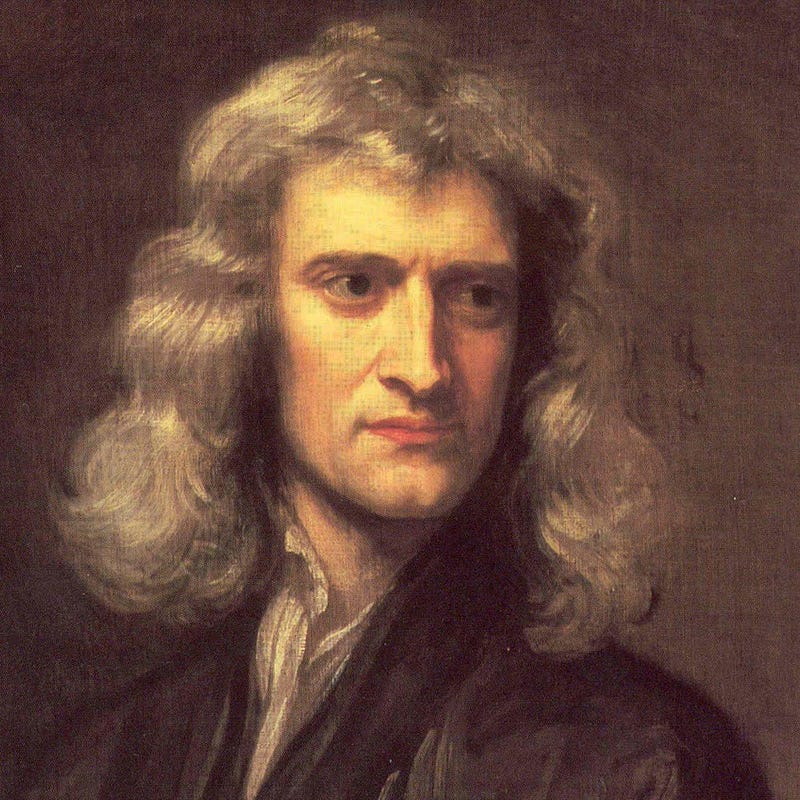

Its 2020, the COVID-19 has spread across the globe. But before discussing it further, let us rewind the clock to 1665. Its April 1665, Isaac Newton has just graduated from Trinity College, Cambridge without any distinction but has secured a scholarship for the Master’s Degree. But in the meantime, something tragic happens. Great Bubonic Plague hits London. The University of Cambridge has closed, and students are directed to leave the University. Newton travels back to his family home in Woolsthorpe that is 160kms north from the University of Cambridge.
Background
17th century is marked by Scientific Revolution that primarily started with Copernicus’ astronomical model known as Heliocentric Theory. But in Newton’s time, Aristotle’s works on physics, logic, rhetoric, and ethics were still part of the curriculum. Newton, on the other hand, was fascinated by the 17th-century scientific revolution. During his 3rd year, in 1664 all his leisure time in College was spent on learning philosophy and mathematics from giants preceding him namely René Descartes (French Philosopher and Mathematician), François Viète(French Mathematician), William Oughtred(English Mathematician) and Robert Boyle(Anglo-Irish Chemist)
Newton and Quarantine
The quarantine of Newton at home starts. This is the best time for him to expand his knowledge about modern science and add more to it. Who doesn’t know the famous incident of the apple falling? This incident happened when he was at home. It is said,
“Necessity is the mother of invention.”
That observation of apple falling led Newton to invent calculus, (though his work on Mathematics started in Cambridge) he eventually formulated his universal law of gravitation. Newton invented calculus as a necessity to explain the motion of heavenly bodies.
The story hasn’t ended here, during quarantine Newton also performed some experiments on the light that gave rise to his theory of optics. He proposed that white light is composed of seven colors by experimentation using prisms. In those times, the belief that color was a combination of light and darkness and that variations in combinations of light and darkness produced different colors was common, and this belief was held even by prominent figures like René Descartes and Robert Hook.
The year 1666, when Newton spent his time in quarantine and maintained social distancing is so important that it is regarded as Annus Mirabilis ( Latin word which means “wonderful year”).
Newton’s Achievements which stemmed from Quarantine
In 1667, Newton returned to Cambridge and got selected as a minor fellow. Based on his work on mathematics, he became Lucasian Professor (Mathematics professor at the University of Cambridge). In 1671, extending his research on optics that he initiated in 1666(the wonderful year), Newton made a reflecting telescope that was ten times smaller than those used at that time. Newton’s achievements earned him recognition among other scientists. From 1670–72, he started lecturing on optics in Trinity College. In 1672, Newton became part of the Royal Society after donating his reflecting telescope to the Royal Society. That same year he became well known after he wrote a paper on refraction of light through a prism. And in 1687, he published his most influential work Philosophiae Naturalis Principia Mathematica (Mathematical Principles of Natural Philosophy) that discussed his laws of motion, the law of gravitation, and derivation of Kepler’s law of planetary motion.
What we can learn from Newton’s Quarantine
All the above-mentioned achievements of Newton became possible because of the year 1666 which he spent in quarantine during the Bubonic Plague. The ripples formed by his inventions and additions not only benefited him but created massive value for generations to come. From the design of a motorbike to the manufacturing space ship, Newton’s laws of motions play a key role. Calculus (invented by Leibniz and Newton independently) itself has a wide range of applications in Engineering, Medical Science, Physics, Statistics, and Economics.
The world hasn’t stopped there, Scientists and Mathematicians that came after Newton further improved the existing models. The chain of advancement that was initiated by Sir Isaac Newton is like a snowball rolling down a never-ending mountain. These advancements further compounded the collective intelligence of humanity. All these rippling progress can be traced back to the deep work done in quarantine during the Great Plague of London by a man known as Sir Isaac Newton.
COVID-19 and Quarantine
Let’s move fast forward to 2020, the world has hit by the COVID-19 pandemic. Most of us are working from home, and a lot of free time is available to us. Its time to stop for a while and ponder what value we can provide to others that can generate a snowball effect. What service we can offer to the world that can create a continuous loop and at the same time creates bread and butter for us too? Initially, on our journey to provide value, it may seem that nothing worth mentioning has been achieved. But things start becoming visual when we put effort consistently.
Let’s understand this with an example. Consider we have a penny that doubles every day. By the end of 10 days, we will have $5.12(not so impressive?) by the end of 20 days it will become $5242.88( not so spectacle either) but you will be surprised to know that by the end of 30 days it will become $5.37 million. That’s the power of doing deep work consistently. Small, seemingly dull, and unattractive steps if done for a long time generate massive results. But why are we concerned with generating massive results? To take an active part in creating maximum value for inhabitants of the earth so that the evolving mankind experience the epitome of its existence, just like Newton did.
I want to leave with this quotation,
All men’s miseries derive from not being able to sit in a quiet room alone. — Blaise Pascal