
How should the protests in Hong-Kong end?
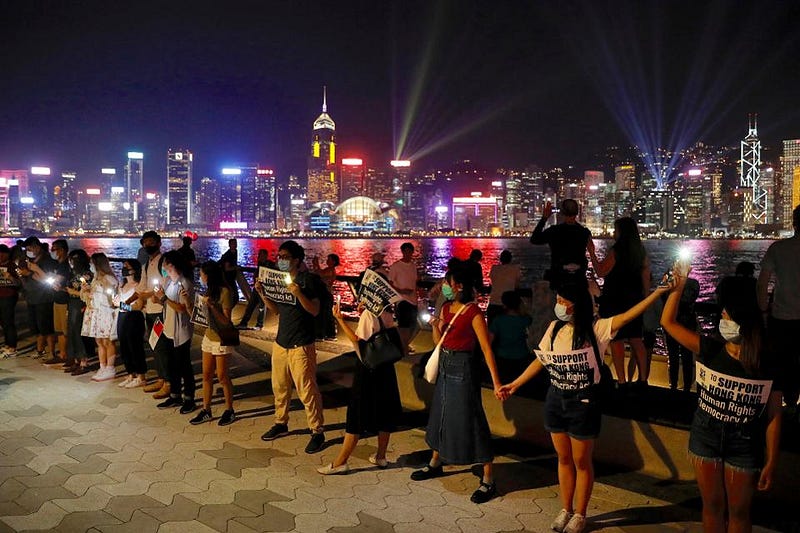
Hong Kong has been roiled by protest since June 2019, following an extradition bill that would have allowed Hong Kong citizens to be extradited to China. The political crisis has shown little signs of waning, causing the Hong Kong economy to contract in the third quarter of 2019. The economy contracted by 0.5% and 3.2% in the second and third quarters of 2019.
This was compounded by a slowdown in retail sales, which fell 9.0% in the first ten months of 2019 as airports, restaurants and administrative buildings were bought to a grounding halt. The slowdown has also been exacerbated by falling tourism revenues, which will place renewed pressure on the government’s fiscal balances. Hong Kong (SAR) is also poised to record its first deficit since 2004 due to falling tax revenues and greater spending to rebuild damaged infrastructure following the protest.
Hong Kong’s extradition request is no different from that between the U.K. and U.S. government.
It is important to note that several countries have agreed to extradition requests in the past, ranging from Interpol to the U.K and U.S. government. This explains why Juliane Assange, a journalist who exposed U.S. human rights abuses in Syria and Iraq i.e indiscriminate shootings killing two Reuters journalists is currently held in custody in the United States. By that regard, the extradition bill holds the same legitimacy to that of the U.S., U.K and countless other countries around the world who cooperate on security and defense issues.
The protest, initially designed to incentivize amendments into the extradition bill has morphed into a broader democracy movement, with protesters outlining five demands.
1). The complete removal of the extradition bill.
2). Hong Kong’s SAR chief executive carrier Lam to step down.
3) Universal suffrage and democratic elections for the post of chief executive.
4). An inquiry into police brutality during the protest.
5). Jailed protesters to be released without prosecution.
The One-Country, two systems appear to be waning
British rule over Hong Kong dates back to the 19th century, where the island was handed to Britain in 1842. On 19 December 1984, the UK Government and the Government of the People’s Republic of China signed the Sino-British Joint Declaration on the Question of Hong Kong and the U.K. transferred sovereignty back to China in 1997. The one-country two systems ensure the right to protest, free elections of its parliament and economic independence.
Although there’s little detail on the extent to which Hong Kong’s freedom has been eradicated in recent times (see government’s 6-month report on Hong Kong), citizens of Hong Kong are also protesting economic inequality, too-high property prices and increased disenfranchisement from the youth. It is, however, important to note that Hong Kong is unlikely to decouple from China from an economic or political standpoint. China has kick-started a global infrastructure project spanning 88 countries with over $870 bn disbursed to finance roads, railways, ports and energy pipelines amongst others. Hong Kong will play an important role in the financing of the Belt and Road Initiative, which is poised to rise 25% from private investors. The Chinese Communist Party should, therefore, look at deescalating the protest by assigning greater freedoms to Hong Kong citizens and renegotiate HongKong’s status after the Sino British-Chinese Joint Declaration has expired.
The Chinese communist party can address the protest in Hong Kong in a variety of ways.
1) Any changes to Hong Kong’s constitution, at present, will constitute a flagrant violation of international law as the joint declaration was registered to the U.N in 1984. President Xi should rather seek to integrate Hong Kong further into the Chinese economy, in other for economic interdependency to create sufficient leverage for both parties to negotiate a way forward independent of foreign views or current discontent with the Chinese communist party.
2). The Chinese communist party is unlikely to allow Carrie Lam to step down just yet but should use this as an opportunity to address economic inequities latent in Hong Kong’s economic design. Furthermore, it should refrain from directly intervening in companies’ affairs directly as it did with Cathay pacific and other companies who rely on the Chinese markets. It should rather seek to further integrate Hong kong companies who rely on the Chinese markets into its economy and ensure it remains its main trading partners.
3). The Chief Executive of Hong Kong should negotiate with protesters in other to establish a credible path towards de-escalation — as seen in the Chinese Univerisity in hong Kong and the Polytechnique University — in other to ensure broader calls for democracy are met.
Hong Kong’s constitution and possible Chinese intervention
The Chinese communist party has taken a more gradualist approach to the protest, as it has with the trade war. Both the U.K and the United States have withdrawn the export license for companies providing military and police equipment such as rubber bullets in other to prevent the use of force during the protest. Nevertheless, Hong Kong’s constitution allows the Chinese security forces to intervene in other to protect private property and/or quell the protest if need be. Despite stationing troops at the border in Shenzen, China’s defense forces are unlikely to intervene with force as rather helped clean up the debris from the previous protest at the Polytechnique University.
Under such circumstances, the U.K has not ruled out sanctions and the United States might conflate its foreign policy objectives and China’s human rights record with trade negotiations. This will reduce the likelihood of consensus on issues ranging from enforcement of intellectual property rights and China might be justified in decrying foreign interference in its domestic political affairs.
All of this bode ill for Hong Kong poised to see a fiscal deficit and little discussion around socio-economic issues such as economic inequality and unaffordable housing amongst others. Can Hong Kong achieve sufficient growth to lessen economic discontent outside China? Its strong property rights and capitalist system suggest some inequality will ultimately accrue over time.
The 1984 Declaration declares the current social and economic systems will remain unchanged for 50 years following the handover (to 2047), as would its existing rights, freedoms, and lifestyle. This explicitly includes rights and freedoms of the person, of speech, of the press, of assembly, of travel, of movement, of choice of occupation, of academic research and of religious belief.
Additionally, its younger population must contend with the question of economic certainty versus political freedoms. By no means does this mean ultimate integration into the Chinese economic model, but it suggests some compromises will inevitably ensue over time.
If Hong Kong’s youth see their freedoms assured, they will welcome China and cultural amalgamation can eventually allow for a Chinese — Hong Kong fusion to allow the development of a broader Chinese identity that is perhaps more forward-looking than previously hoped.
The Chinese communist party should incentivize discussions and a political outcome between the Chief executive, Carrie Lam and the protesters. Pre-empting what would otherwise turn into months of further protest. Rather than see this as acquiescing to the protester’s demand, with risks of emboldening protesters at home or further fuel pr-democracy movements in Taiwan, it must decide on how to make the “One country two systems” work. The future of Hong Kong will ultimately be decided by Hong Kong, but the manner in which it handles the protests and protesters will determine whether Hong Kong feels more like “One country” or “two systems” continues to underpin the once happy political and economic union.
Whether this is the Chinese model preferred by Xi or the protesters is beside the point. it will be neither as the differing views will result in a more mixed form of controlled democracy, not as tightly controlled as XI hopes, but not as free as the Hong Kongers hope given their cultural links to Britain.
Beijing must face the fact that Hong Kong’s youth are inherently free and it must approach negotiations with them as such. Admittedly, protesters have been jailed and prosecuted, reversing such a decision will be the first to start an honest debate and how to approach the changes in Hong Kong. But Beijing must change the perception it has allowed Hong Kong to gain throughout the protest. One that suggest Hong Kong’s independent is divergent from Beijing’s longer term objectives. Taking such a preemptive step will not only serve to quell the protest but ensure Hong kong begins building its economy from the rubles of the protest as it seeks to rebuild its relationship with its youth. China and Hong Kong, can and, should be one country; but an independent and freer Hong Kong is not inconsistent with President Xi’s goal of a country that emphasizes more of the “One country” rather than “Two systems”.